
What is the correct answer to the Gravitation JEE 2019 gaseous-cloud question?
Option B is correct: particle number density falls as the inverse square of radial distance. This Gravitation JEE 2019 question is from JEE Advanced 2019, Paper 1, Physics. It is single-correct, rated medium on this question bank’s scale, with a suggested solving time of 180 seconds.
A spherically symmetric gaseous cloud in free space contains equal-mass particles moving in circular orbits about their common centre. Their mutual gravity provides the force, every particle has the same kinetic energy, and the density profile does not change with time.
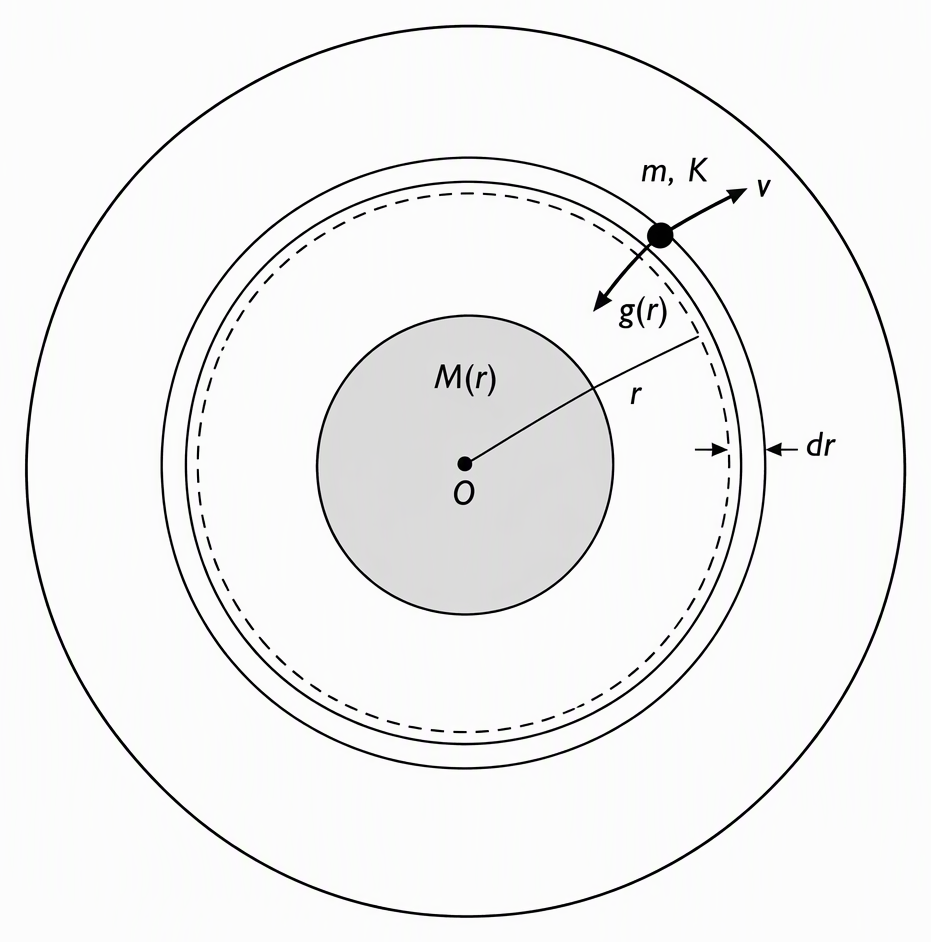
Use the following notation:
Which expression gives the particle number density?
Constant in time does not mean constant with radius. The density at each radius stays unchanged, but different radii can have different densities.
How does the shell theorem give the local density?
The shell theorem relates the field to the enclosed mass. Differentiating this relation with respect to radius gives the mass per unit radial thickness; dividing by the shell’s area gives the local density. This derivative is with respect to position, not time.
Define the enclosed mass and field magnitude:
Spherical shells outside the particle’s radius contribute zero net field at the particle. This does not mean that their gravitational potential is zero.
The shell theorem gives:
Multiply by the radius squared, then differentiate both sides:
A thin shell’s volume is its surface area times its thickness. Multiplying by local mass density gives its mass:
Substitute and isolate the density:
Keep the field inside the derivative. Its dependence on radius must be included.
How does equal kinetic energy determine the gravitational field?
Equal particle masses and equal kinetic energies imply equal speed magnitudes. Circular motion then requires a field that falls inversely with radius. Neither the angular speed nor the gravitational field is equal at every radius.
Gravity supplies the centripetal force:
Substitute into the kinetic-energy expression:
Rearrange explicitly:
The angular speed also changes with radius:
Here, the enclosed mass changes with radius, giving an inverse-radius field. The inverse-square dependence applies when enclosed mass is fixed, not when comparing these orbits inside the cloud.
How do we calculate number density and obtain option B?
Substituting the field before differentiating gives an inverse-square mass density. Divide that result by particle mass once more to obtain number density. This last division supplies the second particle-mass factor in option B.
First simplify the quantity being differentiated:
Its derivative is:
Therefore:
Radius check: doubling the radius, with particle mass and kinetic energy unchanged, reduces number density by a factor of 4:
Units check: number density must have units of inverse volume:
Dimensional analysis cannot distinguish the four numerical coefficients. This idealised density diverges towards the centre; it is not a finite central density.
How does an incorrect derivative produce option D?
Treating the gravitational field as constant during differentiation gives exactly option D. A time-independent field can still vary with radius. Omitting that radial variation doubles the derivative in this problem.
The incorrect calculation is:
Insert the actual field and divide by particle mass:
This gives option D. The correct product rule includes the field’s derivative:
Here:
The two contributions are:
The omitted negative term cancels half the other contribution. Avoid this error by following the official sequence: substitute the known field first, then differentiate.
Which two related gravitation questions check this method?
A uniform-density cloud and an inverse-radius-density cloud test how the density profile controls orbital kinetic energy. These are original related practice questions, not additional verified JEE PYQs. In each, find enclosed mass first, then the field, then kinetic energy.
What kinetic energy is needed inside a uniform spherical cloud?
The required kinetic energy grows as radius squared, so uniform density cannot support equal kinetic energy at every radius. Question 1: find the circular-orbit kinetic energy for a particle inside a uniform spherical cloud with:
The enclosed mass, field and kinetic energy are:
What are the field and orbital kinetic energy when density is inversely proportional to radius?
The field is constant, but orbital kinetic energy grows linearly with radius. Question 2: for a spherical cloud with no central point mass and the density below, find enclosed mass, field and circular-orbit kinetic energy:
Integrating the shell masses from the centre gives:
Compare the three density profiles:
- Uniform density: kinetic energy grows as radius squared.
- Inverse-radius density: kinetic energy grows linearly with radius.
- The solved PYQ’s inverse-square density: kinetic energy is constant.
Redo both practice questions without looking at the answers, then follow How to Study Gravitation JEE: Concepts and Practice Order.
Frequently asked questions
What is the answer to the JEE Advanced 2019 gaseous-cloud question?
Option B is correct: the particle number density is n(r) = K/(2πGm²r²), where K is each particle's kinetic energy, m is its mass and G is the gravitational constant. Number density therefore falls as the inverse square of distance from the centre.
Why does equal kinetic energy give an inverse-radius gravitational field?
Equal masses and equal kinetic energies imply equal speed magnitudes, with v² = 2K/m. Circular motion requires g(r) = v²/r, so g(r) = 2K/(mr). The field decreases inversely with radius even though the density profile is constant in time.
How do you find local density using the shell theorem?
For a spherically symmetric cloud, the shell theorem gives g(r)r² = GM(r), where M(r) is the enclosed mass. Differentiate with respect to radius and use dM/dr = 4πr²ρ(r) to obtain ρ(r) = [1/(4πGr²)] d[g(r)r²]/dr. Divide the mass density by the particle mass to obtain number density.
Why is option D wrong in the 2019 gaseous-cloud question?
Option D results from treating g(r) as constant when differentiating g(r)r². Since g(r) varies as 1/r, the product rule must include the negative term r²g'(r); omitting it doubles the result. Substitute g(r) = 2K/(mr) before differentiating to avoid this error.