
What is the answer to the Properties JEE 2018 NaCl unit-cell question?
The answer is 3, because the final cell contains three effective anions and one effective cation, not six anions. This properties jee 2018 question is from JEE Advanced 2018, Paper 1, Chemistry, under Properties of Solids and Liquids. The question bank classifies it as medium difficulty. It is a numerical-answer question, not an MCQ with supplied options.
Starting with an MX crystal of NaCl type, construct Z sequentially: retain only the central X ion, replace face-centre M ions with X ions, remove corner M ions, then replace the central X ion with M. Find the effective X-to-M ratio in Z, neglecting charge balance.
The starting arrangement places M at the corners and face centres, and X at the edge centres and body centre. Use these sites for every operation.
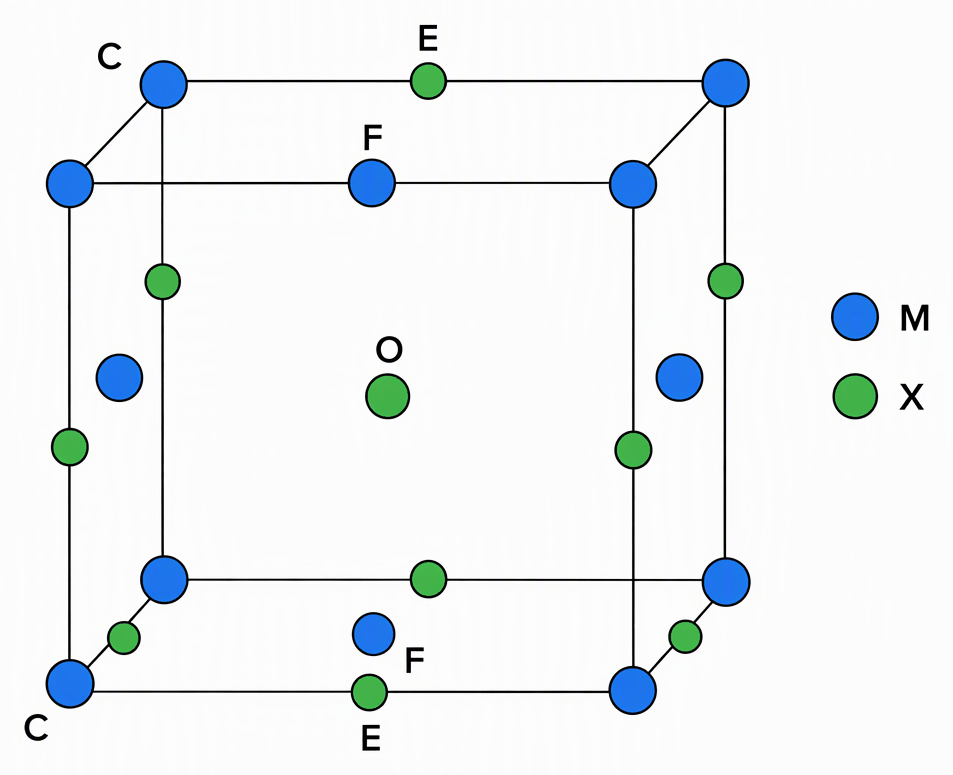
Which ions occupy the FCC sites, and how much does each site contribute?
M occupies the FCC sites; X occupies all octahedral voids. Follow this convention from the official solution throughout. Either ion type can form the FCC arrangement in NaCl, but switching conventions here would put the named ions at the wrong sites for the stated operations.
The sharing fractions come from how neighbouring cells meet:
- A corner belongs to eight cells, so each cell receives one-eighth.
- A face centre belongs to two cells, so each receives one-half.
- An edge centre belongs to four cells, so each receives one-quarter.
- The body centre lies inside one cell and contributes one full ion.
The initial cation count is:
The initial anion count is:
A unit-cell illustration therefore shows more positions than the effective number of ions belonging to one cell. Removing ions from neighbouring sites does not change these sharing weights: an occupied face, edge or corner remains shared in the specified repeating unit cell.
What changes when edge anions are removed and face cations are replaced?
After step (i), only one effective X ion remains. After step (ii), there are four effective X ions and one effective M ion. Replacement changes both totals: subtract the old species and add the new species with the same site weight.
Step (i): remove all X ions except the central one. The twelve edge-centre positions become empty, while the body-centre X remains fully inside the cell.
Step (ii): replace all face-centre M ions with X ions. The six face positions contribute three effective cations:
Subtract that contribution from M and add it to X:
The surviving site groups are corner M, face-centre X and body-centre X. Counting only the removed face cations would miss the anions placed at those same positions.
How do the last two steps give an anion-to-cation ratio of 3?
The final operations leave three effective X ions at face centres and one full M ion at the body centre. Keep the intermediate counts: removing all remaining cations in step (iii) does not leave the final denominator zero, because step (iv) adds a cation.
Step (iii): remove the corner M ions. Their total contribution is one:
Step (iv): replace the body-centre X with M. This site contributes one full ion, so both totals change:
Check each stage against this running-count ledger, with M first, X second:
- Initial:
- After (i):
- After (ii):
- After (iii):
- After (iv):
The requested ratio is:
The final occupancy checks the result: six half-shared face-centre X ions contribute three; one body-centre M contributes one. Do not impose charge neutrality, because the question explicitly excludes charge balance.
Why does counting six face-centre positions give the wrong answer 6?
The result 6 uses geometric position counts instead of effective unit-cell contributions. Six face-centre X positions and one body-centre M position remain, but they have different sharing weights. Dividing their raw counts is invalid:
Each face-centre ion remains shared between two neighbouring unit cells, even when corner and edge sites are empty. Empty sites do not make a boundary ion belong entirely to one cell.
The correct calculation is:
Here, 6 is an illustrative wrong numerical result, not an official distractor. No answer options were supplied for this numerical-answer question.
How do I solve three related unit-cell counting questions?
Write the occupied site groups first, then apply their sharing fractions. These are original related practice questions, not additional verified JEE PYQs. Continue to neglect charge balance in the construction variants.
How many effective X ions occupy the twelve starting edge-centre sites alone?
The twelve edge sites contribute three effective X ions. Each edge is shared by four cells; exclude the body-centre ion because the question asks for edges alone.
What is the anion-to-cation ratio if construction stops after step (ii)?
The ratio is 4. M remains only at corners, while X occupies the face centres and body centre.
What is the anion-to-cation ratio if step (iii) is omitted but steps (i), (ii) and (iv) are performed?
The ratio is three-halves. Corner M ions contribute one, and replacing the central X adds another full M ion; only face-centre X ions remain.
Cover the solution and rebuild the original count ledger in 120 seconds. This is the question bank’s expected solving time, not an official exam time limit.
Next step: the past-paper archive on JEEnius and search every JEE Main paper from 2002 and every Advanced paper from 2007, by year, subject or chapter, each with a worked solution (free).
Keep going with Electrostatics JEE 2018: Field Matching and Option B.
Frequently asked questions
What is the answer to the JEE Advanced 2018 NaCl unit-cell question?
The answer is 3. After all four operations, six face-centre X ions contribute three effective anions, while one body-centre M ion contributes one cation. The anion-to-cation ratio is therefore 3/1 = 3.
Why is the NaCl unit-cell answer 3 and not 6?
Six is the number of occupied face-centre positions, not their effective contribution to one unit cell. Each face-centre ion is shared by two cells, so six positions contribute only three ions. The body-centre cation contributes one full ion, giving a ratio of 3.
What are the sharing fractions for ions in a cubic unit cell?
A corner ion contributes 1/8, a face-centre ion contributes 1/2, and an edge-centre ion contributes 1/4. A body-centre ion contributes one full ion because it lies entirely inside the cell. Emptying other sites does not change these sharing fractions.
Should I apply charge neutrality in the JEE 2018 NaCl construction question?
No, the question explicitly asks you to neglect charge balance. Count the effective X and M ions after the stated operations without imposing charge neutrality. The final counts are X = 3 and M = 1.