
What does the electrostatics JEE 2018 matching question ask?
Subtract opposite fields before making the far-field approximation. In this electrostatics JEE 2018 question, find the field magnitude at observation point P for five separate arrangements: (1) charge Q at the origin, (2) positive Q at height ell and negative Q at height minus ell on the z-axis, (3) an infinite line on the x-axis, (4) opposite infinite wires parallel to the x-axis in the xz-plane, with the positive wire at height ell and the negative wire at height minus ell, and (5) a uniformly charged infinite xy-plane.
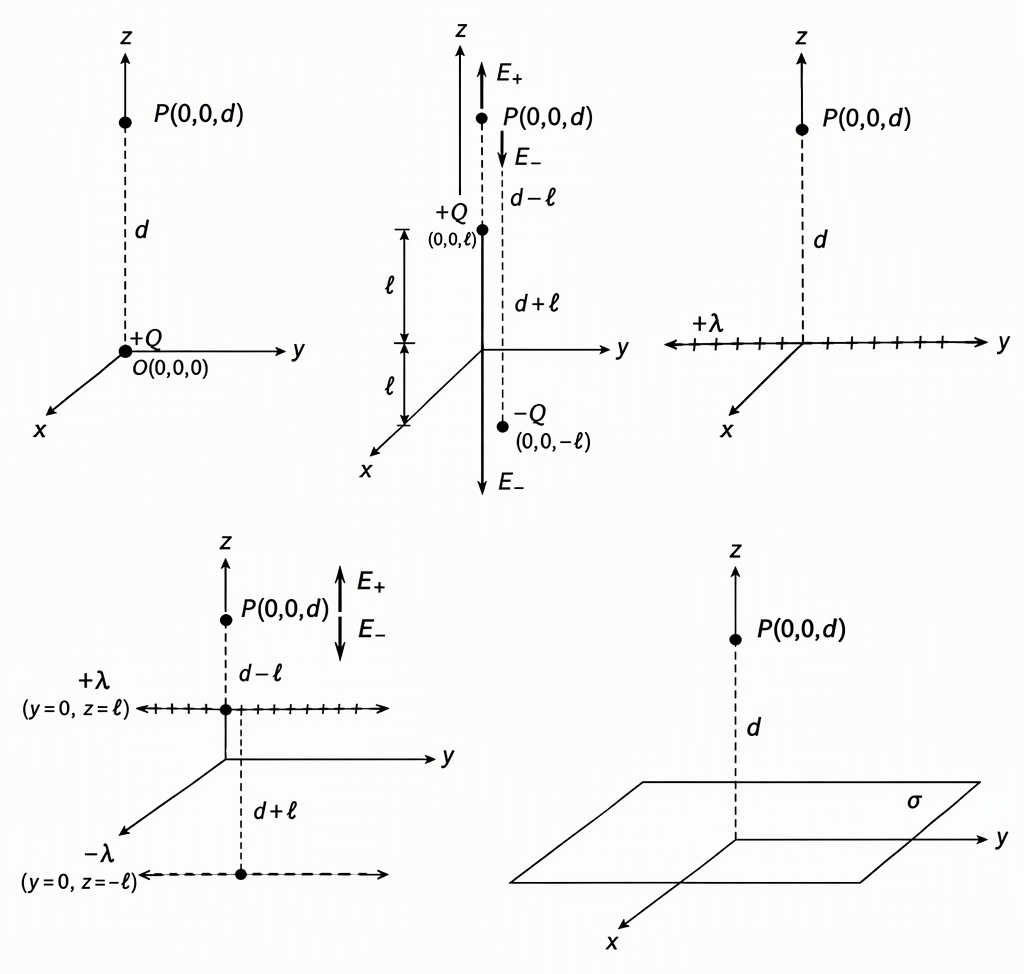
The source is JEE Advanced 2018, Paper 2, Physics. “Medium” difficulty and the 180-second target are question-bank tags, not official exam classifications.
The observation point and separation condition for items 2 and 4 are:
Sigma denotes the sheet’s uniform surface charge density. Match each dependence to every applicable distribution:
- P: field independent of distance.
- Q:
- R:
- S:
The matching-row P is distinct from observation point P. Choose from:
- A:
- B:
- C:
- D:
Attempt the matching before reading further. For each opposite pair, write the two distances and field directions first.
How do the sheet, single line and point charge match?
The sheet matches P, the single line matches Q, and the point charge matches R. Work with field magnitudes, taking Q, lambda and sigma as positive magnitudes. Hold the source strengths and ell fixed while varying the observation distance.
For item 5, the infinite sheet gives:
Distance does not appear, so item 5 matches P. For item 3, use the perpendicular distance from the x-axis, not a distance measured along the line:
Thus item 3 matches Q. For item 1, the source-to-observation distance is the distance from the origin:
The inverse-square dependence places item 1 under R.
Why do opposite infinite wires give an inverse-square field?
Item 4 matches R, not Q, because subtraction cancels the leading inverse-distance contributions. The inverse-square dependence holds in the far field, not at every distance. Start with the observation point beyond both wires:
The positive wire gives a field toward positive z; the negative wire gives a field toward negative z. Their respective perpendicular distances are:
The nearer positive wire produces the larger field, so the net field points toward positive z. Signed superposition gives:
Combine the fractions before approximating:
Hence the exact magnitude for this geometry is:
Now apply the small-separation condition:
The exact denominator retains the finite separation of the wires. Dropping that correction is justified only after subtraction and only in the far field.
How does the axial dipole give option B?
Item 2 matches S, completing option B. The observation point lies on the dipole axis, beyond the positive charge. The contributions oppose each other, but each point-charge field has an inverse-square dependence rather than an inverse-distance dependence.
Write the exact difference:
The combined fraction is:
Expand the numerator without dropping either separation term:
The denominator becomes:
Therefore:
Only now take the far-field limit. The numerator retains one power of distance, while the denominator approaches the fourth power:
The complete matching is:
Correct option: B. Opposite infinite wires cancel leading inverse-distance contributions, while the axial point dipole cancels leading inverse-square contributions:
What method mistake produces option A?
Option A differs from B only by placing item 4 under Q instead of R. That error follows from assuming that because each wire produces an inverse-distance field, their combined field must do the same.
The missing operation is signed superposition. Opposite contributions can cancel the leading distance-dependent term, as the exact difference proves:
Replacing both distances by the observation distance before subtracting is also wrong. It gives zero and erases the nonzero far field.
Use this rule: combine the exact signed fields first; approximate the resulting expression second. That preserves the small difference responsible for the answer.
Can you solve three related electrostatics checks?
Use the same method to test distance scaling, a change of charge sign and the validity of the far-field approximation. These are original practice questions, not additional verified PYQs.
What happens when the opposite-wire observation distance doubles?
Practice 1 answer: The field becomes approximately one-quarter of its original value. Both positions must remain in the far field:
What changes if both wires are positive?
Practice 2 answer: Replace the negative wire with an equally charged positive wire, keeping the geometry fixed. The fields now add, giving an inverse-distance far field:
Is the point-dipole far-field formula accurate at twice ell?
Practice 3 answer: No, the original far-field condition no longer holds. Substitute into the exact result instead:
The far-field formula would give:
The exact field is about 1.78 times the approximation. Check the separation condition before replacing the exact denominator.
Next step: photograph a doubt on JEEnius and photograph any question you are stuck on and get a step-by-step solution, with a free-body diagram when the question needs one (20 free).
For a worked example of the same idea, see How to Study Indefinite Integration JEE: 7-Step Plan.
Frequently asked questions
What is the correct answer to the JEE Advanced 2018 electrostatics matching question?
The correct option is B: P → 5, Q → 3, R → 1, 4, and S → 2. The infinite sheet gives a distance-independent field, the single line gives 1/d, and the point charge gives 1/d². In the stated far-field limit, the opposite wires give 1/d² and the axial point dipole gives 1/d³.
Why does the field of two oppositely charged infinite wires vary as 1/d²?
For equal and opposite line charge densities at z = ±ell, the fields at z = d oppose each other. Subtracting their distance factors gives 1/(d − ell) − 1/(d + ell) = 2ell/(d² − ell²). When d is much larger than ell, the denominator approaches d², so the net field varies as 1/d².
Why does an axial dipole field vary as 1/d³ instead of 1/d²?
Each point charge produces an inverse-square field, but the opposite contributions cancel the leading 1/d² term. For charges at z = ±ell and an observation point beyond both charges, the exact difference is proportional to 4d ell/(d² − ell²)². In the far field, this scales as d/d⁴ = 1/d³.
Should I apply the far-field approximation before subtracting electric fields?
No: combine the exact signed fields first, then apply the far-field approximation. Replacing both d − ell and d + ell by d before subtracting makes the opposite contributions cancel completely. That erases the small but nonzero field responsible for the correct distance dependence.