What is the vectors and scalars JEE 2024 parallelogram question?
Three component-defined vectors generate two diagonals of a parallelogram, and its prescribed area restricts two integer parameters. The key to this vectors and scalars JEE 2024 question is that the cross product of the diagonals gives twice the area, not the area itself.
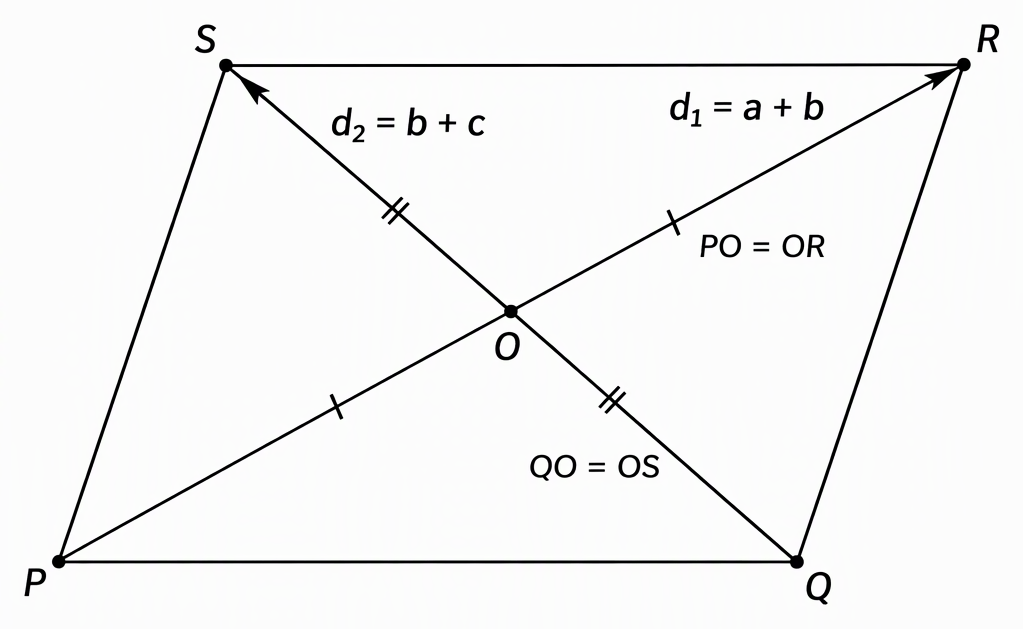
The supplied bank attributes this JEE Main Vector Algebra question to 2024 and tags it Hard. That is the bank’s difficulty tag, not an official NTA rating.
The given vectors and integer condition are:
Their sums form the diagonals of a parallelogram with prescribed area:
Label its two admissible ordered pairs:
Find the following quantity:
Why is the area half the cross product of the diagonals?
For adjacent sides, the cross-product magnitude equals the area; for diagonals, it equals twice the area. Identify which vectors you have before calculating: a correct determinant cannot repair the wrong area formula.
First add the components:
To justify the factor using the figure, take adjacent sides:
Then the diagonals are:
Their cross product expands as:
The self-cross products vanish, and reversing the order changes the sign. The diagonals’ cross-product magnitude is therefore twice the area. Returning to the given diagonals:
How do you expand the cross product without losing a sign?
Keep the minus sign outside the middle cofactor: the second component is negative. Write all three cofactors before simplifying so that the subtraction of a negative in the third component is also visible.
Expanding every component gives:
Hence its magnitude is:
Apply the prescribed area, multiply both sides by two, then square:
Both sides are non-negative, so this squaring is valid. Subtracting four gives:
This is an intermediate constraint, not the requested answer. It must still be combined with the integer-product condition.
Which integer pairs satisfy the area condition, and is the answer 19?
Only two ordered pairs satisfy both conditions, and the requested value is 19. Bound the second parameter before substituting integer pairs. This is shorter than testing every divisor pair of negative six and follows the supplied solution’s method.
Since a square cannot be negative:
The product condition excludes zero. The remaining integer values determine four candidates:
- First candidate, rejected:
- Second candidate, rejected:
- Third candidate, accepted:
- Fourth candidate, accepted:
Choose the labels used in the supplied solution:
Now substitute into the exact target:
Either valid pair has square-sum 13 and product negative six. Swapping their labels therefore leaves the result unchanged.
Correct answer: A) 19.
How can selecting 17 answer the wrong expression?
Selecting 17 after deriving the area constraint answers an intermediate equation rather than the question. This mistake produces option B: the calculation has reached a listed number, but has not evaluated the requested quantity.
The two expressions are different scalar quantities:
For the valid pairs, their values are:
The integer-pair stage determines the square-sum needed in the target expression. An intermediate number appearing among the options does not justify skipping that stage.
Copy the target expression beside your final substitution, then check each square, product and subtraction against it. Match the resulting value to an option only after this check.
Which two practice questions check this method?
Use one cross-product check and one bounded-integer check to test the two main skills separately. Both questions below are original practice, not additional verified PYQs; no extra past-paper questions were supplied.
Original practice 1: For the following vectors, calculate the cross-product magnitude and verify it using the stated identity:
The component calculation gives:
Independently, the identity confirms the squared magnitude:
Original practice 2: Find every ordered integer pair satisfying the following conditions, and calculate its square-sum:
Bound first:
The product condition excludes zero. Test the remaining integer candidates:
Only the first two pairs satisfy both conditions:
Redo the second exercise without looking at the answer. Write the bound before listing pairs, then copy the requested square-sum before substituting.
Next step: photograph a doubt on JEEnius and photograph any question you are stuck on and get a step-by-step solution, with a free-body diagram when the question needs one (20 free).
Related on JEEnius: Properties JEE 2018: NaCl Unit-Cell Ratio Explained.
Frequently asked questions
How do you find the area of a parallelogram from its diagonals?
The area is half the magnitude of the cross product of its diagonal vectors: A = |d₁ × d₂|/2. If the adjacent sides are u and v, the diagonals can be written as u + v and v − u, whose cross product is 2(u × v).
Which integer pairs satisfy the JEE 2024 parallelogram question?
The valid ordered pairs (α, β) are (3, −2) and (−3, 2). The area condition gives 4β² + (α + β)² = 17, so the nonzero integer β must be ±1 or ±2. Combining this with αβ = −6 and testing the four candidates leaves only those two pairs.
What is the answer to the vectors and scalars JEE 2024 parallelogram question?
The answer is 19, option A. Either admissible pair has square-sum 13, while the product of the other pair is −6. Therefore, α₁² + β₁² − α₂β₂ = 13 − (−6) = 19.
Why is 17 not the answer to the parallelogram question?
The value 17 belongs to the intermediate area constraint, 4β² + (α + β)² = 17. The question instead asks for α₁² + β₁² − α₂β₂, which requires finding the admissible integer pairs. Substituting those pairs into the requested expression gives 19.