
How do you solve the Thermal Properties of Matter JEE 2019 heating question?
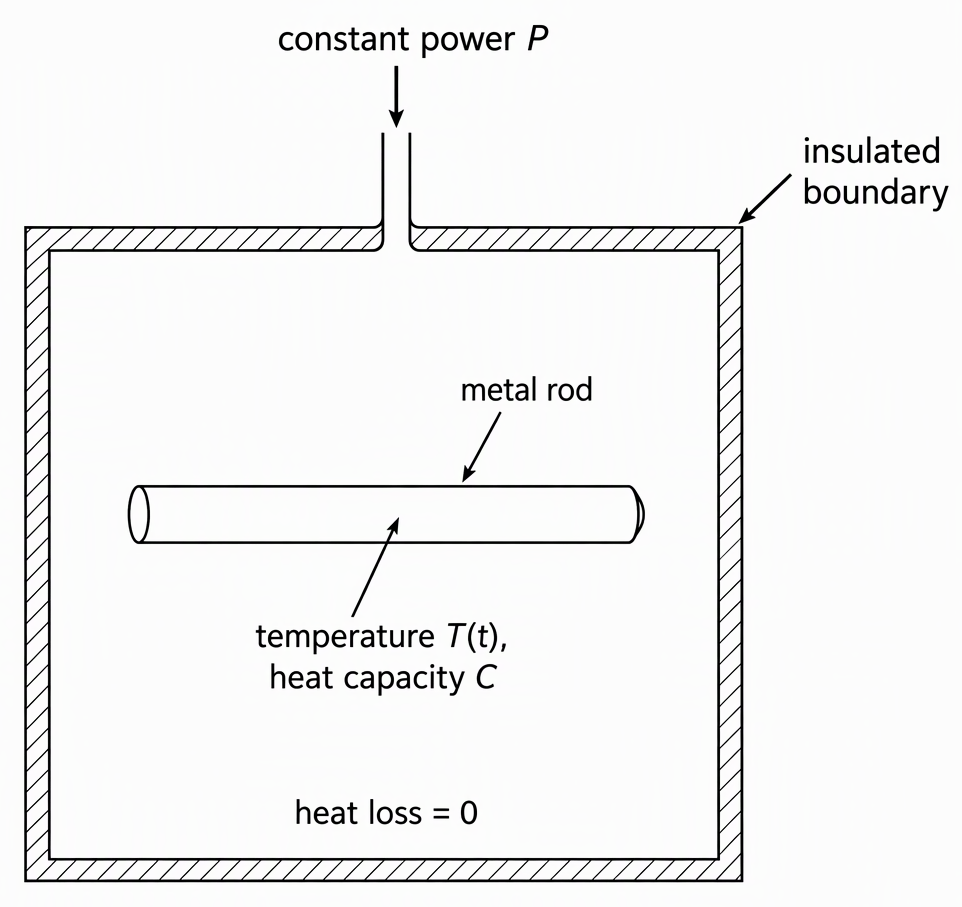
A current-carrying wire transfers constant power to a metal rod inside an insulated container, and the rod’s temperature follows a prescribed time dependence. The Thermal Properties of Matter JEE 2019 heating question requires the instantaneous heating rate, giving option D, not an average over the heating interval.
The prescribed temperature law is:
The constant term is the initial temperature, and beta is a constant that makes the bracket dimensionless. Find the whole rod’s heat capacity at its current temperature.
This is a JEE Advanced 2019, Paper 1, Physics, single-correct MCQ. “Medium” and “90 seconds” are question-bank difficulty and expected-time tags, not official exam classifications.
The supplied choices are:
- Option A
- Option B
- Option C
- Option D
How does constant power give instantaneous heat capacity?
Divide the supplied power by the instantaneous temperature-rise rate. In the stated model, insulation means the supplied power increases the rod’s thermal energy rather than escaping to the surroundings. Following the official solution’s energy balance:
This is the heat capacity of the whole rod, not specific heat capacity, so no mass factor is required. Its units are:
The derivative is necessary because the heating rate changes with time. Over a finite heating interval, the ratio below gives an average heat capacity, not necessarily its instantaneous value:
How do you differentiate the fourth-root temperature law?
Treat the initial temperature and beta as constants, then apply the power rule to the time-dependent term. The derivative has a negative time exponent; taking its reciprocal makes that exponent positive.
Expand the law before differentiating:
Substitute into the energy-balance result:
Dividing by the negative power means multiplying by the positive power:
For positive time in the heating regime, the temperature-rise rate decreases. The same power produces less warming per second, so the heat capacity increases.
The derived time dependence gives a numerical check: increasing elapsed time sixteenfold makes the heat capacity eight times larger.
How do you eliminate time and obtain option D?
Isolate the fourth root of time from the original law, then cube it and substitute into the heat-capacity expression. This gives option D, with heat capacity proportional to the cube of the temperature rise.
Rearrange the temperature law:
Cube both sides to obtain the required time factor:
Substitute it into the heat capacity:
Multiply the denominator factors separately:
The result is option D:
For the dimensions check, the term added to one in the temperature law must be dimensionless. This fixes beta’s units:
The final expression has the required units:
This confirms dimensional consistency. It does not, by itself, prove that the derivative or the temperature dependence is correct.
Why does replacing the temperature rise with the initial temperature give option A?
Option A follows from replacing the evolving temperature rise with the fixed starting temperature in the heating rate. The initial temperature is a baseline, not the amount of warming. The fractional growth law applies to the rise above that baseline.
Rewrite the correctly derived slope:
The unjustified replacement gives:
Compared with the original derivative, this effectively discards the factor:
That factor is dimensionless, but dimensionless does not mean equal to one. It still changes with time.
Using the wrong slope gives:
The original temperature law gives:
Substituting this time into the wrong heat capacity produces:
This is exactly option A. It also passes the units check:
A dimensional check cannot repair an incorrect derivative. Keep the actual temperature rise intact until the time-elimination step is finished.
How do you solve linear and square-root heating laws?
Differentiate temperature, divide power by that slope, and eliminate time if required. These are author-created practice variations, not verified PYQs or additional JEE 2019 questions.
Practice 1: An insulated body receives constant power and follows the linear law below. Find its heat capacity.
Differentiating and dividing the supplied power by the slope gives:
Practice 2: Another insulated body receives constant power with the following law. Express its heat capacity in terms of temperature.
Differentiate and substitute:
Eliminate time:
The outcomes differ because the instantaneous heating rates differ:
- Linear temperature growth: constant heat capacity.
- Square-root growth: heat capacity proportional to temperature rise.
- Fourth-root growth: heat capacity proportional to the cube of temperature rise.
Cover the worked answers and redo both variations. Write the derivative before using the heat-capacity formula, then eliminate time only after the reciprocal is correct.
Next step: photograph a doubt on JEEnius and photograph any question you are stuck on and get a step-by-step solution, with a free-body diagram when the question needs one (20 free).
For a worked example of the same idea, see How to Study Hyperbola JEE: Standard Form and Tangents.
Frequently asked questions
What is the correct answer to the JEE 2019 rod-heating question?
Option D is correct: C = 4P[T(t) - T₀]³/(β⁴T₀⁴). Differentiate T(t) = T₀(1 + βt^{1/4}), use C = P/(dT/dt), then eliminate time using the original temperature law.
Why do we use C = P/(dT/dt) instead of Q/ΔT?
The question asks for heat capacity at the rod's current temperature, so the instantaneous heating rate is required. For the insulated rod, P = C(dT/dt). Over a finite heating interval, Q/ΔT gives an average heat capacity, which need not equal the instantaneous value.
Why is option A wrong even though its units are correct?
Option A results from incorrectly replacing the temperature rise T(t) - T₀ with the initial temperature T₀ in the heating rate. This discards the time-dependent factor βt^{1/4}. Dimensional consistency cannot detect this error because that factor is dimensionless.
Do we need the rod's mass to calculate its heat capacity?
No mass factor is required because the question asks for the heat capacity of the whole rod, measured in J/K. Specific heat capacity is heat capacity per unit mass and would require the rod's mass.