
What was the JEE Main 2020 capacitance question on inclined square plates?
The capacitance is .
Two square plates each of side a placed such that the minimum gap at one edge is d while the other plate is tilted by a very small angle α. This setup creates a linearly increasing separation along one direction.
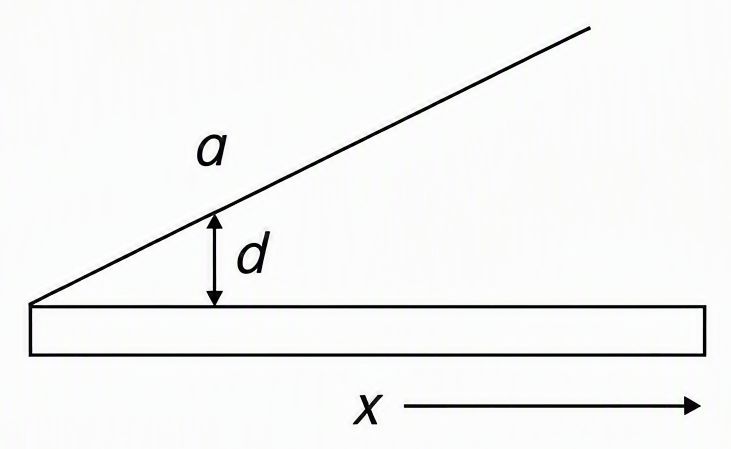
The small value of α allows tan α ≈ α and later series expansions.
How do you solve the JEE Main 2020 inclined plates capacitance question using the official method?
View the system as infinite thin strips of width dx parallel to the a-side, each forming a local capacitor with separation d + αx where tanα≈α. These strips lie side by side and therefore act in parallel.
Write .
The total capacitance is
which yields
Rewrite as
where .
For small x apply . Then
so
This matches option 1.
What exact mistake turns the JEE Main 2020 capacitance question into a wrong option?
Treating the varying gap as an arithmetic-average separation d + (αa)/2 and plugging directly into the single C = ε₀A/d formula produces , an expression that appears among the options.
This bypasses the integral entirely and produces an approximate result missing the precise coefficient obtained from the series expansion of the logarithm. The arithmetic-mean route looks reasonable but skips the 1/d weighting that the official solution captures.
Contrast the wrong algebraic route with the mandatory integration step to illustrate why the average-distance shortcut fails for capacitance.
Why is integration mandatory for the inclined plates capacitance problem?
Separation is a linear function of position, so each infinitesimal strip has a different d(x) and therefore different local capacitance that must be added in parallel.
Direct use of a single d value or simple average ignores the 1/d dependence, which is why the integral of 1/(d+αx) appears. The exact result involves a logarithm, yet JEE expects only the first two terms of its series for small α.
The exact ln result versus the first-order approximation expected by JEE shows that the linear correction term carries the −αa/(2d) factor demanded by option 1.
What two related capacitance problems test the same variable-separation technique?
Question 1: A wedge-shaped dielectric slab of small angle is inserted between parallel plates. Find capacitance using integration with no numerical values.
Hint: Divide the plate area into strips perpendicular to the wedge edge. Write the local thickness and hence the effective local permittivity times area over separation, then integrate the parallel contributions. Keep the small-angle approximation throughout.
Question 2: Two long coaxial cylinders of length L with slight misalignment producing linearly increasing gap. Obtain approximate C for small tilt angle.
Hint: Unroll the cylinders conceptually into flat strips. Express the local gap as d + αx, form dc for each strip, integrate, and apply the same ln(1+x) ≈ x − x²/2 expansion to reach a first-order result in α.
How should you tackle hard capacitance questions in the 3-hour JEE Main paper?
Always draw the dx strip and write d(x) = d + (tanα)x ≈ d + αx before writing dc.
Remember the integral ∫dx/(b+cx) = (1/c)ln(b+cx) and the two-term expansion of ln(1+x). These two facts alone finish the problem once the strip model is set.
For 300-second hard questions, spend the first 90 seconds confirming the parallel-strip model before integrating. You can search every JEE Main paper from 2002 by chapter inside the past-paper archive to see every earlier capacitance variation solved the same way.
What common pitfalls should you avoid in variable-geometry capacitance problems?
- Confusing series versus parallel addition when strips are side-by-side. Side-by-side strips share voltage, so their dc values add directly.
- Using sinα or tanα interchangeably without the small-angle statement. The official solution uses tanα ≈ α only after the figure is examined.
- Stopping after obtaining the ln expression instead of applying the required approximation to match MCQ options.
If a fresh doubt appears while solving them, photograph the doubt for a step-by-step solution with the required diagram.
Next step: photograph a doubt on JEEnius and photograph any question you are stuck on and get a step-by-step solution, with a free-body diagram when the question needs one (20 free).
Read next: P-Block Elements JEE 2021: Metallurgy Question Solution.
Frequently asked questions
What is the correct capacitance for the JEE Main 2020 inclined plates question?
The capacitance is ε₀a²/d (1 - αa/2d). This is obtained after integrating dc = ε₀ a dx/(d + αx) to get the exact logarithmic form and then applying the two-term expansion ln(1+x) ≈ x - x²/2 for small x=αa/d. The factor 1/2 in the correction term is demanded by the official answer.
How do you solve the capacitance JEE 2020 inclined plates problem?
Model the system as thin parallel strips of width dx, each with local separation d + αx. Write dc = ε₀ a dx/(d + αx) and integrate from x=0 to x=a. This produces (ε₀a/α)ln(1 + αa/d). For small αa/d substitute the series ln(1+x)≈x-x²/2 to match the MCQ option. Always confirm the parallel addition before integrating.
Why does using average separation give the wrong answer in capacitance JEE 2020?
Plugging the arithmetic mean separation d + αa/2 directly into C=ε₀A/d yields an expression that matches one of the distractors but is not exact. Capacitance varies as 1/d, so the proper average must come from the integral of 1/(d+αx). The series expansion of the correct logarithmic result supplies the precise coefficient 1/2 that the mean-distance shortcut misses.
Is integration mandatory for the inclined plates capacitance JEE 2020 question?
Yes. Because separation is linear in x, each infinitesimal strip has a different local capacitance that must be added in parallel. The 1/d dependence makes a single-value or simple-average formula invalid. JEE expects candidates to recognise this, perform the integral, and keep the first two terms of the logarithm expansion.