What is the exact setup in the 2018 JEE Advanced circle loci question?
Line T passes through fixed points P(-2,7) and Q(2,-5) with fixed interior point R(1,1). Pairs of circles tangent to T at P and at Q respectively touch each other at M. E1 is the locus of all possible M excluding degenerates. F2 consists of chords of E1 through R. E2 is the set of midpoints of those chords.
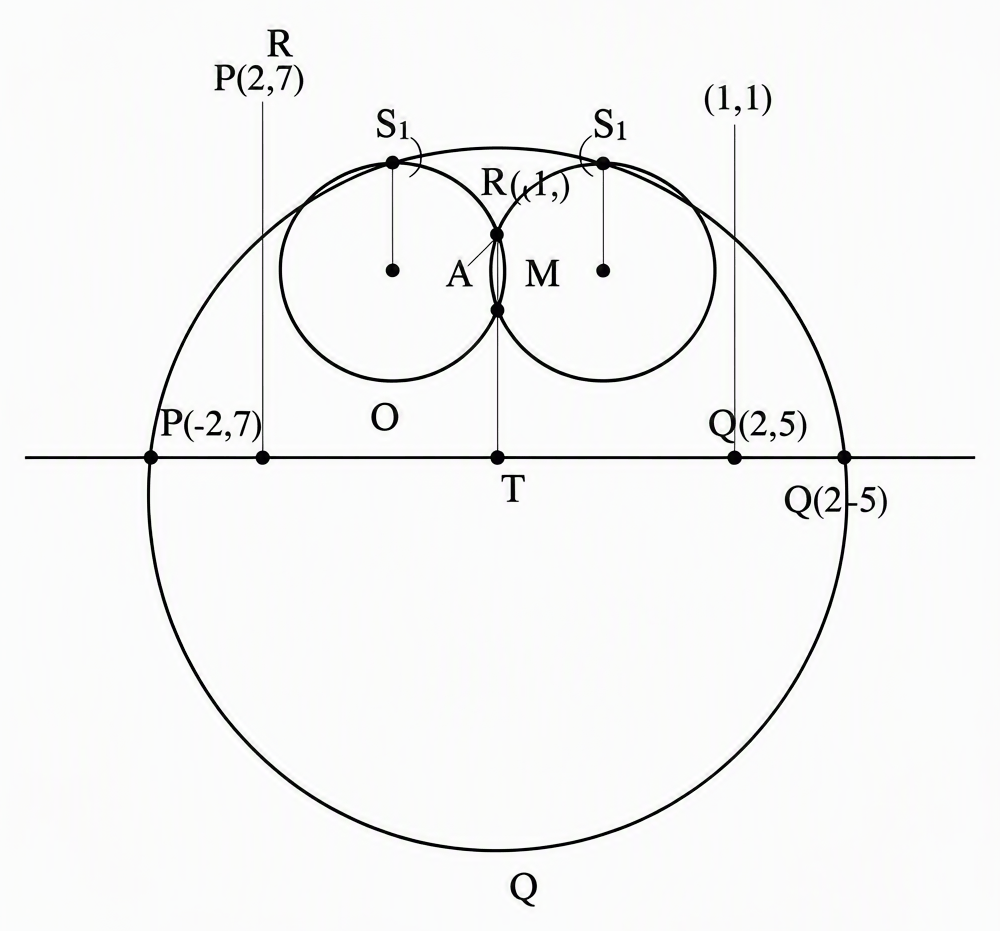
The centres of each pair lie on the normals to T at P and Q. M must lie on the circle with diameter PQ once collinearity is imposed.
How does the official temporary-coordinate method derive the two loci?
E1 is the circle or excluding P and Q. E2 is excluding (4/5, 7/5). The midpoint O of PQ is (0,1). PQ equals . The circle with diameter PQ therefore has equation
Switch to temporary axes with T as x-axis, P at (-d,0), Q at (d,0). Centres lie at (-d,a) and (d,b). Let M be (X,Y). Since M lies on both circles,
Collinearity of radii to M yields (X+d)(Y-b) - (X-d)(Y-a) = 0. This simplifies to . Transforming back gives E1 as the circle with diameter PQ, but P and Q correspond to zero-radius circles outside F1 and must be excluded.
For E2 let N(x,y) be the midpoint of a chord through R. Vector ON is (x, y-1) and RN is (x-1, y-1). The condition ON · RN = 0 gives
Parameterise line RP. Intersection with E1 produces quadratic . Average t equals 1/15 and yields the excluded midpoint exactly (4/5, 7/5).
What algebraic slip produces one of the wrong options?
Students derive for E1 then stop. They declare every point on the circle belongs to E1 without checking limiting cases. For option A this mistake accepts M = P. In fact M coinciding with P forces one circle to zero radius, so the pair lies outside F1.
The same incomplete check applied to option C misses that (1/2,1) fails the perpendicularity equation even though it looks plausible on a sketch.
Which options are correct after substituting the four points into the locus equations?
(-2,7) satisfies but is P, so it is excluded from E1. Statement A is false.
(4/5, 7/5) is the exact midpoint found from the RP chord calculation using average t = 1/15. It satisfies the E2 equation but is excluded, making B true.
(1/2,1) gives , so it fails the perpendicularity condition and C is false.
(0, 3/2) gives , so it is not on E1 and D is true.
Which JEE Advanced questions test the same locus techniques?
A variable chord of the circle subtends a right angle at the fixed point (1,0). Find the locus of the mid-point of the chord.
Two circles touch each other externally at M and have a common tangent at points P and Q respectively. Find the locus of M if the tangent lengths from a fixed point are in a given ratio.
The locus of the intersection point of common tangents to two circles whose centres are fixed and radii vary while remaining in a constant ratio.
Solve these at once. The perpendicularity condition ON · RN = 0 and the collinearity step repeat almost exactly.
What compact equations from this question go in your notes?
E1 equation: (exclude endpoints of diameter).
E2 equation: (circle on diameter from centre to fixed interior point).
Perpendicularity condition ON · RN = 0 appears repeatedly in chord-midpoint problems. Always check limiting positions (zero-radius or coincident points) before declaring a point belongs to the locus.
Search the past-paper archive for every JEE Advanced circle question since 2007. Each worked solution shows the identical vector steps so the pattern becomes automatic before your next mock.
Next step: the past-paper archive on JEEnius and search every JEE Main paper from 2002 and every Advanced paper from 2007, by year, subject or chapter, each with a worked solution (free).
Read next: The p-Block Elements JEE 2021: Oxidation State of Cl in Cl2O6.
Frequently asked questions
What is the locus E1 in the Circle JEE 2018 problem?
E1 is the circle given by x^2 + (y-1)^2 = 40 or x^2 + y^2 - 2y = 39, excluding points P and Q. M lies on the circle with diameter PQ once the collinearity of centres and M is imposed. P and Q correspond to zero-radius circles and are therefore excluded from the actual locus.
What is the equation of E2 in JEE Advanced 2018 circle loci?
E2 is given by x(x-1) + (y-1)^2 = 0, excluding the point (4/5, 7/5). This follows from the condition that vector ON is perpendicular to vector RN for the midpoint N of chords of E1 passing through fixed interior point R(1,1). The excluded point arises as the average parameter from the quadratic along line RP.
Why is (-2,7) not on E1 in Circle JEE 2018?
Point (-2,7) satisfies the equation of E1 but is actually point P. When M coincides with P, one circle degenerates to zero radius. Such degenerate pairs are outside the required family, so P and Q must be excluded from E1.
Why is (4/5, 7/5) excluded from E2 in the 2018 question?
The point (4/5, 7/5) satisfies x(x-1) + (y-1)^2 = 0 yet corresponds to a degenerate chord of E1 through R. Parameterising line RP yields a quadratic whose average root 1/15 produces exactly this midpoint. It is therefore excluded from the locus of midpoints.
What are common mistakes in the Circle JEE 2018 locus problem?
Students derive the circle equation for E1 and then accept every point without checking limiting cases. This error accepts M = P for option A. The same incomplete verification accepts (1/2,1) for option C even though it fails the perpendicularity condition ON · RN = 0.