
current electricity jee 2022: Hard Nodal Analysis
The verified answer to this current electricity jee 2022 question is A, B, C and D. This hard JEE Advanced 2022 Paper 1 Current Electricity question is tagged with an expected solving time of 240 seconds. The decisive step is proving that the top and bottom nodes have equal potential before handling either battery branch.
The circuit has five nodes: top T, bottom B, left L, right R and centre C. Eight resistors, R1 to R8, are each 1 ohm. The C-R branch has a 12 V battery with its positive terminal at C. The L-C branch has a 6 V battery with its positive terminal at L.
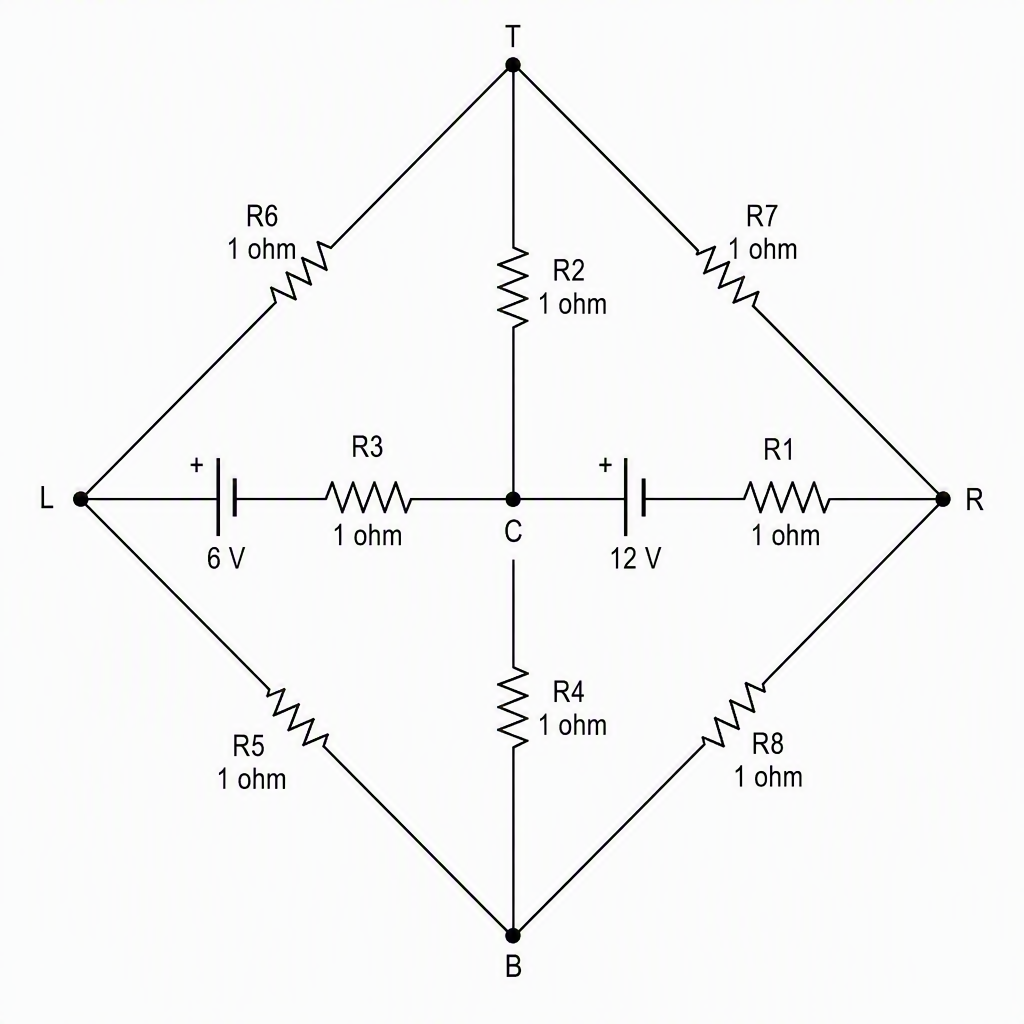
The four multi-correct statements claim these current magnitudes:
How do you choose the reference node and use the circuit symmetry?
Set the centre node C at zero potential and assign potentials to T, B, L and R. KCL at T and B produces identical equations, so the top and bottom potentials must be equal. This equality follows from the node equations, not from visual symmetry, because the circuit contains unequal batteries.
At T, the three connected resistors each have resistance 1 ohm:
Therefore:
At B:
Therefore:
Comparing the two equations gives:
Hence:
How do you write the battery-branch equations and solve the node potentials?
Track the potential immediately after each battery before writing a branch current. In the L-C branch, crossing the 6 V battery from its positive terminal causes a 6 V drop. In the C-R branch, crossing the 12 V battery from positive C makes the resistor-side potential negative 12 V.
For the L-C branch, the potential on the R3 side of the battery is:
Since C is grounded, the current written from L toward C is:
KCL at L gives:
Therefore:
For the C-R branch, the terminal beside R1 is:
The current written from R toward C is:
KCL at R gives:
Therefore:
Apply KCL at C as in the official nodal method:
Using the grounded central node and the equal top and bottom potentials:
The T and B equations gave:
Comparing these relations:
Therefore:
Use the L-node equation:
This gives:
Now use the relation obtained from the T and B equations:
Therefore:
The complete set of node potentials is:
Which current electricity JEE 2022 options are correct?
All four statements are correct. Each requested current follows from the potential difference across its 1-ohm resistor, including the resistor-side potentials created by the batteries. Use current magnitudes here because the options ask for magnitudes, not signed currents based on an assumed direction.
For R1, its terminal potentials are negative 12 V and negative 4.8 V:
For R2, use the T-C potential difference:
For R3, first calculate the resistor-side potential:
Therefore:
For R5, use the L-B potential difference:
Hence, A, B, C and D are all correct. A negative node potential does not mean a negative current magnitude. It only places that node below the chosen zero potential.
Why does treating the 12 V battery as a potential rise give the wrong answer?
The positive terminal of the 12 V battery is at C, which is fixed at zero potential. Crossing from C through the battery toward R1 is a 12 V drop. The terminal beside R1 must therefore be at negative 12 V, not positive 12 V.
The correct assignment is:
The incorrect step is assigning that terminal positive 12 V merely because the battery is labelled 12 V. It produces:
This value would make a student incorrectly reject statement A. Mark the positive and negative battery terminals first, then obtain the adjacent potential by tracking whether the traversal is a rise or a drop.
Which related Current Electricity questions should you practise?
Reuse the solved potentials for three checks involving current direction, power conservation and symbolic battery voltages. These questions remain within Kirchhoff’s laws and nodal analysis. They test the signs and battery polarities that can remain hidden when the original options ask only for current magnitudes.
What are the actual current directions through R1, R3 and R5?
The directions are R to C through the R1 branch, C to L through the R3 branch, and L to B through R5. These follow from conventional current moving through each resistor from higher potential to lower potential, using the node and resistor-side potentials already calculated.
- R1 branch: R to C at 7.2 A.
- R3 branch: C to L at 4.8 A.
- R5: L to B at 2.4 A.
Does battery power equal total resistor heating?
Yes. The 12 V battery supplies 86.4 W, while the 6 V battery supplies 28.8 W. Their total supplied power is 115.2 W. Calculating the heating across all eight 1-ohm resistors gives the same value, so the nodal solution satisfies power conservation.
For the 12 V battery:
For the 6 V battery:
Total supplied power is:
The total resistor heating is:
What happens if the batteries are replaced by symbolic voltages?
Replace 12 V by an emf labelled E1 and 6 V by an emf labelled E2, keeping both polarities unchanged. The identical T and B equations still give equal potentials. Solving the L and R equations with the same nodal method gives the three required symbolic relations.
The L-node equation gives:
The R-node equation gives:
Using:
Therefore:
Use the free past-paper archive to practise more JEE Advanced Kirchhoff and nodal-analysis questions. Keep one fixed habit: mark every battery polarity before writing the first KCL equation.
Next step: the past-paper archive on JEEnius and search every JEE Main paper from 2002 and every Advanced paper from 2007, by year, subject or chapter, each with a worked solution (free).
Frequently asked questions
Which options are correct in the Current Electricity JEE 2022 question?
Options A, B, C and D are all correct. The current magnitudes through R1, R2, R3 and R5 are 7.2 A, 1.2 A, 4.8 A and 2.4 A respectively.
Why are the top and bottom node potentials equal?
KCL at the top and bottom nodes gives identical equations because each connects to the same three node potentials through 1-ohm resistors. Comparing these equations proves that the top and bottom potentials are equal; visual symmetry alone is not sufficient.
How do I handle the 12 V battery polarity in this circuit?
The battery’s positive terminal is at the grounded centre node. Moving from the centre toward R1 crosses from positive to negative, so the resistor-side potential is −12 V, not +12 V.
What are the current directions through R1, R3 and R5?
Conventional current flows from R to C through R1 at 7.2 A, from C to L through R3 at 4.8 A, and from L to B through R5 at 2.4 A. These directions follow from the calculated terminal potentials.
Does the nodal solution satisfy power conservation?
Yes. The two batteries supply 115.2 W in total, and the eight resistors dissipate exactly 115.2 W, confirming the nodal solution.