
What was the hard electric field JEE 2024 numerical with an infinite sheet and line charge?
n equals 16.
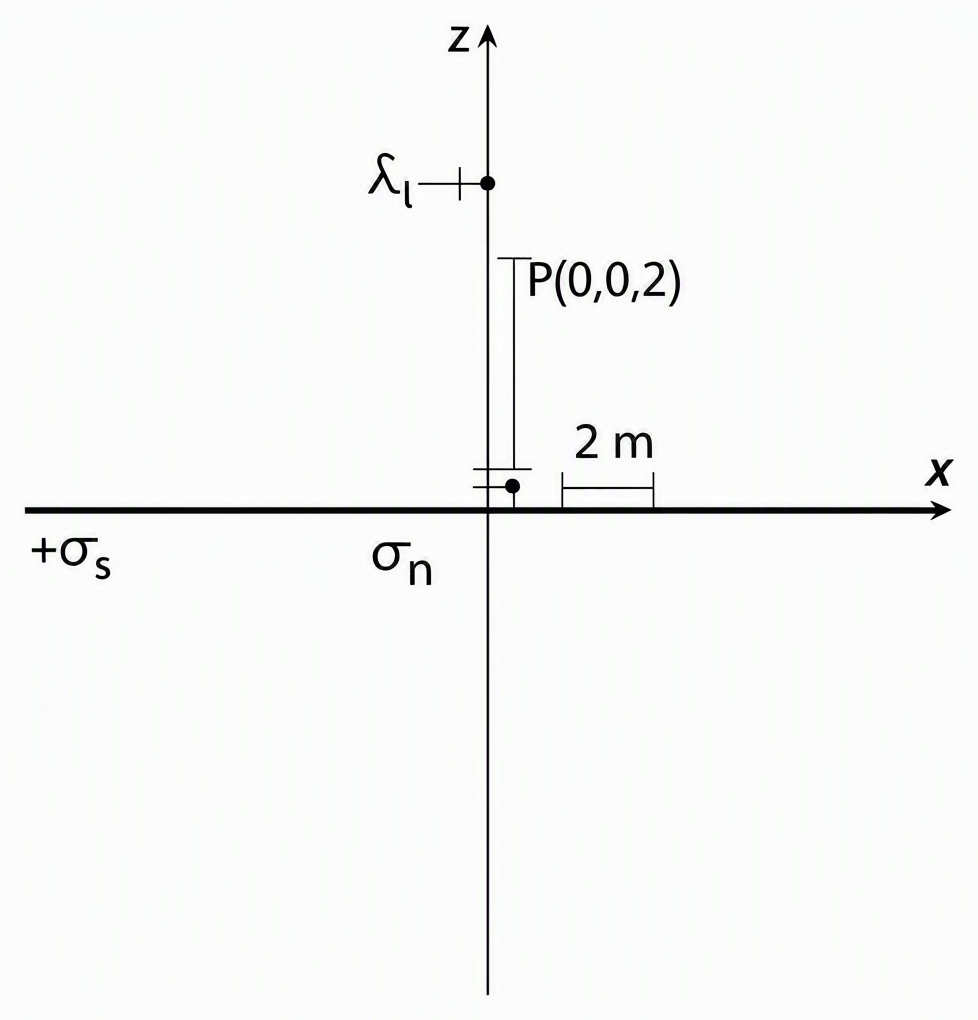
An infinite uniform sheet of positive surface charge density σ_s lies on the xy-plane. An infinitely long straight line charge of positive linear density λ_l sits at z = 4 m and runs parallel to the y-axis. The observation point is fixed at (0,0,2). Given |σ_s| = 2|λ_l|, the ratio of field magnitudes due to sheet to line equals π√n : 1.
How do you solve the complete electric field ratio step by step?
The ratio equals exactly 4π, so n equals 16.
The electric field due to the infinite sheet is independent of distance and given by
The perpendicular distance r from the line charge at z = 4 m to the point at (0,0,2) equals exactly 2 m. The field due to the line charge is therefore
Now form the ratio and substitute the given relation σ_s = 2 λ_l:
The ε_0 terms cancel directly. The λ_l terms also cancel, leaving 4π. Set this equal to the required form:
Divide both sides by π to obtain √n = 4, hence n = 16. Every constant stays visible until the final substitution.
What algebraic mistake produces n = 4 instead of n = 16?
Premature grouping of numerical coefficients before full substitution turns the correct 4π ratio into 2π and yields n = 4.
Students write the ratio as (σ_s × 2π ε_0 × 2) / (2 ε_0 λ_l) and treat the two factors of 2 as a single 2. After inserting σ_s = 2 λ_l they drop the remaining 2, leaving 2π. This gives π√n = 2π, so √n = 2 and n = 4. The procedural error is premature grouping of numerical coefficients before full substitution. Keep every 2 and every π separate until the relation between σ_s and λ_l has been inserted and all like terms have cancelled explicitly.
Why does the 3D geometry make this electric field JEE 2024 question difficult?
The sheet field magnitude is unchanged with z while the line field falls as 1/r with perpendicular distance strictly |4−2| = 2 m. Only magnitudes are required.
The sheet field remains uniform and perpendicular to the xy-plane on both sides, identical in magnitude at any z. The line-charge field stays radial in the xz-plane, so its perpendicular distance is strictly |4 − 2| = 2 m and falls as 1/r. The sheet magnitude never changes with z while the line magnitude drops with increasing separation. Magnitudes only are required; direction vectors are not needed for the asked ratio.
- Sheet field: constant with distance, direction flips across the plane
- Line field: depends on perpendicular distance only, cylindrical symmetry in xz-plane
- Net requirement: magnitudes alone, no vector addition needed
Which other hard numericals test superposition of infinite sheet and line charge fields?
Two additional hard-level practice problems test the same concepts.
An infinite sheet with σ = 10 μC/m² and an infinite line with λ = 5 μC/m placed parallel at 3 m; find the z-coordinate where net field is zero.
Numerical: line charge λ = 2 × 10^{-6} C/m at x=0 and sheet σ = 4 × 10^{-6} C/m² at x=2 m; magnitude of total E at x=1 m expressed as k√n, find n.
Both questions are limited to electric field superposition of sheet and line only.
What habits cut electric field numerical solving time from four minutes to under two?
You can expect the following habits to cut solving time from 240 s to under 120 s because they eliminate premature cancellation.
- Always write E_sheet and E_line with all factors of 2 and π before substituting the given |σ_s| = 2|λ_l|.
- Calculate perpendicular distance first from geometry, never assume r equals the z-coordinate of the line.
- Keep π on the left side when equating to π√n to simplify square-root extraction.
- Practice writing ratio in one line with symbols before plugging numbers.
You can search the past-paper archive for every similar electric field question from 2002 onwards, each with its worked solution. When a similar numerical blocks you during practice, photograph the doubt for a step-by-step solution with the necessary diagram.
Next step: photograph a doubt on JEEnius and photograph any question you are stuck on and get a step-by-step solution, with a free-body diagram when the question needs one (20 free).
Related on JEEnius: Matrices and Determinants JEE 2020: Adjoint of Adjoint Question.
Frequently asked questions
What is n in the electric field JEE 2024 sheet and line charge numerical?
n equals 16. The sheet field is σ_s/(2ε0) independent of distance. The line field at perpendicular distance 2 m is λ_l/(2π ε0 * 2). Substituting |σ_s|=2|λ_l| cancels λ_l and ε0 to give exactly 4π. Setting 4π = π√n yields √n=4 so n=16.
How to solve the electric field ratio for infinite sheet and line charge in JEE 2024?
First identify r=2 m from geometry between line at z=4 m and point at z=2 m. Write E_s = σ_s/(2ε0) and E_l = λ_l/(2π ε0 r). Substitute σ_s=2λ_l, cancel common terms to obtain 4π. Equate to π√n form and solve for n=16 without premature cancellation.
What mistake gives n=4 instead of 16 in electric field JEE 2024 problem?
Premature grouping of the numerical coefficients of 2 before inserting σ_s=2λ_l produces an erroneous 2π ratio. This leads students to set π√n=2π so √n=2 and n=4. Keep every factor separate until after substitution and explicit cancellation to avoid this algebraic error.
Why is the 3D geometry hard in the electric field JEE 2024 sheet and line question?
The sheet field magnitude is constant with z while the line field depends only on perpendicular distance |4-2|=2 m. Students often misread distances or attempt unnecessary vector addition. The question requires only magnitudes, not directions, but the setup in 3D space creates confusion.
What habits help solve electric field numericals faster for JEE?
Write full symbolic expressions for E_sheet and E_line with all 2 and π factors before substituting σ_s=2λ_l. Always compute perpendicular distance from geometry first. Keep π on the left when equating to π√n. Avoid early cancellation of numbers until every like term is explicitly cancelled.