What was the JEE Advanced 2022 multi-correct question on a charged particle above a uniformly charged disk with constant force?
A uniformly charged disk of radius R with charge density σ lies on the xy-plane centred at the origin. The given on-axis potential is . A positive charge q is released from rest at . An additional constant force (c > 0) acts on it. β is defined as . The four statements test whether the particle reaches the origin or returns for specific β and z₀ values.
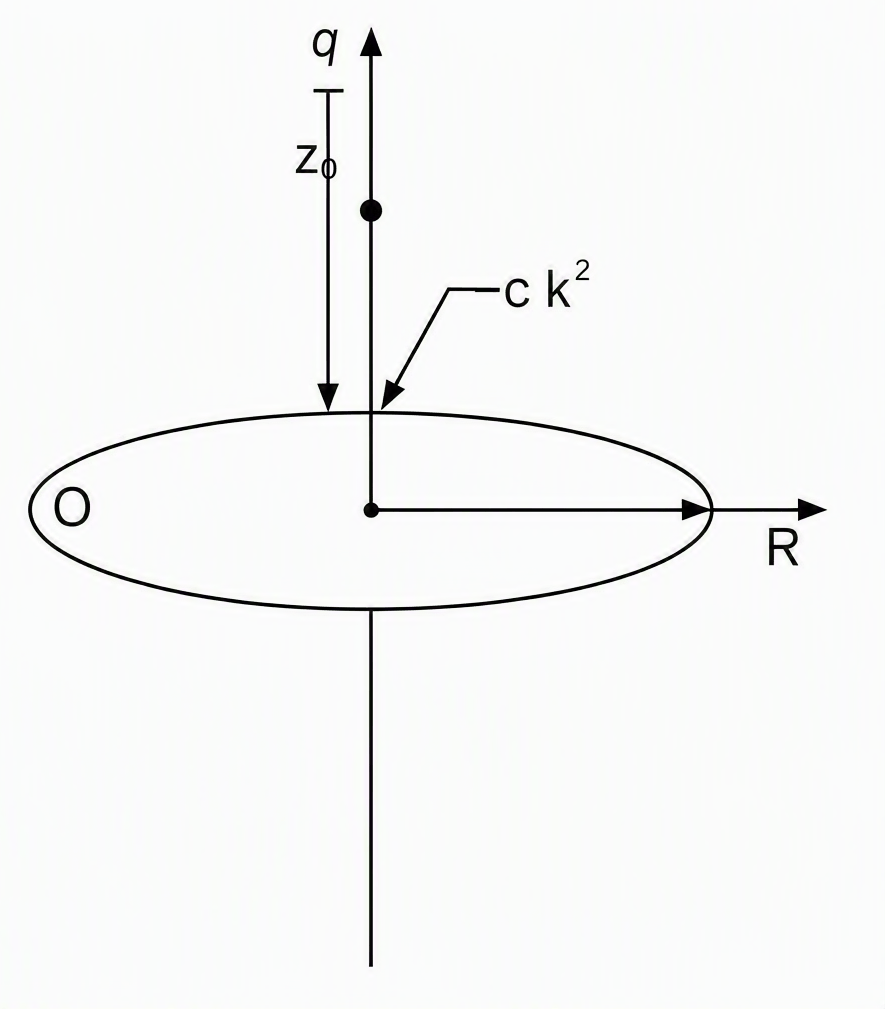
The particle starts at rest, so total mechanical energy equals initial potential energy. Motion is possible only where effective potential stays below or equal to that value.
How do you form the total potential energy U(z) and dimensionless u(x)?
Electrostatic potential energy is . The constant force gives potential energy . Total potential energy is therefore
Substitute and ignore the positive prefactor to obtain the dimensionless form
Total mechanical energy equals u(x₀) because the particle starts at rest.
Where is the minimum of u(x) when β = 1/4?
The minimum occurs at . Start from the derivative
For β = 1/4 this becomes
Set the derivative to zero:
Square both sides:
Cross-multiply to reach , which simplifies to so . Compare each given x₀ with this value: 25/7 ≈ 3.57 lies right of the minimum while 3/7 ≈ 0.429 and lie left.
Which statements are correct after checking u(x₀) versus u(0) and the sign of u'(x₀)?
Statements A, C and D are correct.
You can search every JEE Advanced paper from 2007 by year or chapter in the past-paper archive, each with a worked solution.
What method error leads to selecting option B?
The error is forgetting to evaluate the sign of u'(x₀) to determine initial force direction when x₀ lies left of the potential minimum. This leads to incorrectly assuming that u(x₀) > u(0) is sufficient for the particle to reach the origin even when it must first climb a potential barrier. The slip treats the effective potential as monotonic instead of recognising the minimum at x = 3/√7 created by competition between Coulomb repulsion and the constant downward force.
The official route demands both energy comparison and slope check at the release point.
What practice questions test the same effective-potential technique?
Question 1: A charged particle is released along the axis of a uniformly charged ring; gravity acts downward. Find minimum release height for it to reach centre (express in terms of linear charge density λ, mass m, g).
Question 2: Positive charge q is placed on the perpendicular bisector of a finite line charge with an added uniform electric field E opposing the repulsion; find condition on E so that equilibrium at distance d is stable.
Question 3: Compare the effective potential shape when the constant force is attractive versus repulsive for the given disk.
Solve each by writing total U, nondimensionalising, locating the extremum for the given β, then comparing energies and checking the sign of initial slope.
What checklist should you run before the exam on this type of electrostatics problem?
- Always write total U = qV + potential of extra conservative force.
- Nondimensionalise using x = z/R and given β.
- Solve u'(x) = 0 to locate any minima for the specific β.
- Compare u(x₀) with u at turning points or origin.
- Check sign of −du/dx at x₀ to know initial acceleration direction.
Keep this list next to your notes on potential barriers. When you meet a fresh variation, photograph a doubt for the step-by-step with diagram.
Next step: photograph a doubt on JEEnius and photograph any question you are stuck on and get a step-by-step solution, with a free-body diagram when the question needs one (20 free).
Read next: Chemical Bonding JEE 2026: 6 Paramagnetic Complexes Numerical.
Frequently asked questions
What are the correct options in the JEE Advanced 2022 electrostatics charged disk question?
Statements A, C and D are correct. For β=1/4 and x₀=25/7 the particle reaches the origin since u(x₀)>u(0) and initial force points toward origin. For x₀=1/√3, u(x₀)<1 so origin is inaccessible and particle returns to z₀. When β>1, u(x) is strictly increasing so origin is always reachable.
How do you form the dimensionless u(x) in electrostatics JEE 2022 disk problem?
Total potential energy combines qV(z) and cz from the constant force, giving U(z)=(qσ/2ε₀)[√(R²+z²)+(β-1)z]. Substitute x=z/R and drop the positive prefactor qσR/(2ε₀) to obtain u(x)=√(1+x²)+(β-1)x. Total mechanical energy equals u(x₀) since the particle starts at rest.
Where is the minimum of u(x) for β=1/4 in JEE Advanced 2022 electrostatics?
The minimum is at x=3/√7 ≈1.133. Set derivative u'(x)=x/√(1+x²)+(β-1) to zero. For β=1/4 this simplifies to x/√(1+x²)=3/4. Squaring both sides yields 7x²=9, so x=3/√7. Compare release position x₀ with this value to determine initial force direction.
Why is option B incorrect in the electrostatics JEE 2022 charged disk question?
For β=1/4 and x₀=3/7<3/√7, u'(x₀)<0 so initial force points away from origin. The particle must first climb a potential barrier before any possibility of reaching origin. Simply comparing u(x₀) and u(0) is insufficient; the sign of the derivative at release point must also be checked.
What checklist is used for effective potential problems in electrostatics JEE 2022?
Always form total U=qV plus potential from extra conservative force. Nondimensionalise with x=z/R and given β. Solve u'(x)=0 to locate minima for that β. Compare u(x₀) with u(0) or turning points. Finally check sign of -du/dx at x₀ for initial acceleration direction.