
What is the answer to the JEE Advanced 2021 binary-star question?
The numerical answer to this gravitation jee 2021 question is 9: use the star-to-star separation and the sum of both stellar masses in Kepler’s relation. The source is JEE Advanced 2021, Paper 2, Physics, and the difficulty is medium on this question bank’s scale.
Two stars, with masses three and six times the Sun’s mass, stay nine mean Earth–Sun distances apart. They follow circular paths around their common centre of mass and complete each revolution in the same time.
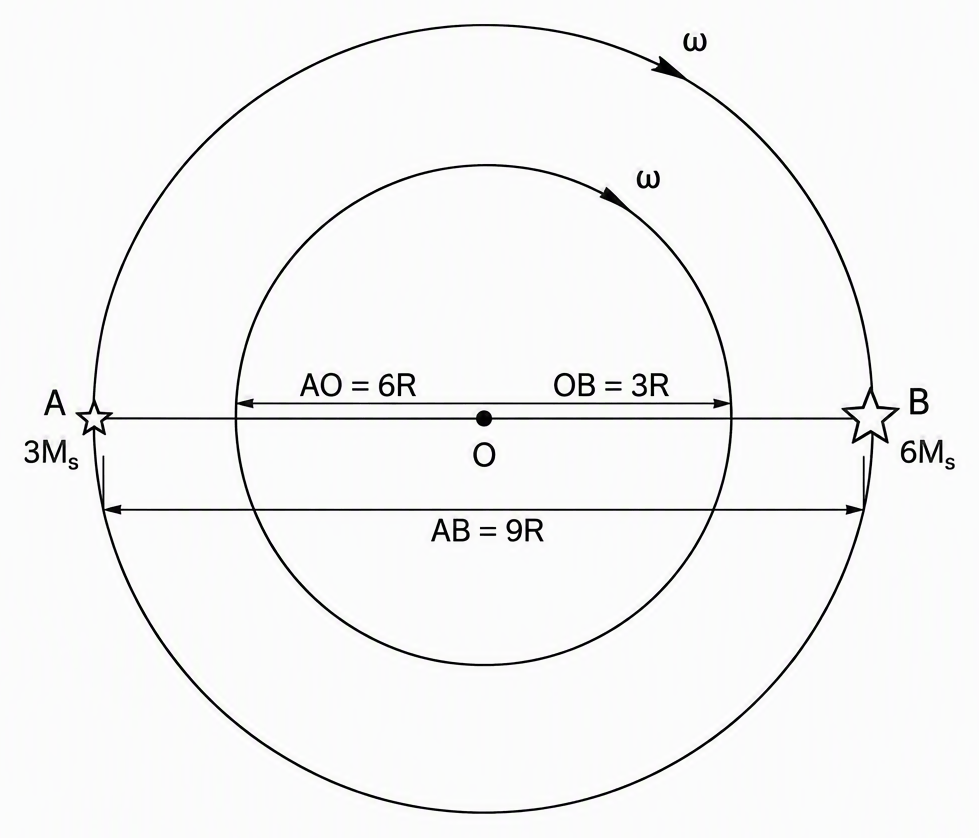
The question defines:
Find the dimensionless multiplier:
This is a numerical-answer question, not an MCQ. No answer options are supplied.
Which mass and radius belong in the binary-star Kepler formula?
Use the total mass of both stars and their full separation, not either individual orbital radius. Both stars revolve around their common centre of mass with the same angular speed and period, although their orbital radii differ. The official solution uses the two-body Kepler relation:
Here the symbols mean:
Read the inputs from the question:
The separation is the distance between the stars’ centres. It is not either star’s distance from the common centre of mass.
As a geometry check, not a second solution method, let the individual orbital radii carry matching subscripts. The centre-of-mass condition and total separation give:
How does comparison with Earth’s orbit give 9?
Dividing the binary period equation by Earth’s period equation gives a squared-period ratio of 81. The positive square root gives the required multiplier, 9. Use this period-ratio method because the gravitational constant, solar mass and reference distance all cancel.
The official solution takes Earth’s mass as negligible compared with the Sun’s mass. The Earth–Sun reference equation is therefore:
For the binary system, substitute the shared period, full separation and total stellar mass:
Divide the complete expressions, keeping the mass term visible:
The common gravitational constant and numerical factor cancel. The remaining cancellation is:
A period is positive, so take the positive square root:
The required numerical entry is:
The multiplier is dimensionless; the actual binary period is nine Earth orbital periods. Do not enter a time value when the question asks for the multiplier.
As a check, increasing separation ninefold contributes a factor of 729 to period squared. Increasing total mass ninefold reduces that factor to 81.
The question bank’s expected solve time is 120 seconds. That is its practice benchmark, not a measured average or an exam-imposed limit.
Why does ignoring the mass factor give the wrong answer 27?
The illustrative wrong numerical entry 27 comes from comparing separation alone. It is not an option from the paper. The incorrect chain is:
This proportionality can be carried across two systems unchanged only when their relevant total masses are equal:
Here, the binary contains nine solar masses, while the Earth–Sun reference uses approximately one solar mass. Those masses cannot be treated as equal or cancelled against each other.
Restore the mass ratio:
The error is in the physical comparison, not in taking the square root. Check total mass before using a separation-only ratio.
How do mass and separation changes affect a binary star’s period?
To find the squared period multiplier, cube the separation measured in Earth–Sun distances, then divide by the total mass measured in solar masses. Take the positive square root to get the multiplier. These three exercises are original practice variations on this gravitation jee 2021 PYQ, not additional verified past-paper questions.
- What is the multiplier if the separation stays unchanged but the masses become four and five solar masses?
Keep the original separation and substitute:
The centre of mass moves relative to the stars, but the period is unchanged. Redistributing a fixed total mass does not change the period at fixed separation.
- What is the multiplier if the original stars are eighteen Earth–Sun distances apart?
Keep the original masses and change the separation:
Relative to the original binary period:
- What is the multiplier if the original separation is kept but both masses are quadrupled?
The new masses give a total of thirty-six solar masses:
Quadrupling total mass halves the period at unchanged separation.
For your next comparison, identify the full separation and total mass in each system first. Then use:
Next step: the past-paper archive on JEEnius and search every JEE Main paper from 2002 and every Advanced paper from 2007, by year, subject or chapter, each with a worked solution (free).
Read next: Coordinate Geometry JEE 2008: Why Option D Is Correct.
Frequently asked questions
What is the answer to the JEE Advanced 2021 binary-star question?
The numerical answer is 9. The stars have a total mass of nine solar masses and a separation of nine mean Earth–Sun distances, so the squared-period ratio is 9³/9 = 81. Taking the positive square root gives P/T = n = 9.
Which mass and radius should I use in the binary-star Kepler formula?
Use the sum of both stellar masses and the full star-to-star separation in P² = 4π²a³/[G(m₁ + m₂)]. For this question, those values are 9M_s and 9R. Neither star's individual orbital radius belongs in this formula.
Why is 27 the wrong answer to the 2021 binary-star question?
The answer 27 comes from cubing the separation ratio and taking its square root while ignoring the total-mass ratio. The binary has nine solar masses, whereas the Earth–Sun reference uses approximately one solar mass. Including that factor gives P²/T² = 729/9 = 81, so the multiplier is 9.
What are the orbital radii of the two stars in the JEE 2021 question?
The star of mass 3M_s has orbital radius 6R, and the star of mass 6M_s has orbital radius 3R, both measured from their common centre of mass. These follow from 3M_s r₁ = 6M_s r₂ and r₁ + r₂ = 9R. Both stars complete each revolution in the same time despite having different orbital radii.