
What is the answer to the Solutions JEE 2025 osmotic-pressure question?
The numerical entry for this Solutions JEE 2025 question is 2.49, not the unscaled molar mass. It comes from JEE Advanced 2025, Paper 2, Chemistry, Solutions. The question bank classifies it as medium difficulty; that is not an official exam rating.
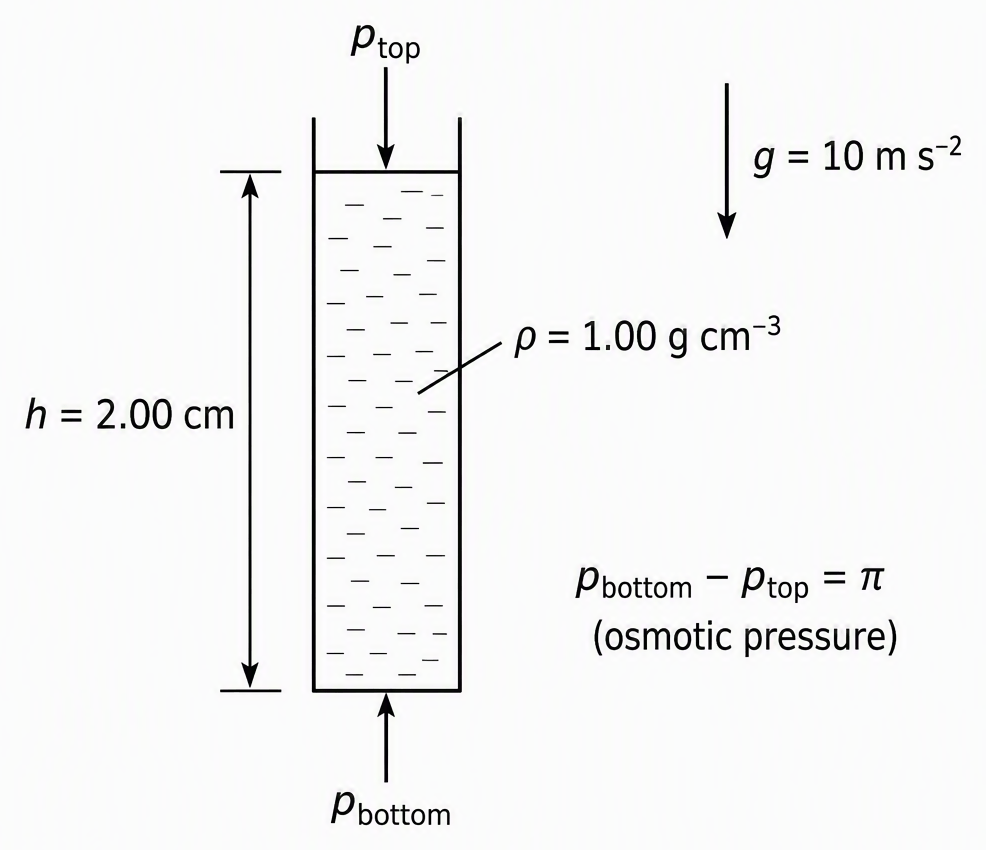
At 300 K, an ideal dilute macromolecular solution has osmotic pressure equivalent to a 2.00 cm column of the same solution. Its density is 1.00 gram per cubic centimetre. The column represents a pressure difference between its bottom and top, not a volume to use in the calculation.
The dissolved macromolecule has mass concentration:
This is a numerical-answer question, with no answer choices. Find the coefficient in the stated molar-mass form, using the supplied constants:
How does the solution-column height give osmotic pressure?
The column gives an osmotic pressure of 200 Pa through the hydrostatic pressure-difference formula. Atmospheric pressure is not added because the stated height represents the required pressure difference. Follow the official solution by converting density and height to SI units, so the pressure is in pascals.
Convert the solution density:
Convert the height:
Substitute every factor:
Solution density is not solute mass concentration. Density describes the mass of the whole solution per unit volume and determines the column pressure. Mass concentration describes only dissolved macromolecule mass per unit solution volume; it enters the next calculation.
How do you convert mass concentration into molar concentration?
Divide the solute mass concentration by its molar mass, after expressing the volume in cubic metres. Mass concentration counts grams of solute per unit volume; molar concentration counts moles. The official method uses the ideal-dilute osmotic-pressure equation:
Here, the concentration symbol denotes molar concentration, with units:
Concentration must be per cubic metre because pressure is in pascals and the supplied gas constant is in joules per kelvin per mole:
Convert the given mass concentration:
Let the numerical molar mass in grams per mole be:
Then:
Keeping grams here is consistent: the gram units cancel between numerator and denominator. Only the hydrostatic density needed conversion to kilograms per cubic metre. Check which units cancel rather than converting every mass to kilograms.
How do you calculate molar mass and extract the numerical entry?
The molar mass is 24,900 grams per mole, but the answer field asks for the coefficient in the stated scaled form. Calculate the molar mass first, then extract that coefficient. Substitution into the official equation gives:
Evaluate the arithmetic:
Compare the result with the requested form:
The numerical entry is:
Verify by substitution:
The recovered pressure matches the column calculation. The question bank’s 90-second expected solve time is a practice benchmark, not an official time limit. Establish the unit chain before using that benchmark as a timing target.
Why does missing the cubic-metre conversion give a wrong entry?
Leaving the mass concentration per cubic decimetre makes the calculated molar mass 1,000 times too small. This is a constructed wrong-entry analysis, not an answer-choice explanation: the supplied question has no options. It isolates one unit mistake while keeping the other steps unchanged.
The inconsistent setup is:
The concentration remains per cubic decimetre while pressure is in pascals and the gas constant is in joules. Carrying that mismatch through gives:
Compare with the correct results:
The scaling step cannot repair the factor-of-1,000 concentration error. Write the concentration units before substituting, and match pascals with moles per cubic metre when using the supplied gas constant.
Which three practice questions check the same Solutions method?
Use these author-created practice variations to check column-to-pressure conversion, the effect of dilution and direct substitution of molar concentration. They are based on the supplied question, not additional verified PYQs. Attempt each before reading its worked check, keeping the stated fixed quantities in view.
- Another macromolecule gives a 4.00 cm column. What is its molar mass? Keep mass concentration, temperature and solution density unchanged. At fixed density, doubling height doubles pressure; at fixed mass concentration and temperature, the calculated molar mass halves.
- What height results when the original mass concentration is halved? Use 1.00 gram per cubic decimetre at 300 K, retaining ideal-dilute behaviour and density of 1.00 gram per cubic centimetre. For the same macromolecule at this fixed temperature, halving mass concentration halves molar concentration and pressure.
- What pressure does the original macromolecule produce at the following molar concentration and 300 K?
No mass-to-mole conversion is needed because molar concentration is already given in the required unit. Under ideal-dilute conditions:
Redo these checks without looking at the equations. Write the concentration unit before every substitution.
Next step: photograph a doubt on JEEnius and photograph any question you are stuck on and get a step-by-step solution, with a free-body diagram when the question needs one (20 free).
If that step was the hard part, work through Gravitation JEE 2021: Binary-Star Period Explained.
Frequently asked questions
What is the answer to the JEE Advanced 2025 osmotic-pressure question?
The numerical entry is 2.49. The calculated molar mass is 24,900 g/mol, but the question asks for X in M = X × 10⁴ g/mol.
How do you calculate osmotic pressure from the solution column height?
Use π = ρhg, converting the density to 1000 kg/m³ and the height to 0.0200 m. With g = 10 m/s², the osmotic pressure is 200 Pa. Do not add atmospheric pressure because the column height represents a pressure difference.
Why is 2.00 g/dm³ converted to 2000 g/m³ in this question?
Pressure is in pascals and the supplied gas constant is in joules, so π = CRT requires molar concentration in mol/m³. Converting the mass concentration gives 2000 g/m³, which is then divided by molar mass in g/mol. Missing this volume conversion makes the calculated molar mass 1,000 times too small.
Do I need to convert grams to kilograms when calculating molar concentration?
No, provided mass concentration is in g/m³ and molar mass is in g/mol: the gram units cancel to give mol/m³. The solution density used in π = ρhg must be converted to kg/m³ to obtain pressure in pascals.