What is the JEE Advanced 2025 gravitation question?
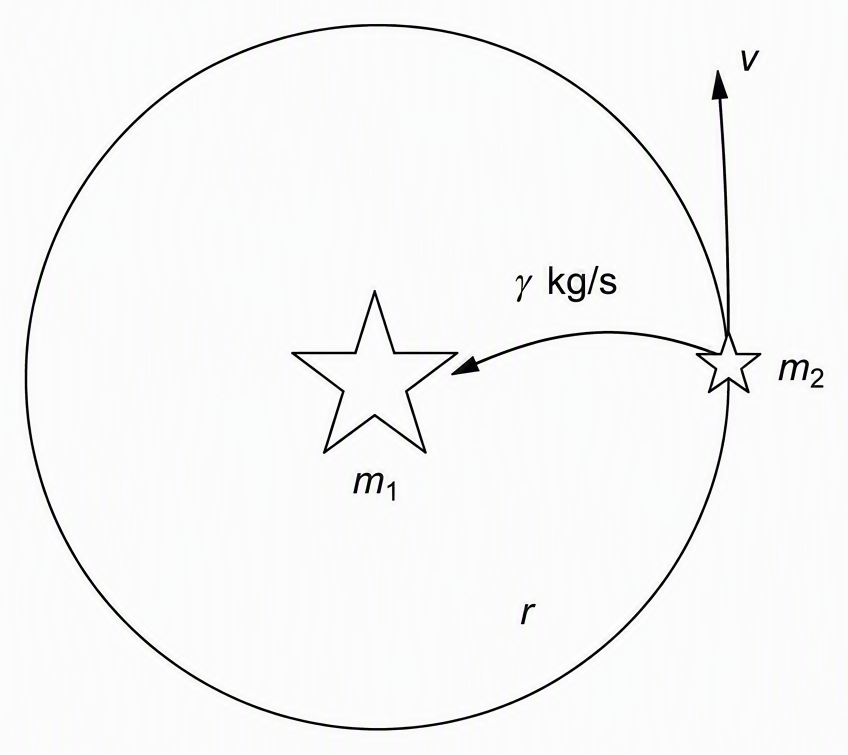
The gravitation JEE 2025 problem is a single-correct Physics question from JEE Advanced 2025 Paper 2. It was tagged hard, with an expected solving time of 240 seconds. A light star moves in a circular orbit around a much heavier star, while mass transfers from the lighter star to the heavier one.
The light star has mass
The heavy star has mass
The transfer rate is
No mass leaves the system. The orbital separation is represented by
The required relative rate is
The four choices are:
- Choice A
- Choice B
- Choice C
- Choice D
The task is to track which masses vary, assign the correct signs and delay the large-mass approximation until the exact rate equation is ready.
How do circular-orbit dynamics and angular momentum conservation combine?
The official solution combines gravitational force balance with conservation of the lighter star’s orbital angular momentum. This route fits the expected solving time of 240 seconds because it produces the required invariant directly. Neither mass should be treated as constant during the transfer, although their total remains unchanged.
For the lighter star, gravity supplies the centripetal force:
The orbital angular momentum used in the official model is conserved because there is no external torque:
Solve the angular-momentum equation for speed:
Mass moves from one star to the other, so both masses change. Treating either one as constant at this stage removes a required term from the final rate equation.
What quantity remains constant during the mass transfer?
The invariant is the product of the heavy star’s mass, the square of the light star’s mass and the orbital radius. The square must come from direct substitution, not memory. It is the decisive algebraic feature of this gravitation JEE 2025 problem.
Substitute the angular-momentum expression for speed into the force equation:
Simplifying the right-hand side gives:
Multiply through and rearrange:
Since gravitational constant and angular momentum are constant:
The exponent of the lighter star’s mass is two because its mass appears in angular momentum and enters again when speed is squared. Missing this square changes the rate equation and the answer.
How does logarithmic differentiation give the correct option?
Differentiate the invariant first, insert the signed mass-transfer rates second and apply the large-mass approximation last. This order gives the exact expression before removing the smaller term. It also shows why the orbit expands and why the heavy star’s fractional mass change is negligible.
Logarithmically differentiate the invariant:
The heavier star gains mass:
The lighter star loses the same absolute amount:
Substitution gives:
Rearrange before making any approximation:
The heavy star is much more massive:
Therefore:
The required rate becomes:
Option B is correct. The positive sign means that the orbital separation increases as the lighter star transfers mass to the heavier star.
How can the approximation be checked numerically?
A numerical check gives an exact relative rate of and an approximate rate of
Take masses of 1000 kg and 10 kg, with a transfer rate of 0.01 kg/s. These values only check the algebra.
The large-mass approximation gives:
The neglected heavy-star term is small, and the separation still increases.
Why does incorrect handling of fractional mass changes produce option C?
Option C results from attaching the controlling fractional change to the heavy star. Mass conservation gives equal absolute transfer rates, not equal fractional rates. Writing the expansion rate as twice the heavy star’s fractional gain uses the accretor’s mass in the denominator and produces option C.
The correct signed derivatives are:
These absolute rates have equal magnitudes. Their fractional rates do not:
Because the heavy star is much more massive, gaining the transferred amount changes its mass by a tiny fraction. The same absolute loss changes the lighter star’s mass by a much larger fraction.
Writing the expansion rate as incorrectly makes the accretor’s fractional gain the controlling factor and produces option C.
Use this repair rule:
- Write the signed derivatives first.
- Divide each derivative by its corresponding mass only during logarithmic differentiation.
- Apply the large-mass approximation only after obtaining the exact expression.
Which three related gravitation questions should you practise?
Practise one exact-rate problem, one finite-change problem and one fixed-mass angular-momentum problem. These three forms make the invariant and logarithmic-differentiation method reusable. The aim is to move correctly from force balance and angular momentum to an invariant, then from the invariant to fractional changes.
- Under the same assumptions, what is the exact relative separation rate without using the large-mass approximation?
The answer must retain both fractional mass-rate terms:
- If the masses change from initial values to final values while angular momentum remains constant, what is the ratio of final to initial separation?
The initial and final masses are represented by:
Apply the invariant at the initial and final states:
Therefore:
- For a circular orbit with both masses fixed, how are small fractional changes in radius and angular momentum related?
Start with:
With both masses fixed:
Hence:
For timed practice, use the free past-paper archive to search JEE Advanced papers from 2007 by chapter. Attempt each Gravitation question before opening its worked solution, and cap this problem at 240 seconds.
Next step: photograph a doubt on JEEnius and photograph any question you are stuck on and get a step-by-step solution, with a free-body diagram when the question needs one (20 free).
If that step was the hard part, work through JEE Chemistry Important Chapters: Best Order and 8-Week Plan.
Frequently asked questions
What is the correct answer to the Gravitation JEE 2025 question?
The correct answer is Option B: (1/r)(dr/dt) ≈ 2γ/m₂. The exact rate is 2γ/m₂ − γ/m₁. Since m₁ ≫ m₂, the second term is negligible.
What remains constant during the mass transfer?
Under the stated model, orbital angular momentum remains constant because there is no external torque. Combining this with circular-orbit force balance gives m₁m₂²r = constant.
Why does the orbital separation increase?
The lighter star loses mass at a much larger fractional rate than the heavier star gains it. Therefore, 2γ/m₂ dominates γ/m₁, making (1/r)(dr/dt) positive and causing the orbit to expand.
Why is Option C wrong in the JEE Advanced gravitation question?
Option C incorrectly uses the heavier star’s mass in the controlling fractional-rate term. Equal absolute mass-transfer rates do not imply equal fractional mass changes because m₁ is much larger than m₂.