
What is the momentum vector at t = T/√2 in the hard JEE Main 2022 projectile question?
The momentum vector is Ns.
A 10 kg body is launched at 45° to the horizontal. Its path passes through the point (20 m, 10 m). Find the momentum vector at time t = T/√2 where T is the total time of flight (g = 10 m s⁻²).
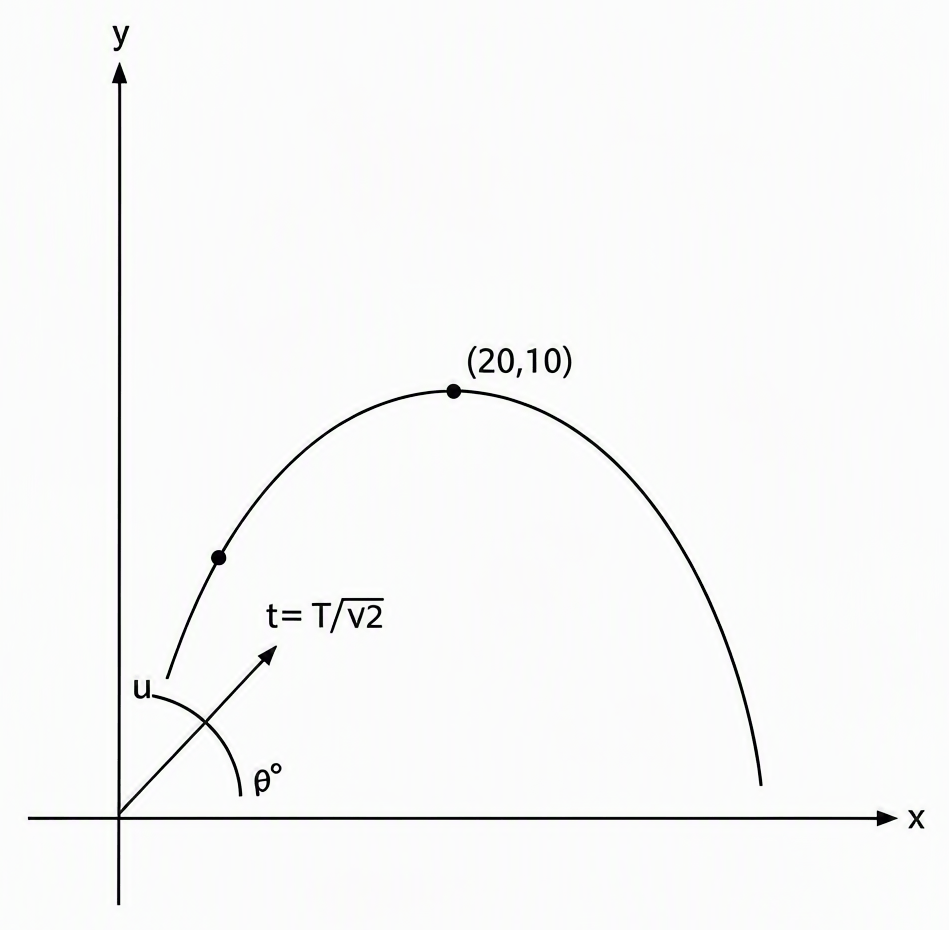
How does the official NTA solution find the momentum vector?
The official NTA solution finds the momentum vector as Ns after extracting u from the trajectory equation.
The trajectory equation for θ = 45° simplifies to
.
Substitute (20, 10) with g = 10 to obtain
,
hence and m/s.
s, therefore s.
m/s.
m/s.
Momentum vector
Ns,
which is option 4.
What trig substitution error produces one wrong option here?
Treating cos 45° incorrectly as 1/2 instead of makes the horizontal component 10 m/s.
Retaining the correct t = 2√2 s (or derived T) when computing the vertical velocity term gives
m/s.
This combination yields Ns that matches the vector encoded in option 3.
Evaluate sin 45° and cos 45° at the same time with exact values. Compute t = T/√2 as a separate step before substituting into .
Why is the JEE Main 2022 projectile momentum question tagged hard?
It requires simultaneous use of the trajectory equation to extract u, exact time-of-flight formula, and component-wise velocity at a non-intuitive instant t = T/√2.
A single trigonometric substitution error carries heavy penalty because √2 appears in every term. Horizontal momentum is constant while vertical changes due to gravity. Students must keep both ideas separate.
What related conservation of momentum questions from Laws of Motion build the same rigour?
A shell of mass 3 kg is projected at 45° with u = 20 m/s. At the highest point it explodes into two fragments of masses 1 kg and 2 kg. If the 1 kg fragment has zero velocity just after explosion, find the velocity of the 2 kg fragment.
At highest point the shell velocity is purely horizontal: m/s. Total horizontal momentum before explosion is kg m/s. The 2 kg piece carries all of it: m/s horizontally.
Two blocks of masses 2 kg and 3 kg lie on a smooth table connected by a light string. The 2 kg block receives velocity 4 m/s toward the 3 kg block which is at rest. Just before the 3 kg block collides with a nearby wall, both blocks move with common velocity. Calculate system momentum.
No external horizontal force exists until wall contact. Momentum conservation gives total momentum 8 kg m/s. Common velocity is 1.6 m/s. Momentum just before wall collision remains 8 kg m/s.
A rocket of initial mass 200 kg ejects fuel at constant rate with exhaust speed 50 m/s relative to the rocket. Calculate velocity gained when half the mass is ejected and no external force acts horizontally.
Variable-mass momentum conservation yields
.
When mass halves, m/s.
How does this JEE Main 2022 projectile solution sharpen preparation for JEE Main 2025-26?
You can expect questions that mix trajectory data with momentum vectors in JEE Main 2025 because Session 1 is confirmed for 2025-01-22 and Session 2 for 2025-04-01.
Practice every Laws of Motion PYQ from 2002 onward via the free past-paper archive on the site. For any stuck doubt, photograph the question and receive a step-by-step solution with a free-body diagram where forces are involved.
Next step: the past-paper archive on JEEnius and search every JEE Main paper from 2002 and every Advanced paper from 2007, by year, subject or chapter, each with a worked solution (free).
If that step was the hard part, work through Limit, Continuity and Differentiability JEE 2016: Official Solution.
Frequently asked questions
What is the momentum vector at t = T/√2 in the JEE Main 2022 projectile question?
The momentum vector is 100√2 î + (100√2 - 200) ĵ Ns. First use the trajectory equation y = x - (g x²)/u² at (20 m, 10 m) with g=10 to get u=20 m/s. Then T=2√2 s so t=2 s, vx=10√2 m/s, vy=10√2-20 m/s. Multiply by 10 kg mass to obtain the vector.
How does NTA solve the laws of motion jee 2022 momentum question?
NTA extracts u from the simplified trajectory equation for 45°, yielding u=20 m/s. It calculates T=2√2 s, sets t=T/√2=2 s, finds velocity components vx=10√2 and vy=10√2-20, then multiplies the vector by mass 10 kg. This gives option 4 as the correct answer.
What trig substitution error is common in the JEE 2022 momentum question?
Students often treat cos 45° as 1/2 instead of 1/√2, making vx=10 m/s. They then compute vy using t=2√2 s to get -10√2 m/s. This produces the incorrect vector 100 î - 100√2 ĵ Ns that matches one of the distractors.
Why is the projectile momentum question in laws of motion jee 2022 rated hard?
It demands simultaneous application of the trajectory equation to find u, the time-of-flight formula, and velocity components at the non-obvious instant t=T/√2. Any trig slip with √2 propagates through every term. Students must also remember horizontal momentum is constant while vertical momentum changes linearly with time due to gravity.
What related conservation of momentum questions help for laws of motion jee 2022?
Practice the shell exploding at highest point into 1 kg and 2 kg fragments, two blocks on a smooth table exchanging velocity before wall collision, and the variable-mass rocket ejecting fuel at constant rate. These reinforce momentum conservation when no external force acts in the horizontal direction.