
What is the orbital motion of satellites JEE 2018 question?
The orbital motion of satellites JEE 2018 question has option B as its answer. Two natural satellites travel in circular orbits around the same planet, with their mutual gravitational attraction neglected. The first satellite is heavier and follows the inner orbit.
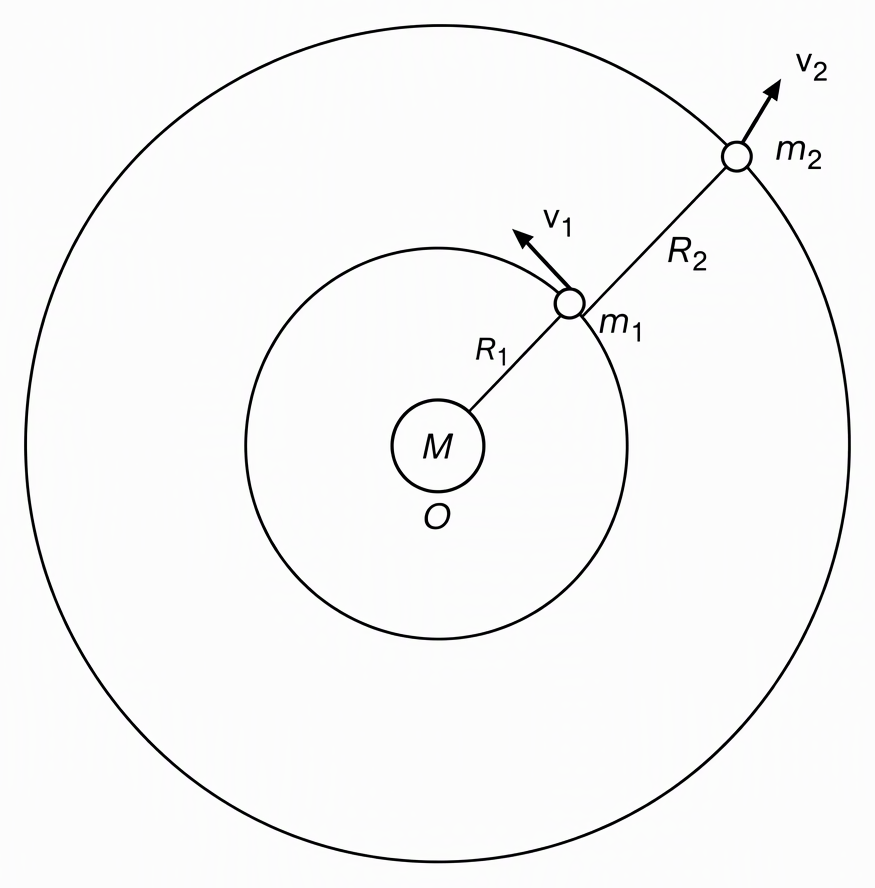
This is a JEE Advanced 2018, Paper 2, Physics, Gravitation match-list question. “Medium” is the question bank’s difficulty classification, not an official exam label.
Orbital radii are measured from the planet’s centre, not its surface. The given ratios are:
The symbols below denote orbital speed, angular momentum about that centre, kinetic energy and orbital period, respectively. Subscripts identify the satellites.
Match each ratio in List-I to its value in List-II.
List-I
List-II
Answer choices
- A
- B
- C
- D
How do you derive the satellite speed ratio?
The inner satellite travels twice as fast, so P matches List-II number 3. Start with gravitational force supplying the centripetal force, as in the official solution. This shows where satellite mass cancels, without assuming it disappears from every orbital quantity.
Cancel satellite mass, then multiply both sides by orbital radius:
Both satellites orbit the same planet, so the gravitational constant and planetary mass are common:
Invert the radius ratio inside the square root:
Independent of satellite mass does not mean independent of orbital radius. The physical check agrees: the inner satellite must travel faster.
Why are the two angular momenta equal?
The first satellite’s doubled mass exactly cancels its smaller square-root radius factor, so Q matches List-II number 2. In circular motion, radius and velocity are perpendicular. The angular-momentum magnitude about the planet’s centre is therefore:
Substitute the derived speed:
For the same central planet, the satellite-mass factor survives:
Insert the given ratios:
Equality here follows from the particular mass and radius ratios. Conservation is different: each satellite’s angular momentum remains constant along its own orbit because gravity exerts zero torque about the planet’s centre. Conservation alone does not make two satellites’ angular momenta equal.
How do you calculate the kinetic-energy ratio?
The first satellite has eight times the kinetic energy, so R matches List-II number 4. Keep the mass factor and square the speed ratio. Start from the definition and substitute the speed-squared result:
Kinetic energy depends on mass divided by radius, not inverse radius alone:
Cross-check using the speed ratio:
Kinetic energy is positive. Do not replace it with negative total orbital energy.
How does the period ratio confirm option B?
The inner satellite takes one-eighth as long to complete an orbit, so S matches List-II number 1. Period is circumference divided by speed. Substitute the force-balance speed rather than introducing a disconnected formula:
The period ratio is:
Check using the shorter circumference and higher speed directly:
Keep calculated values separate from List-II numbers:
- P: calculated ratio 2; List-II number 3.
- Q: calculated ratio 1; List-II number 2.
- R: calculated ratio 8; List-II number 4.
- S: calculated ratio one-eighth; List-II number 1.
The complete matching is:
Therefore, option B is correct. A calculated ratio of two points to entry 3, not entry 2.
How can an equal-radius shortcut lead to option D?
Applying an equal-radius assumption to only speed and angular momentum can produce option D. This is a possible error, not a claim about the official distractor’s design or popularity.
Treating those quantities as if both orbital radii were equal gives:
Keeping the correct energy and period ratios alongside those wrong results produces option D:
The inconsistency is using equal radii for only two quantities, despite the given unequal radii throughout. Repair this by writing all four dependencies before inserting either ratio:
These dependencies come from the same force-balance equation. Use them as a record of the derivation, not four formulas to memorise separately.
How do you solve two related Gravitation questions?
Use the radius powers directly when the radii are given; work backwards from angular momentum when they are unknown. These are original practice variations, not additional verified JEE previous-year questions. Both assume circular orbits around the same planet and neglect satellite–satellite attraction.
Question 1: Two equal-mass satellites have the following radius ratio. Find their speed, angular-momentum, kinetic-energy and period ratios.
The mass ratio is one, so only the radius powers remain:
The outer satellite is slower but has greater angular momentum. Its larger radius outweighs its lower speed in the angular-momentum product.
Question 2: Two satellites have equal angular-momentum magnitudes and the following mass ratio. Find their radius and period ratios.
Work backwards from angular momentum:
Then calculate the period ratio:
For this inverse problem, isolate the square root first and square only after dividing by the mass ratio. The radius ratio is one-ninth, not one-third.
Next step: the past-paper archive on JEEnius and search every JEE Main paper from 2002 and every Advanced paper from 2007, by year, subject or chapter, each with a worked solution (free).
For a worked example of the same idea, see How to Study Kinematics JEE: Six Steps Before Formulas.
Frequently asked questions
What is the answer to the orbital motion of satellites JEE 2018 question?
Option B is correct: the speed, angular-momentum, kinetic-energy and period ratios are 2, 1, 8 and 1/8, respectively. These values give the matching P→3, Q→2, R→4 and S→1.
Does a satellite's orbital speed depend on its mass?
For the circular orbits assumed in this question, v = √(GM/R), so orbital speed is independent of satellite mass. It still depends on orbital radius and the planet's mass. Around the same planet, the satellite at one-quarter the orbital radius travels twice as fast.
Why are the angular momenta of the two satellites equal?
For a circular orbit, L = m√(GMR), so angular momentum is proportional to m√R around the same planet. Here, L₁/L₂ = 2√(1/4) = 1. The equality follows from the given mass and radius ratios, not from angular-momentum conservation alone.
Why is option D wrong in the JEE 2018 satellite question?
Option D assigns a speed ratio of 1 and an angular-momentum ratio of 2, which are inconsistent with the given unequal orbital radii. Those results can arise from incorrectly assuming equal radii for these two quantities while retaining the correct energy and period ratios. Using v ∝ R^(-1/2) and L ∝ mR^(1/2) gives the correct ratios of 2 and 1.