
What is the organic compounds containing oxygen jee 2025 question?
The verified answer to the organic compounds containing oxygen jee 2025 hard numerical is 84.00 g. The decisive step is the coupling ratio: two moles of X form only one mole of P. Keeping separate reaction-identity and mole-and-yield ledgers prevents this factor from being lost within the expected 240-second solving time stated by the hard tag.
The question starts with 16 mol of 2-(2-bromophenyl)-1,3-dioxolane, labelled X, which undergoes the sequence from X through P, Q, R and T to S. Sodium in dry ether followed by acidic hydrolysis forms P, whose given molar mass is 210 g mol⁻¹. P forms in 100% yield, followed by four successive steps at 50% yield each.
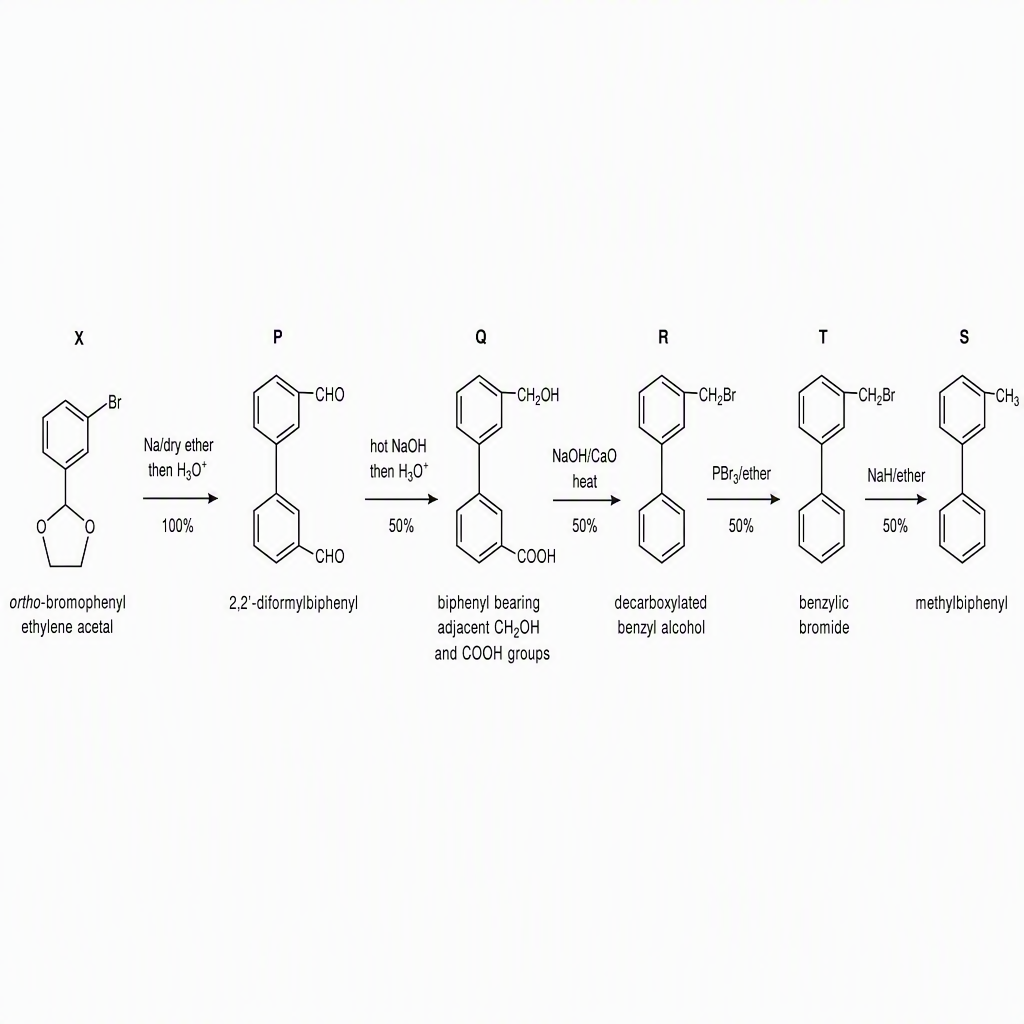
The reaction sequence is:
The required numerical answer is the mass of S in grams. The safest method is to complete the reaction-identity ledger before starting the mole-and-yield ledger.
How do you identify what each reagent does?
The reagents produce biphenyl coupling, acetal hydrolysis, Cannizzaro-type disproportionation, decarboxylation, alcohol-to-bromide conversion and finally methylbiphenyl. Complete this structural ledger before applying any percentage yield. The key structural fact is that the first step joins two carbon skeletons, while each later conversion is treated as one-to-one.
Why do two molecules of X produce one molecule of P?
Two molecules of X produce one molecule of P because sodium in dry ether couples two aryl bromide molecules. This is the step where two separate carbon skeletons unite to form one biphenyl skeleton. Acidic hydrolysis then removes both acetal protecting groups and restores the two aldehydes.
P is therefore 2,2′-diformylbiphenyl. The stated molar mass supports this identification:
What happens when P is heated with sodium hydroxide and then acidified?
One aldehyde group is oxidised to a carboxylic acid, while the other is reduced to a primary alcohol. This Cannizzaro-type disproportionation occurs with hot sodium hydroxide, followed by acidification. Q therefore contains adjacent carboxylic acid and benzyl alcohol groups on the biphenyl framework.
How are Q, R, T and S formed?
Q is first decarboxylated to alcohol R. The benzylic alcohol group is then converted into a benzylic bromide group to form T. Following the official scheme, the final sodium hydride and ether step gives S as methylbiphenyl.
- Soda lime, sodium hydroxide with calcium oxide and heat, decarboxylates Q. Loss of the carboxyl group gives benzyl alcohol R.
- Phosphorus tribromide converts the benzylic alcohol group of R into a benzylic bromide group, producing T.
- Following the official scheme, sodium hydride in ether converts T into S, identified as methylbiphenyl. Do not replace the supplied pathway with an alternative mechanism or product.
How do you build the mole and yield ledger?
Begin with 16 mol of X. First apply the two-to-one coupling ratio, then apply the 100% yield of P and the four successive 50% yields. For this organic compounds containing oxygen jee 2025 calculation, every transformation after P is treated as a one-to-one conversion of the surviving molecules.
The starting amount is:
Two moles of X produce one mole of P, so the theoretical amount of P is:
P is obtained in 100% yield:
Q is obtained in 50% yield:
R is obtained in 50% yield:
T is obtained in 50% yield:
S is obtained in 50% yield:
The compact check is:
How do you convert the final moles into 84.00 g?
S is methylbiphenyl, with a molar mass of 168 g mol⁻¹. Multiplying this by the final amount of 0.5 mol gives 84 g. Since the required response is a numerical-entry answer, it must be entered as 84.00 g.
Its molecular formula is:
Using the supplied atomic masses:
Therefore:
The given molar mass of P, 210 g mol⁻¹, supports the identification of P as 2,2′-diformylbiphenyl. It must not be multiplied by the final 0.5 mol because the requested substance is S, not P.
Why does the wrong answer 168 g appear?
The answer 168 g results from assuming that 16 mol of X directly gives 16 mol of P. The four 50% yields are then applied correctly, but to the wrong starting amount. The error is not in percentage-yield arithmetic. It is the omission of the two-to-one coupling stoichiometry.
The incorrect assumption is:
Applying four successive 50% yields gives:
The resulting incorrect mass is:
The omitted coupling ratio is:
Use one prevention rule: write the balanced molecular ratio at every carbon-skeleton-changing step before multiplying any yields. Percentage yield cannot repair an incorrect stoichiometric base.
Which related organic compounds containing oxygen questions should you practise?
Practise questions that combine reaction recognition, molecular ratios and successive yields. The best method is to identify each product first, write every carbon-skeleton-changing ratio, and then calculate the surviving moles. The following three questions test dimerisation, Cannizzaro-type disproportionation and successive benzylic conversions.
What is the final amount when an aromatic acetal dimerises?
The final amount is 1 mol. Start with 10 mol of an aromatic acetal that dimerises in a two-to-one ratio with 80% yield. Two later one-to-one steps each have 50% yield. Apply the dimerisation ratio before applying the three percentage yields.
Answer: 1 mol.
What does hot concentrated sodium hydroxide do to 2,2′-diformylbiphenyl?
The product contains one carboxylic acid group and one primary alcohol group. After treatment with hot concentrated sodium hydroxide followed by acidification, one aldehyde group undergoes oxidation while the other undergoes reduction. This tests the two simultaneous changes in a Cannizzaro-type disproportionation.
Answer check: the product contains one carboxylic acid group and one primary alcohol group.
What mass forms after two successive benzylic conversions?
The product mass is 151.2 g. Start with 3 mol of a benzylic alcohol. Conversion with phosphorus tribromide has 60% yield, and a second reagent produces a compound with the following formula in 50% yield:
The surviving product amount is:
Its molar mass is:
Therefore:
Answer: 151.2 g. For further drills, use the free past-paper archive to search JEE Advanced questions by chapter and solve each one with separate reaction and mole ledgers.
Next step: the past-paper archive on JEEnius and search every JEE Main paper from 2002 and every Advanced paper from 2007, by year, subject or chapter, each with a worked solution (free).
Frequently asked questions
What is the answer to the organic compounds containing oxygen JEE 2025 question?
The verified numerical answer is 84.00 g. The sequence produces 0.5 mol of methylbiphenyl, whose molar mass is 168 g mol⁻¹.
Why do 16 moles of X give only 8 moles of P?
Sodium in dry ether couples two aryl bromide molecules to form one biphenyl skeleton. Therefore, the molecular ratio is 2X to 1P, so 16 mol of X can produce only 8 mol of P at 100% yield.
How are four successive 50% yields calculated?
Multiply the amount of P by (0.50)⁴ because each later transformation is one-to-one. Thus, 8 × (0.50)⁴ gives 0.5 mol of S.
Why is 168 g the wrong answer?
The 168 g result comes from incorrectly treating 16 mol of X as 16 mol of P. It omits the initial 2:1 coupling ratio, doubling the correct final mass.
What does hot sodium hydroxide do to 2,2′-diformylbiphenyl?
It causes a Cannizzaro-type disproportionation in which one aldehyde group is oxidised and the other is reduced. After acidification, the product contains one carboxylic acid group and one primary alcohol group.