
What was the JEE Main 2019 photoelectric effect question with superposed magnetic field?
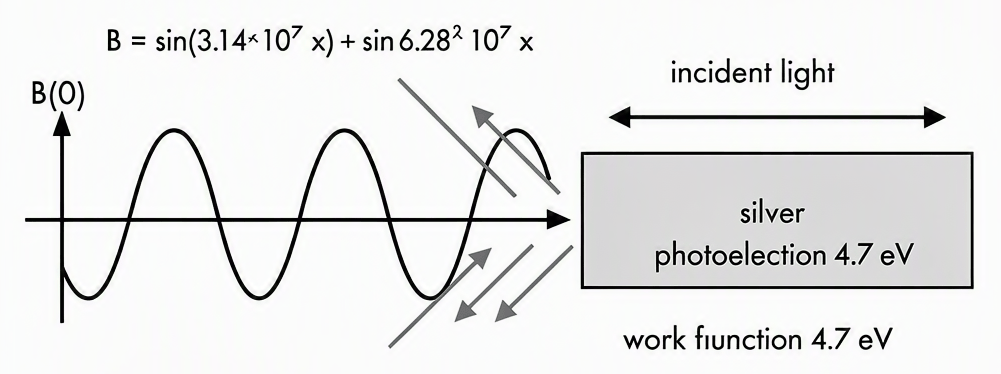
The magnetic field at the origin is expressed as superposition of two sine terms with coefficients 3.14×10^7 ct and 6.28×10^7 ct. This wave falls on a silver plate whose work function is 4.7 eV. Given c = 3×10^8 m s^{-1} and h = 6.6×10^{-34} J s, the task is to find the maximum kinetic energy of emitted photoelectrons.
The physical situation is an electromagnetic wave composed of two independent monochromatic components striking the metal surface. The maximum kinetic energy comes from the highest frequency after subtracting the work function.
How do you solve the JEE Main 2019 photoelectric effect question using the official method?
The magnetic field expression corresponds to two waves with wave numbers k1 = 3.14×10^7 m^{-1} and k2 = 6.28×10^7 m^{-1}. These yield λ1 = 2π/k1 = 2×10^{-7} m and λ2 = 2π/k2 = 1×10^{-7} m. The frequencies are ν1 = c/λ1 = 1.5×10^{15} Hz and ν2 = c/λ2 = 3×10^{15} Hz. Both photon energies exceed 4.7 eV, so K_max comes from the larger one and equals 7.675 eV ≈ 7.72 eV.
E1 = hν1 = (6.6×10^{-34})(1.5×10^{15}) = 9.9×10^{-19} J
E2 = hν2 = (6.6×10^{-34})(3×10^{15}) = 1.98×10^{-18} J
Search the past-paper archive by chapter to solve every similar superposition question from 2002 onward.
What method mistake produces the 12.5 eV option in the 2019 photoelectric effect question?
Computing only the higher photon energy hν2 ≈ 12.5 eV and stopping without subtracting the 4.7 eV work function produces the wrong option. This is a method mistake of confusing incident photon energy with the kinetic energy of the photoelectron.
The photoelectric equation demands the subtraction step every single time. I follow the official route: calculate all frequencies, convert each hν to eV, compare with φ, then subtract. No shortcuts survive in hard questions.
What two related practice questions from dual nature of matter test the same frequency and Kmax concepts?
Question A is a metal surface with work function 2.3 eV and incident light of frequency 6×10^{14} Hz. Question B gives an electric field with two angular frequencies ω1=4×10^{15} rad/s and ω2=8×10^{15} rad/s on a cathode of φ=4.7 eV. Only the highest frequency decides K_max while both may cause emission.
For Question A, photon energy is 2.475 eV. It exceeds 2.3 eV, so emission occurs and K_max = 0.175 eV.
For Question B, convert angular frequencies to ν = ω/(2π). The higher frequency gives hν ≈ 5.25 eV. After subtracting 4.7 eV, K_max = 0.55 eV. The lower frequency yields only 2.63 eV, which lies below threshold.
Why does a superposed B-field make the JEE Main 2019 photoelectric effect question hard?
A superposed B-field forces extraction of two distinct frequencies from a single summed expression. At x=0 the expression simplifies to B=B0[sin(ω1 t)+sin(ω2 t)] where ω = k c. Each term represents an independent monochromatic wave that can eject electrons independently.
K_max is always decided by the largest ν present. The lower frequency only adds more electrons but not higher speed. This distinction separates those who understand the physics from those who apply formulas blindly.
What approach must you follow for photoelectric effect problems with superposed fields in JEE Main 2025 and 2026 attempts?
Convert k to λ using 2π/k then ν=c/λ in every such problem. This step turns the given B(t) into usable frequencies within 30 seconds. Always compare each hν (in eV) with φ before deciding emission and K_max. Perform unit conversion hν to eV carefully using 1.6×10^{-19} exactly as shown.
Never equate raw photon energy to kinetic energy. The subtraction step is mandatory. You can expect this sequence to solve any similar JEE Main question in under a minute because it matches the official 2019 method exactly.
When a fresh doubt appears during practice, photograph a doubt for a step-by-step solution, with a free-body diagram when the question needs one (20 free).
Next step: photograph a doubt on JEEnius and photograph any question you are stuck on and get a step-by-step solution, with a free-body diagram when the question needs one (20 free).
Related on JEEnius: Integral Calculus JEE 2014: Solving (2 Cosec x)^17.
Frequently asked questions
What is the maximum kinetic energy in photoelectric effect JEE 2019 question?
The maximum kinetic energy is 7.675 eV which rounds to 7.72 eV. It is obtained from the higher frequency ν2 = 3×10^15 Hz giving photon energy 12.375 eV minus the 4.7 eV work function. The lower frequency produces a smaller K_max so it is irrelevant for the highest value. Always identify the largest ν present in any superposed wave question.
How to find frequencies from the superposed magnetic field in JEE 2019 photoelectric effect?
The given B expression at origin yields wave numbers k1 = 3.14×10^7 m^{-1} and k2 = 6.28×10^7 m^{-1}. Compute λ = 2π/k for each to get 2×10^{-7} m and 1×10^{-7} m. Then ν = c/λ produces 1.5×10^{15} Hz and 3×10^{15} Hz. This conversion step must be done first in every such JEE problem.
Why is 12.5 eV the wrong answer in photoelectric effect JEE 2019?
Selecting 12.5 eV means the student calculated only the higher photon energy hν2 but forgot to subtract the work function of 4.7 eV. The photoelectric equation K_max = hν – φ is mandatory on every question. Official method requires converting both hν values to eV, confirming both exceed φ, then subtracting to reach 7.675 eV.
What decides K_max when two frequencies are incident in photoelectric effect?
The highest frequency present always decides the maximum kinetic energy of photoelectrons. In the 2019 question both frequencies exceed threshold so both cause emission, yet only the 3×10^{15} Hz component sets the highest speed. The lower frequency merely increases photocurrent without raising K_max. This concept is tested repeatedly in dual nature of matter chapter.