What was the JEE Advanced 2022 Paper 2 multi-correct question on entropy?
The JEE Advanced 2022 Paper 2 multiple-correct question (3 marks, medium difficulty) gave four statements labelled A to D on entropy changes. Only B, C and D are correct.
A: For a metal reacting with acid to form its ion and hydrogen gas, if dE_cell/dT equals R/F then the reaction entropy equals R.
B: A hydrogen concentration cell with different H+ levels on each side runs as an entropy-driven process.
C: Racemisation of an optically active compound produces positive ΔS.
D: The reaction [Ni(H₂O)₆]²⁺ + 3 en → [Ni(en)₃]²⁺ + 6 H₂O has ΔS greater than zero.
R is the gas constant, F is the Faraday constant, and T is temperature.
How does the hydrogen concentration cell in the JEE Advanced 2022 question actually look?
The concentration cell uses two Pt electrodes in separate compartments joined by a salt bridge. The left compartment holds H+(0.01 M) with hydrogen gas at 1 bar while the right holds H+(0.1 M) with hydrogen gas at 1 bar. Cell notation is Pt(s) | H₂(g, 1 bar) | H⁺(0.01 M) || H⁺(0.1 M) | H₂(g, 1 bar) | Pt(s).
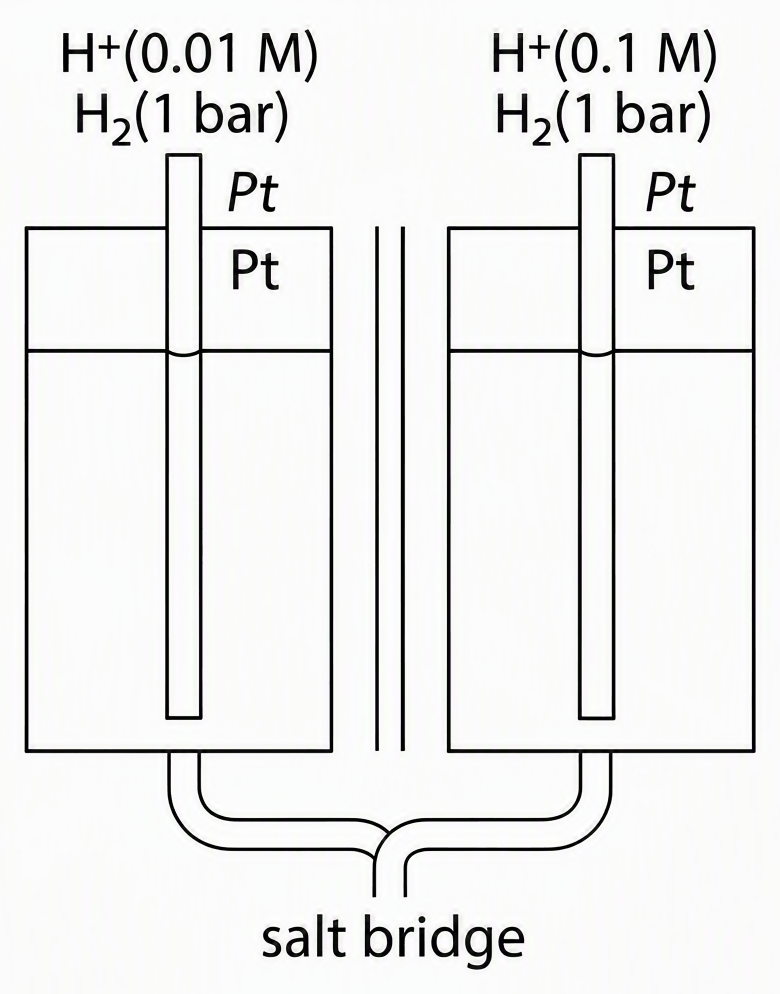
There is no net chemical change. Only H+ transfers from high to low concentration.
What is the official worked solution for the JEE Advanced 2022 entropy question?
B, C and D are correct. The official method starts from the relations ΔG = –nFE_cell and (∂ΔG/∂T)_P = –ΔS.
This yields
For A the half-reactions are M → M²⁺ + 2e⁻ and 2H⁺ + 2e⁻ → H₂, so n = 2. Given dE_cell/dT = R/F,
The statement claims ΔS = R, so A is incorrect.
For B the concentration cell has no significant ΔH. Spontaneity arises solely from increase in randomness as ions move down the concentration gradient, so B is correct.
For C one enantiomer converts to a 50:50 mixture. This increases the number of microstates, so ΔS > 0 and C is correct.
For D the reaction has 4 independent particles on the left and 7 on the right. The translational entropy gain explains the chelate effect, so ΔS > 0 and D is correct.
The official answer is B, C, D.
Why does option A trap students in the JEE Advanced 2022 entropy question?
Students treat the relation as ΔS = F(dE_cell/dT) instead of nF(dE_cell/dT). They forget to identify n = 2 from the balanced half-cell reactions M → M²⁺ + 2e– and 2H⁺ + 2e– → H2.
The arithmetic then gives ΔS = R instead of 2R. Writing the half-reactions first and counting electrons transferred removes the error.
How do you apply these concepts to related electrochemistry questions?
Working these tests exact use of ΔS = nF(dE/dT), entropy of mixing, and particle-count arguments for the chelate effect. You will compute ΔS correctly for any n and recognise entropy-driven cells on sight because the official relations are now fixed.
Question 1: Given dE/dT = –0.5 mV K⁻¹ for a cell with n = 1, calculate ΔS at 298 K.
Convert –0.5 mV K⁻¹ to –0.0005 V K⁻¹ and insert F = 96500 C mol⁻¹:
Question 2: Explain why dilution of a concentrated solution in a concentration cell is entropy-driven while a Daniell cell is usually enthalpy-driven.
A concentration cell has ΔH ≈ 0. The negative ΔG comes entirely from positive TΔS as the system moves toward uniform concentration.
A Daniell cell has large negative ΔH from the redox reaction. Enthalpy dominates.
Question 3: Predict the sign of ΔS for [Cu(H₂O)₄]²⁺ + 2 en → [Cu(en)₂]²⁺ + 4 H₂O and justify using particle count.
Reactants have 3 independent particles. Products have 5. The increase raises translational entropy, so ΔS > 0.
Search the past-paper archive for every JEE Advanced paper from 2007 by chapter to find more; each comes with a worked solution.
Which thermodynamic relations must you remember for entropy in JEE Advanced electrochemistry questions?
(∂ΔG/∂T)_P = –ΔS converts directly to ΔS = nF(dE_cell/dT). Determine n from balanced electron count.
Concentration cells have ΔH ≈ 0. Driving force is purely the TΔS term.
Chelate effect entropy contribution arises from increase in independent molecules (4 → 7 in the nickel–en reaction).
What quick revision checklist confirms understanding of entropy in electrochemical cells?
- n-factor must be taken from balanced electron transfer, not from stoichiometric coefficients alone.
- Racemisation always increases configurational entropy.
- For any concentration cell, entropy increases as the system heads toward uniform concentration.
If a similar doubt appears during revision, photograph the question to receive a step-by-step solution, with a free-body diagram when the question needs one (20 free).
Next step: photograph a doubt on JEEnius and photograph any question you are stuck on and get a step-by-step solution, with a free-body diagram when the question needs one (20 free).
For a worked example of the same idea, see The P-Block Elements JEE 2022: Why PbCl2 Dissolves in HCl.
Frequently asked questions
What is the correct answer for the JEE Advanced 2022 entropy question?
The correct options are B, C and D. Option A is incorrect because students miss that n=2 for the metal-acid cell reaction. The correct ΔS equals 2R when dE_cell/dT = R/F, not R.
Why is a hydrogen concentration cell an entropy-driven process?
In the hydrogen concentration cell there is no net chemical reaction and ΔH is approximately zero. Spontaneity comes solely from the positive ΔS generated as H+ ions move from higher to lower concentration, increasing randomness.
How do you calculate ΔS from dE_cell/dT for electrochemical cells?
Use the thermodynamic relation ΔS = nF(dE_cell/dT)_P derived from ΔG = –nFE_cell and (∂ΔG/∂T)_P = –ΔS. Always determine n by writing the balanced half-reactions and counting electrons transferred.
Why does the [Ni(H2O)6]2+ with en reaction have positive ΔS?
The reaction [Ni(H₂O)₆]²⁺ + 3 en → [Ni(en)₃]²⁺ + 6 H₂O increases the number of independent particles from 4 to 7. This raises translational entropy and explains the positive ΔS associated with the chelate effect.
What mistake do students make in the JEE Advanced 2022 entropy option A?
Most candidates forget to identify n=2 from the half-reactions M → M²⁺ + 2e⁻ and 2H⁺ + 2e⁻ → H₂. They incorrectly compute ΔS = R instead of the actual value 2R when dE_cell/dT = R/F.