What is the correct answer to the JEE Advanced 2018 match-list question?
The correct answer to the JEE Advanced 2018 Work, Energy and Power match-list question is option A. This is Question 18 from JEE Advanced 2018 Paper 2, Physics. It is in the hard difficulty tier, with an expected solving time of 240 seconds based on its difficulty classification.
The two constants are positive and dimensional, with the stated condition:
The force acting on the particle is either zero or conservative. The four paths are:
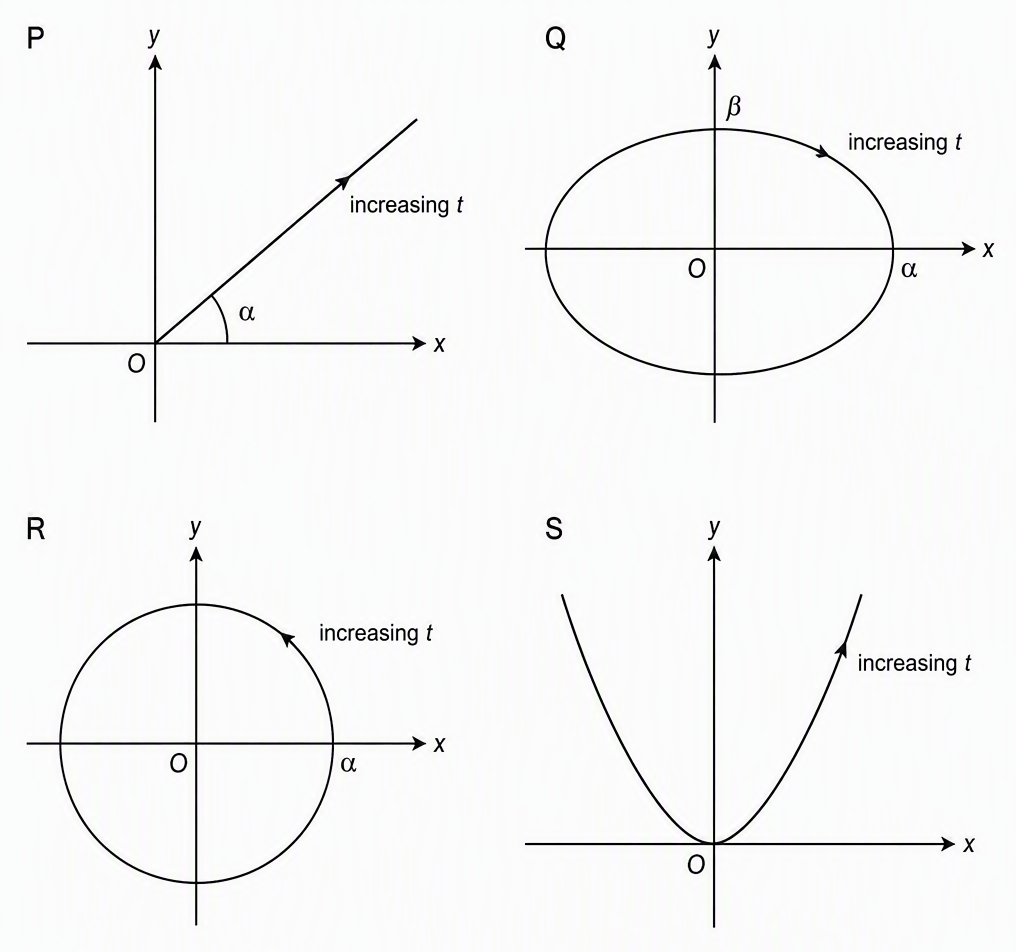
Each path must be matched with linear momentum, angular momentum about the origin, kinetic energy, potential energy and total mechanical energy:
The four answer mappings are:
Which conservation tests should be applied to every path?
Use one fixed mechanical audit for all four paths. Differentiate position to obtain velocity and acceleration, identify force and torque, test speed squared, find potential energy, and then check total energy. This order prevents confusion between constant speed and constant momentum, or between constant force and zero torque.
Apply the quantities in this order:
For constant mass, linear momentum is constant if and only if acceleration is zero:
Angular momentum about the origin is conserved only when torque about that origin is zero:
Kinetic energy depends on speed, not on the direction of velocity:
For the stated zero or conservative forces, total mechanical energy is conserved:
Conservation of total energy does not imply that kinetic and potential energies are separately constant.
How are paths P and Q solved completely?
Path P conserves all five listed quantities. Path Q conserves only angular momentum and total mechanical energy. These results follow from velocity, acceleration, torque and speed calculations. The straight-line and elliptical shapes alone are not enough to classify either motion.
Why does path P conserve all five quantities?
Path P has constant velocity and zero acceleration, so its force is zero and its linear momentum is conserved. Its speed is constant, while its position remains parallel to its velocity. These facts establish conservation of kinetic energy and angular momentum before potential and total energy are checked.
Differentiating gives:
Therefore:
Linear momentum is constant. Speed squared is also constant:
Hence kinetic energy is conserved. Since position is parallel to velocity:
Therefore:
Zero angular momentum is still constant. Zero force also permits potential energy to be taken as constant, so total energy is constant:
Why does the elliptical path Q not conserve kinetic energy?
Path Q has acceleration directed towards the origin, which makes its torque about the origin zero. Its angular momentum is therefore conserved. However, its speed depends on time because the two semi-axes are unequal. Its kinetic and potential energies vary separately while their sum remains constant.
Its velocity is:
Its acceleration is:
Therefore:
Since force is parallel to position:
Angular momentum about the origin is conserved. Speed squared is:
This varies because:
For a concrete check, take the constants as 2 and 3, with angular frequency 1. Speed squared changes from 9 at zero time to 4 after a quarter cycle.
The harmonic potential energy is:
Here:
Potential energy also varies because the two constants are unequal. However:
Thus total energy remains constant:
How are paths R and S solved completely?
Path R conserves angular momentum, kinetic energy, potential energy and total energy, but not vector momentum. Path S conserves only total energy. Constant speed settles the kinetic-energy test for R, while the time-dependent angular momentum and potential energy settle the tests for S.
Why is momentum not conserved in path R?
Path R is uniform circular motion about the origin. Its acceleration is central, so torque about the origin is zero and angular momentum is conserved. Its speed and distance from the origin are constant. Vector momentum is not conserved because its direction changes continuously.
For this path:
Therefore:
The torque about the origin is zero:
Speed squared and radial distance are constant:
Hence:
Both are constant, so total energy is constant. The direction of velocity changes continuously, so vector momentum is not conserved:
Why does path S conserve only total energy?
Path S has constant non-zero acceleration, so its vector momentum changes. Its speed and angular momentum also depend on time. The constant force has a time-dependent torque about the origin, while its potential energy cancels the changing part of kinetic energy.
Differentiating gives:
Momentum is not conserved. Speed squared is:
Therefore kinetic energy is not conserved. Angular momentum about the origin is:
Substituting the coordinates and velocity components:
Thus:
Angular momentum is not conserved. The force and corresponding potential energy are:
Using the vertical coordinate:
Kinetic energy is:
Therefore:
Only total energy is conserved:
The final matching is:
The correct answer is option A.
Why does option B fail?
Option B fails because it assigns kinetic-energy conservation to Q and angular-momentum conservation to S. Both assignments contradict direct calculation. Constant angular frequency does not give constant speed on an ellipse with unequal semi-axes, and constant force does not guarantee zero torque about the origin.
Option B assigns:
For Q, speed squared is:
This varies because:
Therefore Q does not conserve kinetic energy. It does conserve angular momentum because acceleration and force are parallel to position:
The elliptical shape does not invalidate the torque test.
For S, the force is constant, but its torque about the origin is not zero. Torque depends on the cross product of position and force, not merely on whether force is constant. The decisive result is:
Trajectories should never be matched by labels such as “ellipse”, “circle” or “constant force”. Derivatives and cross products decide the answer.
Which three related Work, Energy and Power questions should you practise?
These three questions test the same distinctions as the JEE Advanced 2018 Work, Energy and Power problem: separate conservation of kinetic and potential energy, constant speed versus constant vector momentum, and constant force versus zero torque. Check each answer from derivatives rather than the path’s name.
- For the motion below under the stated central harmonic force, when are kinetic and potential energies separately constant?
They are separately constant only when:
For all positive values of the semi-axes, force is parallel to position, so torque is zero. Angular momentum and total energy remain conserved for all positive values of the semi-axes.
- A particle follows:
under the constant force:
Which of linear momentum, angular momentum about the origin, kinetic energy and total energy are conserved?
For non-zero values of horizontal speed and acceleration, only total energy is conserved. Acceleration changes momentum, speed changes kinetic energy, and angular momentum varies with time.
- A particle moves uniformly in a circle centred at the origin under a central conservative force. Does constant kinetic energy imply constant momentum?
No. Speed is constant, but momentum changes direction. The central force gives zero torque, while the fixed radius gives constant potential energy. Angular momentum, kinetic energy, potential energy and total energy are constant.
For each follow-up problem, apply the same order:
Next step: photograph a doubt on JEEnius and photograph any question you are stuck on and get a step-by-step solution, with a free-body diagram when the question needs one (20 free).
Related on JEEnius: JEE Main Mock Test Analysis: A 7-Step Error Audit.
Frequently asked questions
What is the correct answer to the JEE Advanced 2018 Work, Energy and Power question?
The correct answer is option A. The matching is P → 1,2,3,4,5; Q → 2,5; R → 2,3,4,5; and S → 5.
Why is kinetic energy not conserved for path Q?
For the elliptical path Q, speed squared is ω²[α²sin²(ωt) + β²cos²(ωt)]. It varies with time because α ≠ β, so kinetic energy is not conserved. Angular momentum and total mechanical energy remain conserved.
Why is momentum not conserved in uniform circular motion?
Momentum is a vector, so changing its direction changes the momentum even when speed is constant. In path R, kinetic energy is constant, but the continuously rotating velocity means linear momentum is not conserved.
Why does path S conserve only total energy?
Path S has non-zero acceleration, time-dependent speed and time-dependent angular momentum. Its kinetic and potential energies vary by equal and opposite amounts. Their sum remains constant because the force is conservative.