
What was the bullet and pendulum problem asked in work, energy and power jee 2021?
The minimum value of v is 400 m/s. A 10 g bullet moving at unknown speed v strikes a stationary 1 kg pendulum bob. The bullet rebounds at exactly 100 m/s in the opposite direction. The string length is exactly 0.5 m, g = 10 m/s². This is the minimum v so that the bob describes a complete vertical circle.
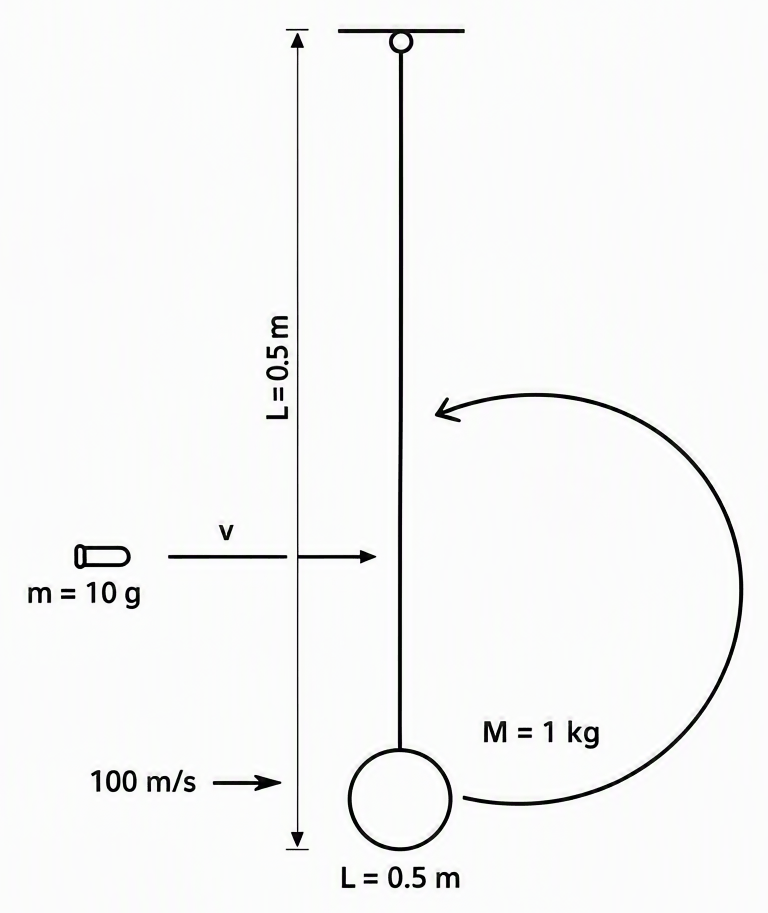
How do you solve the bullet pendulum collision from work, energy and power jee 2021 using official method?
Start with conservation of linear momentum. The bullet mass is 0.01 kg. Let V be the velocity of the bob just after collision.
This simplifies to
At the highest point tension is zero, so gravity supplies the centripetal force.
This gives
Mechanical energy is conserved from bottom to top. Height difference is exactly 2L.
Cancel M. Substitute . This simplifies to
With g = 10 and L = 0.5,
From the momentum equation,
The answer is 400 m/s.
What method mistake produces 200 m/s on this question?
One concrete slip replaces the correct height 2L with L and drops the kinetic energy term at the top. The wrong energy equation then reads
With the given numbers this yields so m/s. Substituting the wrong V into the momentum equation then gives v ≈ 216 m/s which rounds to the wrong option 200.
The mistake occurs because the bob is treated as needing only to reach the horizontal position at height L and arrive with zero speed. In reality the bob must reach the diametrically opposite top point at height 2L and still possess there so that the string stays taut.
The correct method always uses Δh = 2L plus the (1/2)M v_top² term with v_top² = gL. If the free-body diagram at the top still feels unclear, photograph a doubt for a step-by-step solution with the required diagram.
Why does the bob need exactly sqrt(5gL) speed at the bottom to complete the vertical circle?
Free-body analysis at the top shows tension equals zero at the limiting case. Only gravity supplies the centripetal acceleration.
This gives
Potential energy gain from bottom to top is 2MgL. The bob still carries
at the top. Total energy required at bottom is
This simplifies to
For L = 0.5 m and g = 10 the product 5gL equals 25 exactly, so sqrt(25) = 5 m/s. This condition is stricter than for a bead on a smooth wire or a rigid rod pendulum, where the constraint force can push inward at the top and the minimum bottom speed drops to sqrt(4 g R).
What two similar problems test the same ideas from work, energy and power?
Question 1: A 20 g bullet moving at 300 m/s strikes a 2 kg stationary bob of a 1 m pendulum and continues forward at 100 m/s; minimum speed of bob just after collision needed to complete the circle (g=10).
This requires momentum conservation first, then the bob must reach √(5gR) at the bottom.
Question 2: A particle of mass m is projected from the lowest point of a vertical circle of radius R with speed u; find the minimum u such that tension is zero at the highest point and compare the energy equation with the bullet case.
The answer is u = √(5gR) directly.
Solve both immediately while the algebra sequence is fresh.
What habits stop you from picking the wrong option in work, energy and power jee 2021 style questions?
- Always treat recoil as negative velocity in the momentum balance.
- For string pendulum completing circle, bottom speed must be exactly √(5 g L).
- Convert grams to kg before writing the momentum equation.
- Never apply energy conservation across the collision itself unless coefficient of restitution is given.
Use the past-paper archive to search every JEE Main paper from 2002 for similar collision-plus-vertical-circle questions with their worked solutions.
Next step: photograph a doubt on JEEnius and photograph any question you are stuck on and get a step-by-step solution, with a free-body diagram when the question needs one (20 free).
If that step was the hard part, work through Limit, Continuity and Differentiability JEE 2015 Official Solution.
Frequently asked questions
What was the bullet and pendulum problem in work energy and power JEE 2021?
A 10 g bullet strikes a 1 kg stationary pendulum bob and rebounds at 100 m/s. The minimum v for the bob to complete a vertical circle with 0.5 m string is 400 m/s. The solution uses conservation of momentum and mechanical energy.
Why is minimum speed at bottom sqrt(5gL) for a pendulum to complete vertical circle?
At the top, tension is zero and gravity provides the centripetal force, so v_top = sqrt(gL). The height gain is 2L, leading to total energy requirement of (1/2)mv^2 = mg(2L) + (1/2)m(gL), which simplifies to v = sqrt(5gL).
What mistake gives 200 m/s in the JEE 2021 pendulum problem?
The common mistake is using height L instead of 2L and ignoring the kinetic energy at the top. This leads to V = sqrt(2gL) ≈ 3.16 m/s and then v ≈ 216 m/s which is close to the wrong option of 200 m/s.
How to solve bullet pendulum problem from JEE 2021?
Apply conservation of linear momentum to relate bullet speed v and bob speed V after collision. Then use conservation of energy from bottom to top of circle with v_top = sqrt(gL) to get V = sqrt(5gL) = 5 m/s. Solve for v = 400 m/s.