What was the exact multi-correct question on the set S in JEE Advanced 2020?
The correct options are B and C. S is the set of all complex z satisfying |z² + z + 1| = 1. The four statements tested one upper bound on |z|, one upper bound on |z + 1/2|, the opposite lower bound on |z + 1/2|, and the claim that S contains exactly four elements. Only |z| ≤ 2 for all z in S and |z + 1/2| ≥ 1/2 for all z in S hold true.
The question required students to decide which statements must be true without solving for every point in S.
How does the locus of |z² + z + 1| = 1 appear in the Argand plane?
The locus is a continuous closed curve symmetric about the real axis, not four isolated points. The curve lies outside |z + 1/2| = 1/2 and inside |z| = 2.
Shift variables by setting w = z + 1/2. The original condition then becomes |w² + 3/4| = 1.
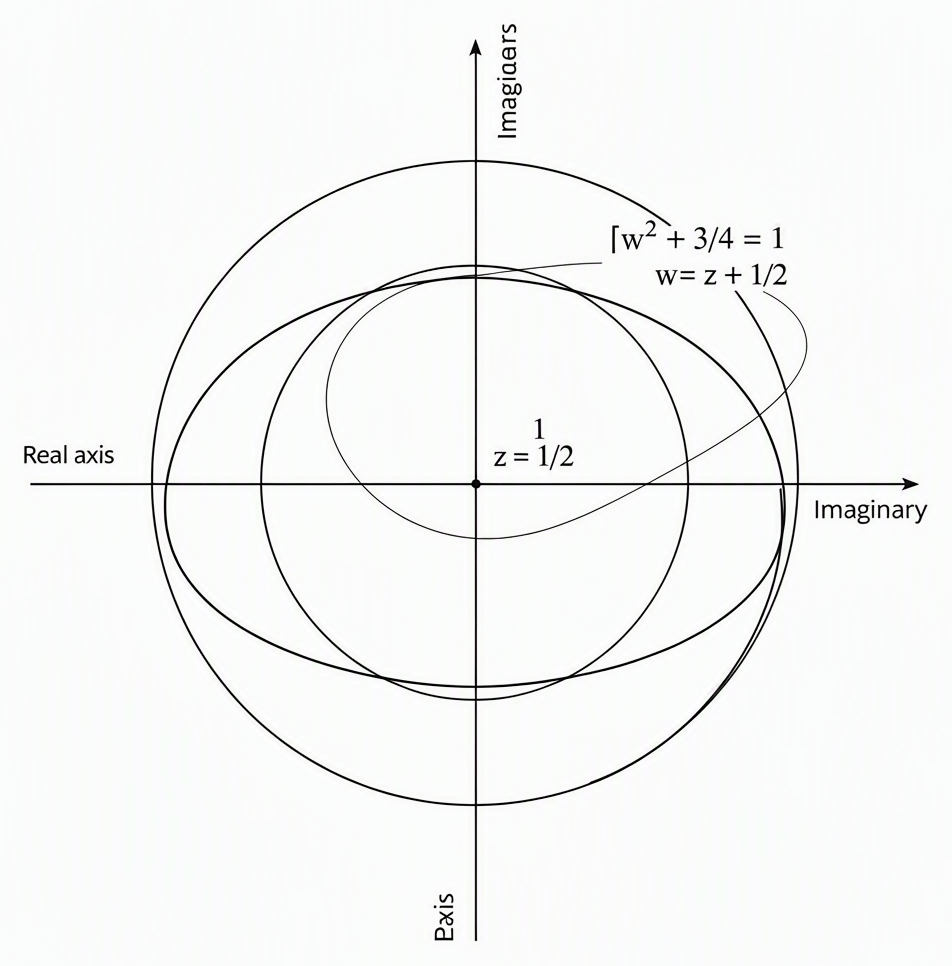
This picture rules out any claim of exactly four points and shows why |z + 1/2| cannot stay below 1/2.
What does the official solution prove for options B and C?
The official solution proves B with |z| ≤ 2 via reverse triangle inequality and C with |z + 1/2| ≥ 1/2 via contradiction after completing the square.
Start with
Since |z² + z + 1| = 1, which rearranges to
Factorisation gives (|z| − 2)(|z| + 1) ≤ 0. Because |z| + 1 > 0, it follows that |z| ≤ 2. This establishes B exactly.
Complete the square first:
Let w = z + 1/2 so the condition becomes
Assume for contradiction that |w| < 1/2. Then |w²| < 1/4. Using the triangle inequality,
This contradicts the equality to 1, so |w| ≥ 1/2. Substituting back yields |z + 1/2| ≥ 1/2, proving C.
Numerical verification uses z = -1/2 + i√7/2. Then z + 1/2 = i√7/2, so |z + 1/2| = √7/2 ≈ 1.32 which is greater than 1/2. Direct substitution confirms the modulus is exactly 1, placing the point in S.
What algebraic slip produces the incorrect choice of option A?
Treating the completed-square form as |w² + 3/4| ≥ 3/4 − |w²| and then incorrectly concluding a lower bound |w| ≤ 1/2 is possible reverses the logic of the inequality. Students making this error fail to test the assumption |w| < 1/2 inside the triangle inequality in the forward direction, which immediately yields the strict contradiction.
The counter-example z = -1/2 + i√7/2 gives |z + 1/2| = √7/2 ≈ 1.32 > 1/2 while still satisfying the original modulus equation, exposing why A cannot hold.
Why does option D fail for the set S?
Option D fails because the equation defines a continuous curve with infinitely many points, not exactly four isolated solutions. Set w = r e^{iθ} into |w² + 3/4| = 1 and square both sides.
This produces
which simplifies to the quartic
Treat it as quadratic in r². For continuously many θ ∈ [0, 2π) the discriminant allows positive real r², hence infinitely many distinct z on the curve.
What two related practice questions test the same modulus techniques?
Related question 1: Let T = {z : |z² - z + 1| = 2}. Prove that |z| ≤ 3 for all z ∈ T using reverse triangle inequality and solve the resulting quadratic inequality in |z|.
Apply |z² − z + 1| ≥ |z|² − |z| − 1. Set equal to 2 to obtain |z|² − |z| − 3 ≤ 0. Factorisation gives (|z| − 3)(|z| + 1) ≤ 0, so |z| ≤ 3 exactly as required.
Related question 2: For |w² + 1| = 2 where w = z + i, show by contradiction that |w| cannot be less than √(2 − 1) and give one explicit point on the locus with |w| > 1.
Assume |w| < 1. Then |w²| < 1, so |w² + 1| ≤ |w²| + 1 < 2, contradicting equality to 2. Hence |w| ≥ 1. One explicit point is w = i√3: w² = −3, |−3 + 1| = 2 and |w| = √3 > 1.
Both reuse the exact completion-of-square plus contradiction pattern used for option C. Question 2 mirrors the official shift and forward-triangle test. Question 1 shows the reverse-triangle step produces an upper bound without needing contradiction.
What techniques separate full marks from partial attempts on JEE Advanced modulus problems?
Reverse triangle inequality is mandatory for upper bounds on |z|; forward triangle gives only the contradiction direction for lower bounds. Completing the square before substitution converts the quadratic modulus into a form where |a| − |b| < 1 immediately yields contradiction. Polar form after substitution is the fastest way to prove a locus contains infinitely many points rather than solving the biquadratic algebraically.
Start your next similar problem by writing the reverse triangle inequality for the upper bound, then shift and contradict for any claimed lower bound. Search the past-paper archive for every JEE Advanced complex-number locus question since 2007 to practise the pattern immediately.
Next step: photograph a doubt on JEEnius and photograph any question you are stuck on and get a step-by-step solution, with a free-body diagram when the question needs one (20 free).
Keep going with Kinetic Theory of Gases JEE 2017: Moving Plate in Rarefied Gas.
Frequently asked questions
What were the correct options for set S in JEE Advanced 2020 complex numbers question?
The correct options are B and C. B is |z| ≤ 2 for all z in S. C is |z + 1/2| ≥ 1/2 for all z in S. These hold by reverse triangle inequality for the upper bound on |z| and contradiction after completing the square for the lower bound on |z + 1/2|.
What is the locus of |z² + z + 1| = 1 in the Argand plane?
The locus is a continuous closed curve symmetric about the real axis, not four isolated points. Shifting by w = z + 1/2 converts it to |w² + 3/4| = 1. The curve lies entirely outside the circle |z + 1/2| = 1/2 and inside |z| = 2.
How to prove |z| ≤ 2 for |z² + z + 1| = 1 in JEE Advanced 2020?
Apply reverse triangle inequality: |z² + z + 1| ≥ |z|² - |z| - 1. Given equality to 1, this yields |z|² - |z| - 2 ≤ 0. Factoring gives (|z| - 2)(|z| + 1) ≤ 0. Since |z| + 1 > 0, it follows that |z| ≤ 2.
Why is |z + 1/2| ≥ 1/2 true for the JEE 2020 quadratic complex number equation?
Complete the square: z² + z + 1 = (z + 1/2)² + 3/4. Let w = z + 1/2 so |w² + 3/4| = 1. Assume |w| < 1/2 for contradiction. Then |w²| < 1/4 and |w² + 3/4| < 1 by triangle inequality, contradicting the given equality. Hence |z + 1/2| ≥ 1/2.
Does |z² + z + 1| = 1 have exactly four solutions in JEE Advanced 2020?
No. The equation represents a continuous closed curve with infinitely many points, not four isolated elements. Substituting w = r e^{iθ} and solving the resulting equation in r² for θ ∈ [0, 2π) yields positive real solutions for continuously many angles.