What setup did the 2017 JEE Advanced question use for a plate moving in rarefied gas?
A flat plate moves perpendicular to its own plane under constant force F through gas at very low pressure with plate speed v much smaller than molecular average speed u. This multi-correct question from Advanced Paper 1 has correct choices A, B and D.
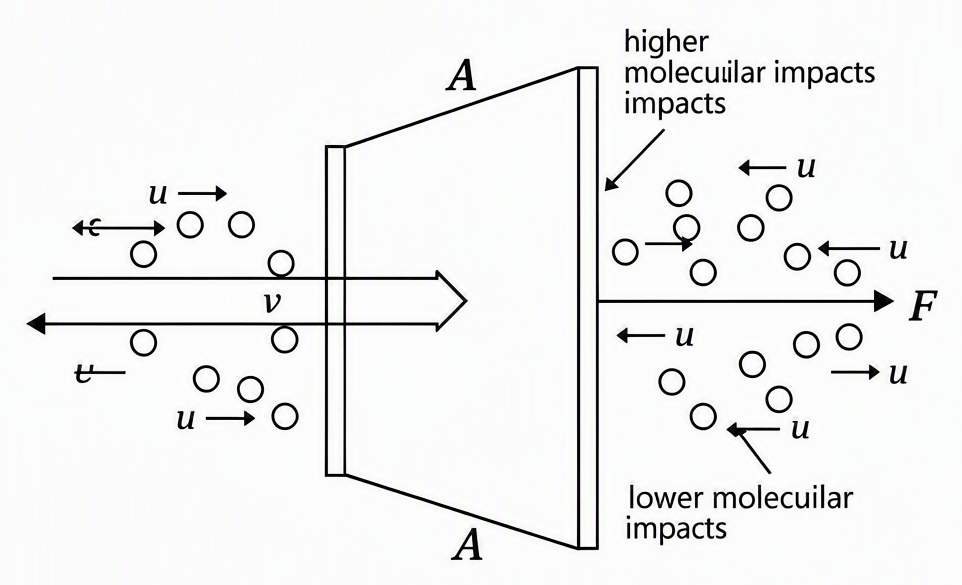
How does the official solution derive the answers for the kinetic theory of gases JEE 2017 question?
Intermolecular collisions are negligible. Drag arises solely from the difference in molecular impacts on the leading and trailing faces.
In the plate frame, relative normal speeds are approximately u+v on front and u-v on back (v ≪ u).
Pressure on each face is proportional to (relative speed)^2 because both collision rate and momentum transfer per collision scale with relative speed.
Thus
Subtract:
The pressure difference ΔP is therefore proportional to uv. This confirms option B.
Resistive force equals ΔP times plate area A. With u fixed and A constant, resistive force is proportional to v. This confirms option A.
The equation of motion is
Initial acceleration is F/M when v=0. As v grows, acceleration decreases so it is not constant. Option C is false.
The plate reaches terminal speed v_t when F = k v_t. The external force balances the resistive force. This confirms option D.
Why do students mark the wrong option in this kinetic theory of gases JEE 2017 problem?
Students treat net force as permanently equal to the constant F and therefore write a = F/M at all times. They fail to write the resistive term kv that grows with velocity and neglect to analyse the differential equation for long-time behaviour.
The consequence is that they conclude acceleration remains constant and non-zero forever and select C.
The error is procedural: write the resistive force explicitly as soon as proportionality to v is established, then examine the limiting behaviour of the first-order differential equation.
What concepts from rarefied-gas drag carry over to other kinetic theory of gases questions?
At very low pressure only molecule-plate collisions matter; intermolecular mean free path is large.
For v ≪ u the pressure difference is linear in v because the quadratic terms cancel leaving only the cross term 4uv.
Linear drag coefficient k leads to exponential approach to terminal velocity even though external force is constant.
Stokes drag is also linear in v at low Reynolds number, but the microscopic origin here is purely kinetic.
What practice questions test the same ideas at similar difficulty?
Question 1: A container with a movable piston has gas at low pressure; the piston is pulled at constant small speed v; find the pressure difference across the piston.
The same (u+v)^2 – (u-v)^2 reasoning applies and the difference is proportional to 4uv.
Question 2: In a rarefied gas a small sphere moves with velocity v ≪ u; show that the viscous drag is proportional to v and to the average molecular speed u.
Question 3: If the plate in the 2017 question has mass M = 0.1 kg, F = 10 N and reaches terminal speed 2 m/s, find the value of the drag coefficient k.
At terminal speed acceleration is zero, so
Unit is kg s^{-1}.
How does the 2017 kinetic theory of gases question fit into broader JEE Advanced preparation?
This belongs to the hard band (tag 4) of Kinetic Theory. Similar difficulty appears in other years under pressure due to moving walls or effusion.
Use the past-paper archive to locate every Kinetic Theory question from 2007 onward, each with its worked solution. For any doubt in a printed problem, photograph it and receive a step-by-step solution with a free-body diagram when the question needs one.
The variable-force differential equation reappears in other chapters. Expect the same approach to work in the linked article Gravitation JEE 2025: Mass Transfer and Orbital Expansion where mass changes with time.
Frequently asked questions
What are the correct options in kinetic theory of gases JEE 2017?
Options A, B and D are correct. Resistive force is proportional to velocity because pressure difference simplifies to a term linear in v. The plate reaches terminal speed when external force balances drag. Option C is incorrect as acceleration decreases with increasing v.
How is pressure difference derived in the 2017 JEE advanced kinetic theory question?
In the plate frame relative molecular speeds are u+v on the front face and u-v on the back. Pressure scales with the square of relative speed on each face. Subtracting (u+v)^2 - (u-v)^2 yields 4uv. For v much smaller than u this means ΔP is proportional to uv.
Why is acceleration not constant in the kinetic theory of gases jee 2017 problem?
Net force on the plate is F minus the resistive term kv. As velocity rises the opposing force grows. This makes dv/dt decrease continuously. At long times acceleration reaches zero when the plate attains terminal velocity.
Why do students get the kinetic theory of gases jee 2017 question wrong?
Students assume net force remains equal to the constant F at all times. They forget to include the velocity-dependent resistive force kv in the equation of motion. Consequently they conclude acceleration is always F/M. The correct approach requires writing and analysing the differential equation M dv/dt = F - kv.