
What was the 2015 JEE Advanced common tangent question for two ellipses?
There exist two axis-aligned ellipses E1 and E2 that share the straight line x + y = 3 as a common tangent. The task requires finding the product of their eccentricities e1 e2 together with the sum of the squares of their eccentricities.
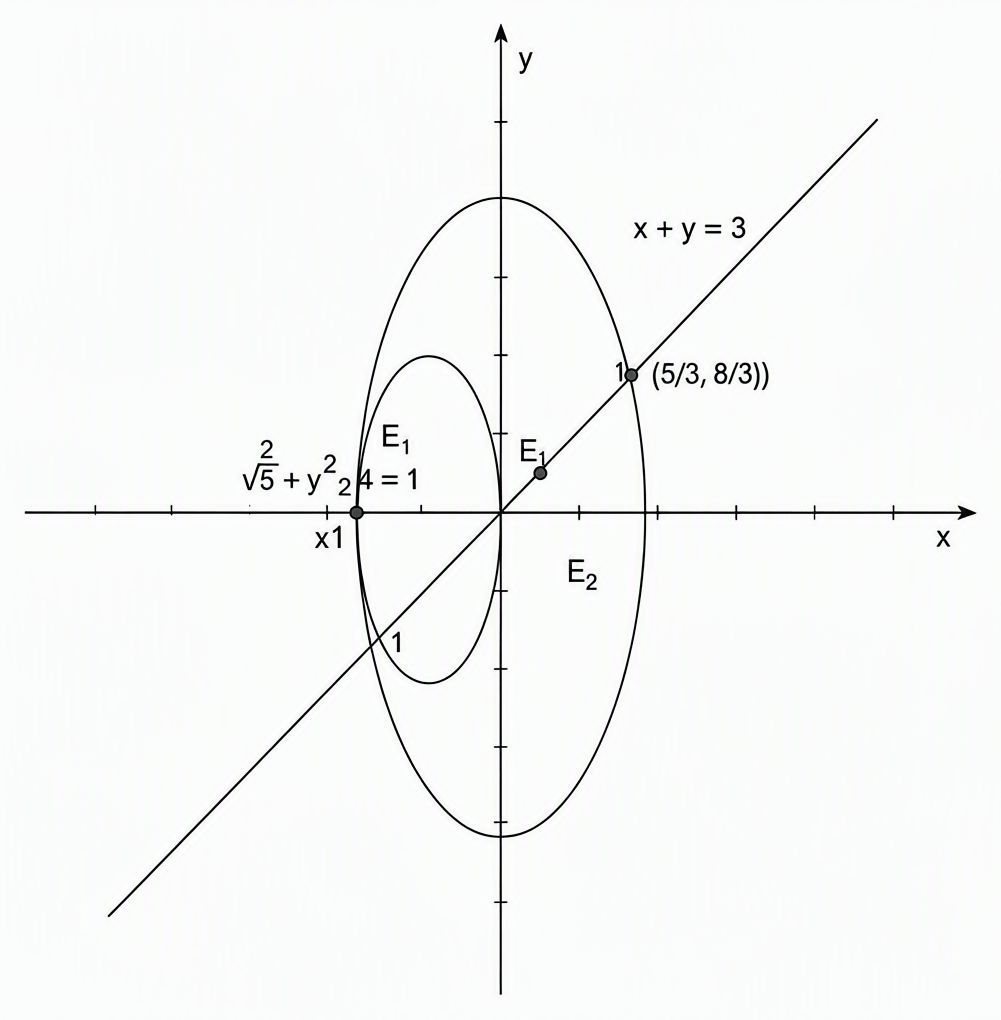
The official method uses direct coefficient comparison after rewriting the tangent in intercept form.
How does the official 2015 solution derive the eccentricities using coefficient matching?
Rewrite the tangent x + y = 3 as x/3 + y/3 = 1.
For E1 given by the tangent at (x1, y1) is , so equating coefficients yields x1 = a²/3 and y1 = b²/3.
Comparison of the contact point with the given geometric condition produces a² = 5 and b² = 4.
.
For E2 given by the same coefficient comparison yields A² = 1 and B² = 8.
.
.
.
Why does swapping the major axis for the second ellipse produce a wrong option in this 2015 question?
Treating the second ellipse as having its major axis along x instead of correctly identifying B² = 8 as the larger denominator along y leads to the exact error. Substituting the swapped semi-axis squares into the eccentricity formula yields e2² = 1 − 8/1 instead of 1 − 1/8, which then produces an erroneous value for e1² + e2² that matches one of the distractor options in the multi-correct format.
The official comparison avoids this by checking the actual denominators against the coordinate axes before writing the eccentricity formula.
The contact point must satisfy both the tangent equation and the ellipse equation simultaneously. Skipping this explicit label step is the precise procedural flaw that invalidates an option even when the first ellipse is handled correctly.
Which ellipse tangent and eccentricity formulas matter most for this problem?
- Tangent at (x1, y1) on is .
- After normalising any tangent line lx + my = 1, direct coefficient comparison immediately supplies the contact point without solving simultaneous equations.
- Eccentricity is always 1 − (smaller semi-axis square / larger semi-axis square); orientation of each ellipse must be checked separately.
- The contact point must satisfy both the tangent equation and the ellipse equation simultaneously.
Keep these four lines on a single sheet.
What similar JEE-level ellipse tangent questions can you solve with the same method?
Find the condition on m such that y = mx + c is tangent to and compute the corresponding eccentricity if the ellipse is confocal with another given ellipse.
For the ellipse , find the equation of the tangent at the point whose eccentric angle is π/4 and show that it passes through a given external point.
JEE Advanced 2018-style multi-correct: two concentric ellipses share a common tangent of slope 1; options involve possible values of e1² − e2² and the product a1 a2.
Search the past-paper archive for every JEE Advanced paper from 2007 by chapter to find the full set of official solutions and practise these patterns.
How do you convert this 2015 solution into a template for coordinate geometry questions in future JEE Advanced mocks?
Always begin by writing the tangent in intercept form divided by the constant term before comparing coefficients.
Explicitly label which denominator belongs to x and which to y for each ellipse before writing the eccentricity formula. Cross-check that the derived (x1, y1) actually lies on the ellipse to avoid the method mistake illustrated earlier.
Maintain a one-page formula sheet containing only the coefficient-matching step and the two eccentricity expressions for quick recall under time pressure. Run this sequence on any common-tangent ellipse pair and you can expect to select the correct combination, since it follows the official coefficient-matching method that isolates the substitution error.
If you get stuck, photograph a doubt to get a step-by-step solution with a free-body diagram when the question needs one.
Next step: photograph a doubt on JEEnius and photograph any question you are stuck on and get a step-by-step solution, with a free-body diagram when the question needs one (20 free).
For a worked example of the same idea, see Laws of Motion JEE 2022: Hard Projectile Momentum Vector.
Frequently asked questions
What was the 2015 JEE Advanced common tangent question for two ellipses?
There are two axis-aligned ellipses sharing x + y = 3 as a common tangent. The question asks for the product of their eccentricities and the sum of the squares of their eccentricities.
How does coefficient matching work for ellipse tangents in JEE?
Rewrite the tangent line in intercept form x/3 + y/3 = 1. Compare with the standard tangent equation at the point of contact to get the coordinates in terms of a² and b². Substitute into the ellipse equation to solve for the semi-axes.
Why does swapping the major axis give wrong answer in 2015 JEE ellipse question?
For the second ellipse x²/1 + y²/8 = 1, 8 is the larger denominator along y. Thus e2² = 1 - 1/8 = 7/8. Treating 8 as along x gives the wrong e2² = 1 - 8/1, which matches a distractor option in the multi-correct question.
What are the values of e1e2 and e1² + e2² for the 2015 JEE ellipse problem?
The calculations give e1² = 1/5 and e2² = 7/8. Therefore the product e1 e2 equals √(7/40) and the sum e1² + e2² equals 43/40.
How to avoid mistakes in coordinate geometry ellipse tangent JEE questions?
Always label which denominator belongs to x and which to y before writing the eccentricity formula. Verify that the derived contact point satisfies both the tangent and the ellipse equation. Maintain a one-page sheet with the coefficient-matching steps.