
Which option is correct in the electrostatics JEE 2019 spherical-shell question?
Option C is correct in this electrostatics JEE 2019 question: subtract the missing patch’s potential from the complete shell’s potential. This is a JEE Advanced 2019, Paper 1, Physics single-correct MCQ. The question bank classifies it as medium and gives an expected solving time of 180 seconds, not an official exam allowance.
A thin insulating spherical shell initially carries uniform surface charge. Its radius, original surface potential and removed patch area are specified below. Removing the small patch leaves the remaining charge distribution unchanged.
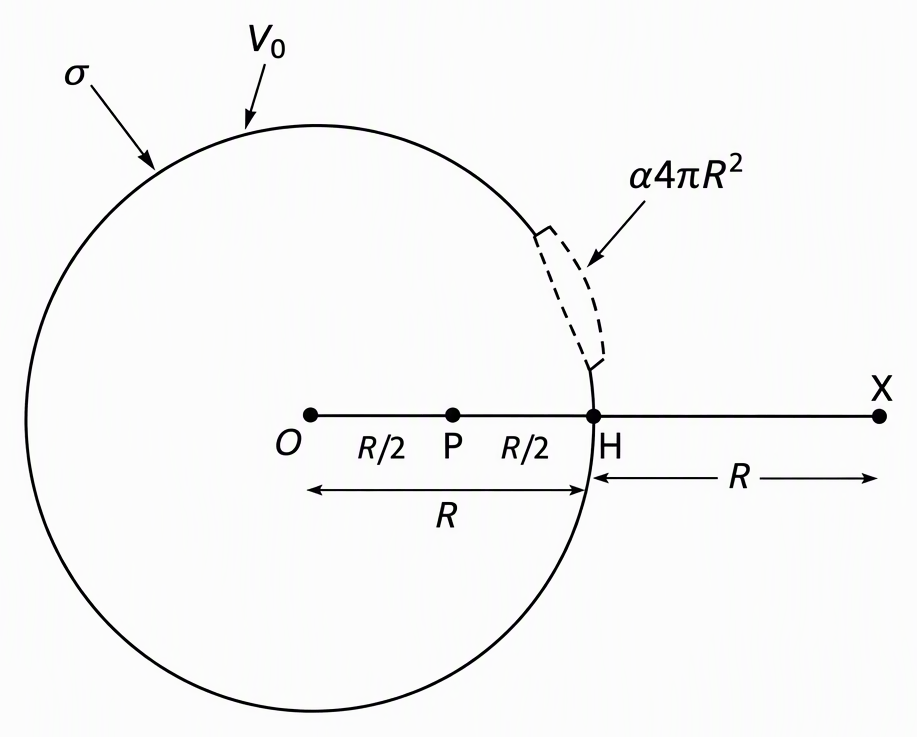
The four alternatives claim:
- A: At the exterior axial point X, the field magnitude decreases by
- B: At the centre O, the field magnitude decreases by
- C: The centre-to-halfway potential ratio is
- D: The centre potential decreases by
How do you express the removed charge using the original surface potential?
The removed charge is the same fraction of the original charge as the hole’s area is of the shell’s area. Expressing it through the given surface potential removes the unknown charge from the final ratio.
Define the original uniform surface charge density and total charge:
For the complete shell,
The removed charge is
Substitution shows the cancellation:
The official method approximates the small removed patch as a point charge at H. This is justified by the small area fraction and because the observation points are well away from the patch.
Superposition means intact-shell potential minus the removed positive patch’s contribution. It does not mean that an actual negative charge was added.
What is the potential at the centre after removing the patch?
The centre potential falls by the removed charge’s contribution at one shell radius. This result is exact for the stated removed charge: every element of the patch is the same distance from O, so no point-patch approximation is needed here.
Taking zero potential at infinity, the complete uniform shell contributes its original surface potential at every interior point. At O, the patch originally contributed
Therefore,
Do not extend the complete shell’s symmetry to the perforated shell. Constant interior potential belongs to the complete uniform shell, not automatically to what remains after removing charge.
How does the halfway-point potential give option C?
The halfway point loses approximately twice as much potential as the centre because it is half as far from the missing patch. The intact-shell contribution stays unchanged; only the subtracted contribution changes.
From the labelled geometry,
The relevant distance is from the observation point to the missing patch, not to the shell’s centre. Those two distances happen to be equal here.
Using the small-patch approximation,
Hence,
and
The official answer is C. Its expression uses the small-hole approximation; it is not an exact finite-hole result at P.
The ratio is dimensionless. It also approaches the intact-shell value as the removed area approaches zero:
For a numerical check, use these illustrative values, not extra exam data. Substitution gives:
Why does using the wrong distance produce option D?
Option D comes from using the halfway-point distance while calculating the centre potential. That substitution doubles the removed contribution, but it belongs to P, not O. Every removed charge element is one shell radius from O.
The incorrect centre calculation is
This reproduces D. The correct reductions are
Use this fix every time:
- Name the observation point.
- Find its distance to the missing patch.
- Only then substitute into the patch-potential formula.
Potential uses the first power of distance in the denominator. Point-charge field magnitude uses the square.
How do you apply the method to three related electrostatics questions?
Keep the intact-shell contribution and subtract the patch’s contribution at the new observation point. These are original practice variations, not additional JEE 2019 questions or verified PYQs. Try each subtraction before reading its worked answer.
- Find the potential one-third of a radius from O towards H.
The patch is two-thirds of a radius away. Subtract its potential from the intact shell’s interior potential:
- Find the potential half a radius from O directly away from H.
Now the distances add. The reduction is smaller than at the towards-hole halfway point because the missing patch is farther away:
- Find the electric field at O after removing the patch.
The complete shell’s field is zero. Subtract the patch’s field as a vector:
For positive original potential, the positive patch’s field at O points away from the hole. Removing it leaves a field towards the hole. Write that direction before calculating the magnitude.
Next step: the past-paper archive on JEEnius and search every JEE Main paper from 2002 and every Advanced paper from 2007, by year, subject or chapter, each with a worked solution (free).
For a worked example of the same idea, see How to Study Hydrocarbons JEE: Reactions and Practice.
Frequently asked questions
Which option is correct in the JEE Advanced 2019 spherical-shell question?
Option C is correct: the centre-to-halfway potential ratio is approximately (1 − α)/(1 − 2α), where α is the fraction of the shell's area removed. Subtract the missing patch's potential from the complete shell's potential at each point. The ratio uses the small-hole approximation.
Why can the removed patch be treated as a point charge?
The removed patch can be approximated as a point charge because its area fraction is very small and the observation points are well away from it. Its charge is q = αQ, where Q is the original shell charge and α is the removed area fraction. At the centre, its potential contribution is exact without this approximation because every patch element is one radius away.
Why is option D wrong in the spherical-shell question?
Option D incorrectly gives the centre's potential reduction as 2αV₀, where V₀ is the original surface potential and α is the removed area fraction. Every removed charge element is at distance R from the centre, so the actual reduction is αV₀. The reduction 2αV₀ applies approximately at the halfway point towards the hole, whose distance from the patch is R/2.
What is the electric field at the centre after removing a small charged patch?
For a uniformly charged insulating shell of radius R and original surface potential V₀, removing a small area fraction α leaves a centre field of magnitude approximately α|V₀|/R. This follows by subtracting the patch's field from the complete shell's zero interior field. For positive original charge, the remaining field points towards the hole.