What was the JEE Main 2024 gravitation question on maximising total fall time after elastic impact?
The ratio h/H that maximises total time to ground equals 1/2. A body dropped from rest at height H falls vertically, strikes an inclined plane located at height h above ground, undergoes perfectly elastic collision that makes its velocity purely horizontal, and we must find the ratio h/H that maximises the total time until it reaches the ground.
The official route uses basic kinematics plus single-variable calculus on the total-time expression. Once set up correctly the maximum sits at k = 1/2 with second-derivative confirmation.
How does the geometric setup look for this gravitation JEE 2024 elastic-bounce problem?
For the vertical incident velocity to become exactly horizontal after perfectly elastic impact the plane must be at 45°. The setup has a body released from rest at total height H that falls straight down and strikes a plane inclined at 45° whose lowest edge meets ground. The plane sits at vertical height h above ground.
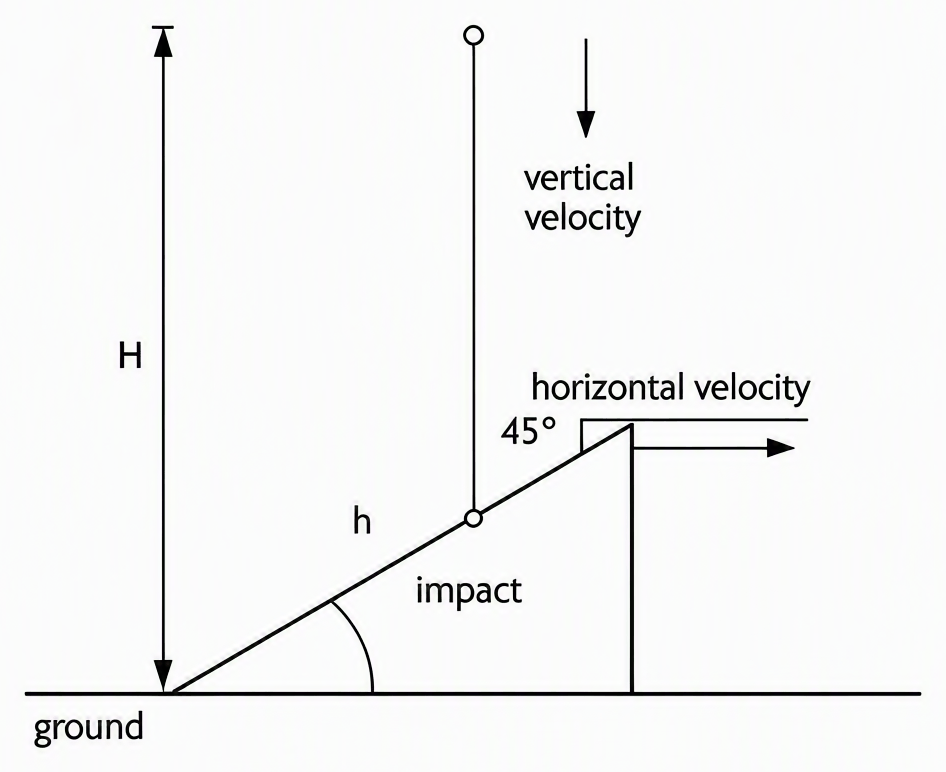
The 45° condition follows directly from reflection. The normal to the plane bisects the 90° turn from vertical to horizontal. Any other angle leaves a non-zero vertical component after collision.
What is the official step-by-step solution for the JEE Main 2024 gravitation time-maximisation MCQ?
Distance fallen before impact = H – h, so
.
Impact speed
.
After elastic impact velocity is horizontal with zero initial vertical component, therefore
.
Total time
.
Substitute k = h/H (0 < k < 1) and maximise
.
Differentiate:
implies
,
hence k = 1/2.
The second derivative confirms a maximum, therefore h/H = 0.5 (option B). Every step follows free-fall equations under constant g with the post-collision vertical velocity reset to zero.
Why do students reach 3/4 instead of 1/2 in this gravitation jee 2024 question?
Students treat the problem as identical to the standard maximum-range-down-an-incline projectile exercise whose optimum height ratio is 3/4. That exercise maximises horizontal distance along a slope by varying launch angle or height. The time function and constraint differ completely from pure vertical fall plus elastic redirection.
Some perform incorrect differentiation or algebraic rearrangement of the total-time expression that artificially yields k = 3/4 instead of setting the two square-root terms equal. The error is cross-contamination. Kinematic fall times scale with square root of height while range formulas mix sine and cosine terms. Setting is the only correct stationarity condition here.
You can search every JEE Main paper from 2002 and every Advanced paper from 2007, by year, subject or chapter, each with a worked solution (free) to locate every elastic-collision or variable-g variant.
What related practice questions from gravitation test the same method?
A particle is dropped from height 4R above Earth’s surface (R = radius); find the fraction of total fall time spent between 2R and R above surface (use g variation).
A ball falls vertically on a smooth 30° wedge that is free to move on horizontal floor; after elastic collision find ratio of times of descent for maximum total time to ground.
Body projected horizontally from height h above an inclined plane; for what inclination will time of flight be maximum before second collision.
These questions test the same habits: constraint from collision or gravity variation, single-variable optimisation, and refusal to import formulas from unrelated geometries. Compare your time function against the official method shown above.
How should I approach optimisation problems in JEE Main gravitation involving elastic bounce and time maximisation?
Always convert the collision condition into a constraint on the incline angle before writing time expressions. Here the 45° requirement simplified the post-impact vertical velocity to zero.
Express total time in a single dimensionless variable k and apply standard single-variable calculus; second-derivative test is sufficient. Keep kinematic quantities (√(height)) separate from projectile-range formulas to avoid cross-contamination of standard results.
Expect similar variants in 2025–2026 attempts. Write t(k), differentiate once, set to zero, solve for k, then check the sign of the second derivative. This two-stage template based on the 2024 official solution finishes the question inside 90 seconds. Photograph any doubt you are stuck on and get a step-by-step solution, with a free-body diagram when the question needs one (20 free).
Next step: photograph a doubt on JEEnius and photograph any question you are stuck on and get a step-by-step solution, with a free-body diagram when the question needs one (20 free).
Read next: Electric Field JEE 2024 Numerical: Sheet and Line Charge.
Frequently asked questions
What h/H ratio maximises total time in the gravitation JEE 2024 question?
The ratio is 1/2. After substituting k = h/H, the total time is proportional to sqrt(1-k) + sqrt(k). Differentiating and setting the derivative to zero yields sqrt(k) = sqrt(1-k), so k = 1/2. The second derivative test confirms this is a maximum.
Why do students get 3/4 in the gravitation JEE 2024 elastic impact problem?
Students often confuse this with the classic problem of maximising range down an incline, which has an optimal ratio of 3/4. However, here we are maximising time for vertical fall plus horizontal projection after elastic collision, leading to a different condition that gives 1/2.
What is the incline angle for the JEE 2024 gravitation problem with elastic collision?
The plane is inclined at 45 degrees. Only this angle converts the purely vertical incident velocity into purely horizontal velocity after a perfectly elastic collision, as the normal bisects the 90 degree angle change.
How do you solve optimisation problems in gravitation JEE like the time maximisation one?
Express the total time in terms of a single variable k = h/H. Differentiate with respect to k, set the first derivative to zero to find critical points, and use the second derivative test to confirm whether it is a maximum. Always derive the constraint from the collision condition first.