What was the mixed mathematics JEE 2015 matrix-match question in JEE Advanced?
The correct matching for this mixed mathematics JEE 2015 question is (A)→P,R,S; (B)→P; (C)→P,Q; (D)→S,T. It presents four independent situations (A) to (D) each requiring matching of possible numerical values from Column II.
(A) uses the triangle side-angle relation and defines , then asks for possible integer values of that satisfy .
(B) supplies a trigonometric equation in angles and and asks for possible ratios .
(C) supplies the position vectors of points , and with respect to origin and requires the distance of from the acute-angle bisector of and to equal , then asks for possible values of .
(D) defines as the area bounded by , , and the piecewise linear function for and , then asks for the values taken by .
How do you solve the 2015 mixed mathematics JEE question using the official method?
For (A), apply the sine rule so sides are proportional to sines: , , . Substitute into the given side relation:
Cancel :
Replace the difference of squares with the identity . In a triangle , so . This simplifies to:
Divide by (non-zero):
Thus and the equation becomes . This holds only for odd integers . From the options the matches are therefore 1, 3 and 5, so (A) matches P, R, S.
For (B), start with the given equation . Replace by . Use double-angle substitutions to reach the quadratic . The positivity argument on sines in a triangle yields , so (B) matches P.
For (C), the position vectors are , and . Vector makes with the positive x-axis and makes , so the acute-angle bisector is the line at , which is .
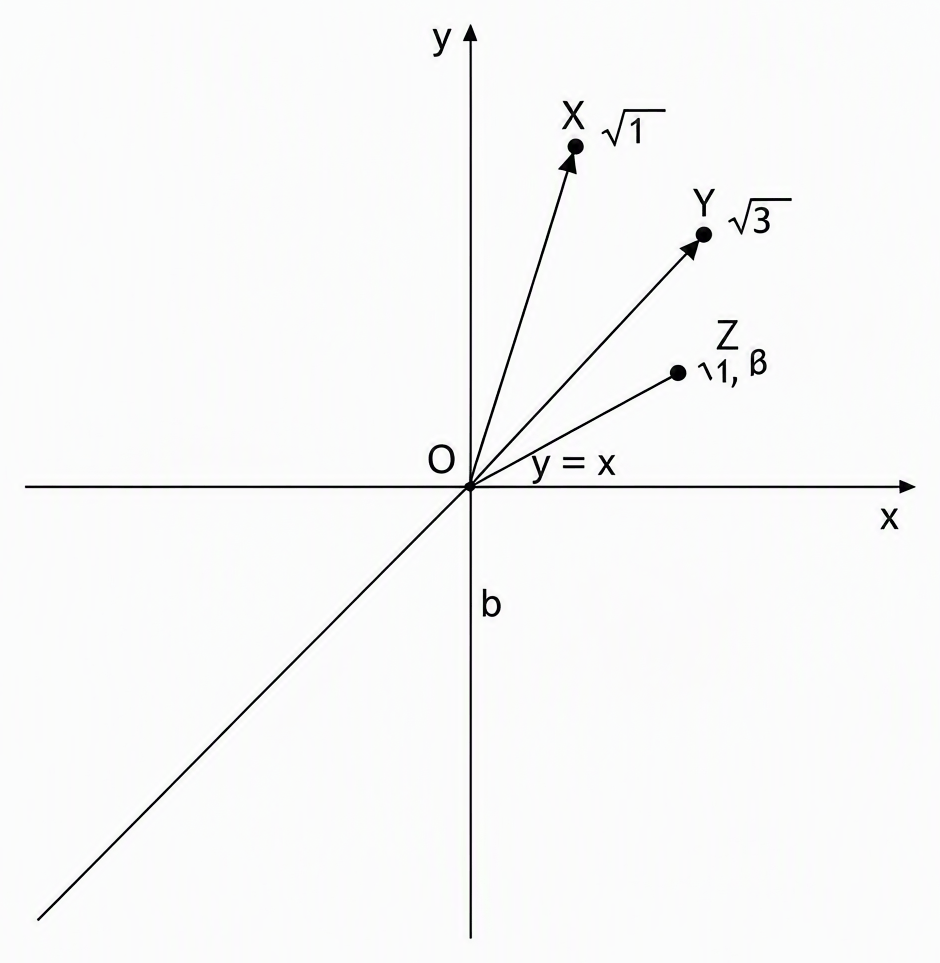
The distance of point from line is:
Set equal to the given distance :
Solve the two cases: or . Thus and (C) matches P, Q.
For (D), first set . The linear piece collapses to the constant . The area between this line and the upper branch of the parabola from to is:
Therefore , matching T.
Now set . The linear expression changes at the points where the arguments of the absolute values are zero. For , . For , . Split the integral:
First integral evaluates to . Second evaluates to . Adding gives:
Thus , matching S. So (D) matches S, T.
(A)→P,R,S; (B)→P; (C)→P,Q; (D)→S,T.
What single algebraic slip ruins the matching in part A?
Students who reach the line sometimes drop the factor of 2 when dividing. They write instead of , so .
The equation then becomes . This equation has no integer solution. The student therefore matches none of the odd values 1, 3 or 5 and loses P, R and S completely.
The mistake is purely procedural. The student knows the sin-squared identity and the supplementary-angle substitution but fails to carry the coefficient through the simplification. One coefficient error collapses the entire column.
Which practice questions should I solve right now to lock in these methods?
Triangle trigonometry: In with sides opposite angles , suppose . Convert sides to sines first, apply the companion identity for , and find the exact value of . Hint: the official 2015 replacement works identically here.
Vectors in plane: Position vectors of points and are and . A point has position vector . Find possible if the distance from to the acute-angle bisector of and equals . Hint: locate the angles, confirm the bisector is still , then apply the absolute-value distance formula exactly as in the 2015 vector part.
Area under curves: Compute the area bounded by , the x-axis from to , and the graph of . Split the integral at the points where the expression inside each modulus is zero. Hint: treat the upper parabola branch as the reference curve and evaluate the piecewise linear pieces separately before adding, following the identical interval-splitting steps used for in the original question.
Search every JEE Advanced paper from 2007 in the past-paper archive by chapter to find more matrix matches that mix the same three topics.
Which core techniques does this mixed mathematics JEE 2015 question reinforce?
- Conversion of sides to sines via sine rule before substituting any side relation.
- Standard identity and its companion with .
- Coordinate geometry route for angle bisector: locate angles of given vectors then average for the 45° line .
- Strict interval splitting at points where expression inside modulus equals zero before integrating against parabola .
These four steps appear in many later problems. Master the sequence once and the combined questions lose their terror.
Why do mixed-concept matrix matches reward method over memory?
Mixed-concept matrix matches reward method over memory because each part tests one clean concept but the matrix format forces simultaneous accuracy across trigonometry, vectors and calculus. The 900-second expected time indicates deliberate design to punish procedural slips such as the one shown above.
The same year also tested mixed concepts in an ellipse common-tangent question. Work through it next at 2015 coordinate-geometry ellipse tangent question for additional mixed practice.
If a similar mixed match blocks you, photograph any similar doubt using the 20-free doubt service for instant step-by-step clarification.
Frequently asked questions
What is the correct matching for mixed mathematics JEE 2015?
The correct matching is (A)→P,R,S; (B)→P; (C)→P,Q; (D)→S,T. Part A yields lambda = 1/2 so only odd n satisfy cos(n pi lambda)=0. Part B simplifies to a/b=1. Part C gives |beta|=1 and 2. Part D evaluates to 6 and 5 after adding (8/3)sqrt(2).
What single algebraic slip ruins the matching in part A of mixed mathematics JEE 2015?
After reaching 2 sin Z sin(X-Y) = sin^2 Z, students sometimes forget the factor of 2 and obtain lambda=1 instead of 1/2. Then cos(n pi * 1) = (-1)^n = 0 has no integer solutions. This causes them to miss matching with P, R and S entirely.
How do you solve the trigonometry part of mixed mathematics JEE 2015?
Apply the sine rule to substitute sides, simplify 2(sin^2 X - sin^2 Y) = sin^2 Z using the identity sin^2 X - sin^2 Y = sin(X+Y)sin(X-Y) and X+Y=pi-Z. This reduces to lambda = sin(X-Y)/sin Z = 1/2. Thus cos(n pi /2)=0 holds for odd integers n matching P, R, S.
How to solve the vector bisector part in mixed mathematics JEE 2015?
Vectors OX at 30° and OY at 60° give the acute bisector as y=x. Distance from Z(beta,1-beta) to y=x is |1-2beta|/sqrt(2). Setting equal to 3/sqrt(2) yields |1-2beta|=3 so beta=-1 or 2. Hence |beta|=1,2 matching P and Q.
What practice questions should I solve for mixed mathematics JEE 2015?
Practice the triangle with a^2 + b^2 = 2c^2 to find cos(A-B). Solve the similar vector problem with points (2,1), (1,2) and R(mu,3-mu) at distance sqrt(2) from y=x. Compute area bounded by y^2=4x and y=|x-1|+|x-3|+x/2 from x=0 to 4 by splitting at modulus points.