
What was the JEE Main 2020 numerical on moment of inertia of equilateral triangle lamina after removing smaller triangle ADE?
N equals 11.
An equilateral triangular plane lamina ABC of side a and mass m has D and E as midpoints of AB and AC. G is the centroid of the whole lamina with MOI I0 about perpendicular axis through G. After removing smaller triangle ADE the remaining part has MOI equal to N I0/16 about the same axis. The integer value of N is 11.
How do you visualise the geometry of equilateral triangle ABC with midpoints D E and centroids G G' before calculating MOI?
The height of ABC is (√3/2)a so centroid G lies at distance a/√3 from A and a/(2√3) from base. ADE is similar with side a/2, its own centroid G' lies at distance (a/2)/√3 from A. This fixes GG' at a/(2√3).
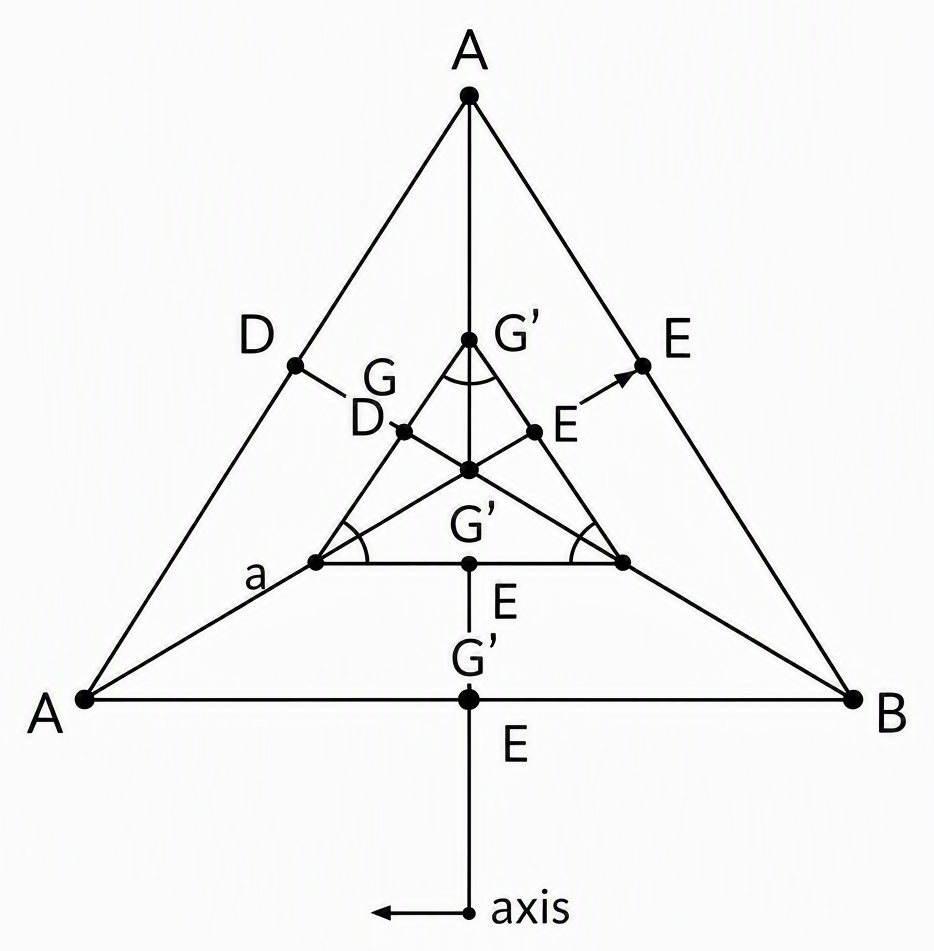
Place equilateral triangle ABC with side a. Mark D and E as midpoints so ADE forms equilateral triangle of side a/2 sharing vertex A. G is centroid of ABC and G' of ADE. The axis passes perpendicular to the plane at G.
What is the official step-by-step solution to the JEE Main 2020 equilateral triangle MOI numerical?
The remaining MOI equals 11 I0/16, so N equals 11.
Mass of ADE m1 equals m/4 because area ratio (1/2)² equals 1/4.
Distance GG' equals a/√3 minus a/(2√3) which equals a/(2√3).
Remaining MOI equals I0 minus I2.
Therefore N equals 11.
What mistake in parallel-axis application produces the wrong N for this lamina problem?
Forgetting the parallel-axis m1 d² term and subtracting only I1 from I0 produces N equals 15.
This yields ma²/12 minus ma²/192 equals 15 ma²/192 which equals (15/16) I0.
Moment of inertia must be calculated about the common axis through G, so the parallel-axis shift term cannot be omitted when the centres do not coincide. Correct distance GG' must be derived from the difference in median lengths, not assumed zero or taken as full median length. Omitting m1 d² underestimates the removed portion's contribution.
What related questions on MOI of lamina with cut-outs test the same concepts?
Question 1: A uniform circular disc of radius R and mass M has a smaller disc of radius R/2 cut out with the centre of the small disc at R/2 from the centre of the large disc. Find MOI of remaining about axis through centre perpendicular to plane. The answer involves 13/32 MR².
Question 2: An equilateral triangular plate of side 2a and mass m. Find MOI about an axis along one side. Use perpendicular-axis theorem and parallel-axis shift from centroid.
Question 3: Square lamina of side length L and mass M with a corner square of side L/4 removed. Compare MOI about the centre perpendicular to plane before and after removal. Compute the exact ratio.
Solve these next. Each repeats the exact skills of area-based mass scaling, centroid location, and parallel-axis correction shown above.
How does the JEE Main 2020 triangle cut-out numerical connect to the full Rotational Motion syllabus?
Standard MOI value for triangle (ma²/12 about centroid) must be memorised exactly as used in official solution.
Area scaling for uniform lamina always gives mass ratio (linear ratio)². Never use linear ratio directly.
Parallel-axis theorem is mandatory whenever the removed body’s own centroid does not lie on the given axis.
You can expect to compute the remaining MOI for any lamina with a cut-out portion correctly by scaling area, locating centroids, and applying parallel-axis theorem because the sequence matches the official method exactly. Search every JEE Main paper from 2002 and every Advanced paper from 2007, by year, subject or chapter, each with a worked solution (free) in the past-paper archive.
Next step: photograph a doubt on JEEnius and photograph any question you are stuck on and get a step-by-step solution, with a free-body diagram when the question needs one (20 free).
Keep going with Mixed Mathematics JEE 2015: Official Matrix Match Solution.
Frequently asked questions
What is N in the JEE Main 2020 moment of inertia equilateral triangle numerical?
N equals 11. The remaining MOI after removing smaller triangle ADE is exactly 11I0/16 about the perpendicular axis through G. This is obtained by subtracting the MOI contribution of the removed part (its own I1 plus m1 d² term) from the original I0.
How is GG' distance calculated in the moment of inertia jee 2020 triangle problem?
Height of ABC is (√3/2)a so its centroid G is at a/√3 from A. Centroid G' of ADE (side a/2) is at (a/2)/√3 from A. Subtracting these gives GG' = a/(2√3). This exact value is required for the parallel-axis shift.
Why apply parallel axis theorem in the JEE 2020 moment of inertia lamina problem?
The required axis passes through G, the centroid of the original triangle, but not through G', the centroid of removed triangle ADE. Therefore I_removed about G equals I1 + m1 d² where d = GG'. Omitting the m1 d² term produces the incorrect value N=15.
What is the mass of smaller triangle ADE in the JEE Main 2020 MOI question?
ADE has side length a/2 so its area is (1/2)² = 1/4 the area of ABC. For a uniform lamina mass scales with area, hence m1 = m/4. This ratio is then used in both its own MOI formula and the parallel-axis term.