What was the JEE Advanced 2014 ketone question asking?
The verified answer to the organic compounds containing oxygen JEE 2014 question is 5. The task is to take every possible ketone of molecular mass 100, including separately counted stereoisomers, and reduce each independently with NaBH4. The required integer is the number of starting ketones whose reduction produces a racemic mixture, not the number of alcohol stereoisomers formed.
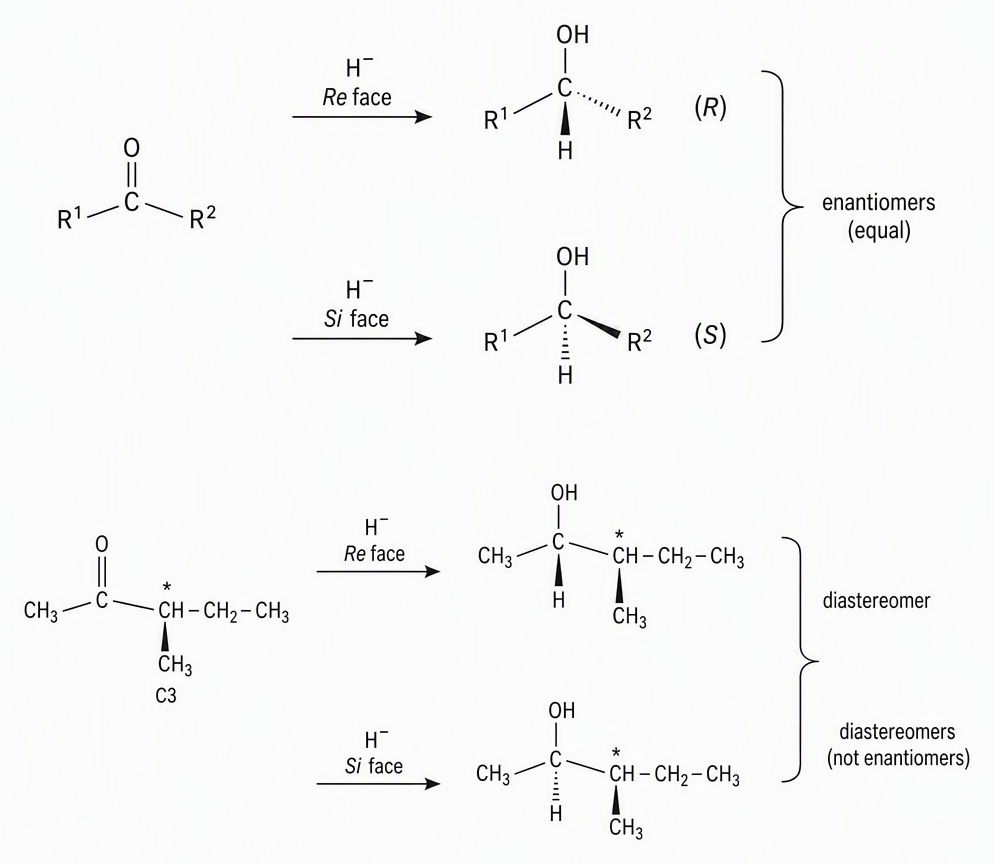
Keep three counts separate:
- Constitutional ketones
- Stereoisomeric starting ketones
- Starting ketones whose products form an enantiomeric pair in equal amounts
How do you determine the molecular formula from molecular mass 100?
The required molecular formula is obtained by assuming a saturated acyclic monoketone. Under this stated assumption, its general formula is:
The official molecular-mass method gives:
The required ketones therefore have the molecular formula:
Molecular mass alone does not justify using this formula. The saturated acyclic monoketone assumption must be stated before the calculation.
How do you enumerate all six ketones with this molecular formula?
There are six constitutional ketones. Write a ketone in the following form:
The carbonyl carbon uses one of the six carbons, leaving five carbons across the two alkyl groups. The only distinct partitions are:
Reversing the two alkyl groups does not create a new ketone because the connectivity remains unchanged.
Which ketones come from the 1 plus 4 partition?
This partition gives four ketones by combining methyl with the four possible butyl groups:
- Hexan-2-one
- 3-Methylpentan-2-one
- 4-Methylpentan-2-one
- 3,3-Dimethylbutan-2-one
Which ketones come from the 2 plus 3 partition?
This partition gives two ketones by combining ethyl with the two possible propyl groups:
- Hexan-3-one
- 2-Methylpentan-3-one
The organic compounds containing oxygen JEE 2014 enumeration therefore contains six constitutional ketones before stereoisomers are counted separately.
Which ketones give racemic alcohols after reduction with NaBH4?
Five ketones are achiral and have two different carbon groups attached to the carbonyl carbon. Their planar carbonyl carbons are prochiral. Because NaBH4 is achiral, attack on the two enantiotopic faces gives equal amounts of two enantiomeric alcohols.
The three-column audit is:
- Hexan-2-one
- Chirality before reduction: Achiral
- Product relationship: Enantiomers
- Racemic mixture: Yes
- Hexan-3-one
- Chirality before reduction: Achiral
- Product relationship: Enantiomers
- Racemic mixture: Yes
- 4-Methylpentan-2-one
- Chirality before reduction: Achiral
- Product relationship: Enantiomers
- Racemic mixture: Yes
- 3,3-Dimethylbutan-2-one
- Chirality before reduction: Achiral
- Product relationship: Enantiomers
- Racemic mixture: Yes
- 2-Methylpentan-3-one
- Chirality before reduction: Achiral
- Product relationship: Enantiomers
- Racemic mixture: Yes
- Each enantiomer of 3-methylpentan-2-one
- Chirality before reduction: Chiral, with C3 already stereogenic
- Product relationship: Diastereomers
- Racemic mixture: No
The exception is 3-methylpentan-2-one. C3 is a pre-existing stereogenic centre, so this ketone exists as two enantiomers. The question requires each enantiomer to be reacted independently.
During reduction, the original configuration at C3 remains fixed while a new stereocentre forms at the former carbonyl carbon. The two products from one starting enantiomer differ at the new centre but retain the same configuration at C3.
They are diastereomers, not mirror images. A pair of diastereomers is not a racemic pair, even if both products form.
Why is the final answer 5 rather than 6 or 7?
Exactly five independently treated ketones produce equal amounts of enantiomeric alcohols. Six is only the number of constitutional ketones. Both separately treated enantiomers of 3-methylpentan-2-one must be excluded because neither independently gives an enantiomeric product pair.
Included:
- Hexan-2-one
- Hexan-3-one
- 4-Methylpentan-2-one
- 3,3-Dimethylbutan-2-one
- 2-Methylpentan-3-one
Excluded:
- One enantiomer of 3-methylpentan-2-one
- Its mirror-image enantiomer
The final integer is:
The fast diagnostic is this: a prochiral ketone with no existing stereocentre is expected to give a racemate with an achiral reducing agent because its two faces are enantiotopic. If a stereocentre already exists, attack on the two carbonyl faces generally gives diastereomers because the original stereocentre remains unchanged.
Which counting error produces the incorrect answer 7?
The incorrect route counts five achiral ketones, adds the two enantiomers of 3-methylpentan-2-one, and assumes all seven give racemic products. The precise mistake is treating attack on the two faces of every carbonyl as automatically producing an enantiomeric pair.
Opposite-face attack creates opposite configurations at the new alcohol centre. That alone does not prove that the complete product molecules are mirror images.
For an achiral substrate, the two products are mirror images. For one pure enantiomer of 3-methylpentan-2-one, the existing C3 configuration remains unchanged in both products, so the complete molecules are diastereomers.
Equal access to two carbonyl faces does not automatically establish a racemic mixture. First check whether another stereocentre is already present.
Which related questions test the same method?
These three problems use the same sequence: enumerate the substrates, check substrate chirality, and identify the exact relationship between the products.
How many saturated acyclic ketones with five carbons give a racemic alcohol mixture?
The formula is:
The answer is 2. Pentan-2-one and 3-methylbutan-2-one are achiral ketones with two different groups on the carbonyl carbon, so reduction gives racemic alcohol mixtures.
Pentan-3-one is symmetric. Reduction does not create a stereogenic alcohol carbon because the two ethyl groups remain identical.
How many stereoisomeric alcohols form from 4-methylpentan-2-one?
Two stereoisomeric alcohols form. The achiral ketone gains one new stereocentre, so NaBH4 gives two enantiomers in a racemic mixture.
What is the relationship between the products from one pure enantiomer of 3-methylpentan-2-one?
The alcohol products are diastereomers, not enantiomers. The original C3 stereocentre stays fixed while the newly formed alcohol stereocentre can have either configuration.
For further chapter practice, solve Organic Compounds Containing Oxygen JEE 2025: Answer. Before accepting any count, record each substrate’s connectivity, chirality before reaction and product relationship.
Frequently asked questions
What is the answer to the JEE Advanced 2014 ketone question?
The correct answer is 5. Five achiral ketones produce racemic alcohol mixtures on reduction with NaBH4.
How many ketones have molecular formula C6H12O?
There are six constitutional saturated acyclic ketones with formula C6H12O. They are obtained from the alkyl-group partitions 1 + 4 and 2 + 3 around the carbonyl carbon.
Why does 3-methylpentan-2-one not give a racemic mixture?
It already contains a stereogenic centre at C3. Reduction of one pure enantiomer creates products that differ at the new alcohol centre but retain the same C3 configuration, making them diastereomers.
Why is the answer 5 and not 7?
The count of 7 incorrectly includes both enantiomers of 3-methylpentan-2-one as racemate-forming substrates. Each enantiomer independently gives a pair of diastereomers, so both must be excluded.