What was the JEE Advanced 2021 multi-correct question on the Nernst equation?
E°_cell only needs to exceed −0.0591 V for the given concentrations to keep E_cell positive and drive dissolution of X. The question gave four standard reduction potentials: Pb2+/Pb (−0.13 V), Ni2+/Ni (−0.24 V), Cd2+/Cd (−0.40 V), Fe2+/Fe (−0.44 V). A solution contained 0.001 M of one divalent ion and 0.1 M of the other. Metal rods of X and Y were inserted and shorted by wire, leading to dissolution of X at 298 K. Students had to identify all correct (X, Y) pairs from the four listed combinations.
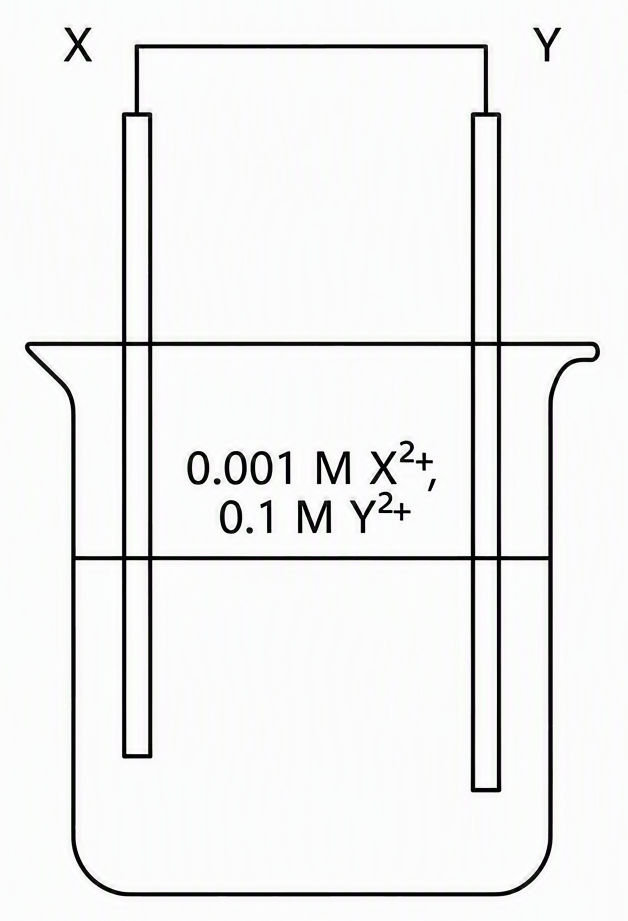
The official answer is options A, B and C.
What does dissolution of X imply for the cell reaction and spontaneity?
Dissolution of X fixes X as the anode where oxidation occurs: X → X²⁺ + 2e⁻. Y²⁺ undergoes reduction at the cathode: Y²⁺ + 2e⁻ → Y. The net spontaneous reaction is X + Y²⁺ → X²⁺ + Y. Spontaneity at the stated concentrations demands E_cell > 0.
This matches the official pivot that E_cell = E°_cell + 0.0591 must be strictly greater than zero.
How does the official Nernst equation solution identify the correct options for the 2021 question?
The official solution begins with the cell potential definition tied to the spontaneous direction.
The reaction quotient is
so log Q = −2.
At 298 K the Nernst equation simplifies to
Substituting the log value gives E_cell = E°_cell + 0.0591. The condition for dissolution of X therefore tightens to E°_cell > −0.0591 V.
Option A (X = Cd, Y = Ni): E°_cell = 0.16 V, so E_cell = 0.2191 V > 0. Correct.
Option B (X = Cd, Y = Fe): E°_cell = −0.04 V, so E_cell = 0.0191 V > 0. Correct.
Option C (X = Ni, Y = Pb): E°_cell = 0.11 V, so E_cell = 0.1691 V > 0. Correct.
Option D (X = Ni, Y = Fe): E°_cell = −0.20 V, so E_cell = −0.1409 V < 0. Incorrect.
The +0.0591 V term rescues the borderline negative E°_cell in option B while correctly eliminating D. For a similar doubt, photograph any question you are stuck on and get a step-by-step solution, with a free-body diagram when the question needs one.
What sign error leads to the wrong option in the 2021 JEE Advanced question?
The precise procedural error is reversing the subtraction while writing E°_cell as E°(X) − E°(Y) instead of E°(Y) − E°(X). This sign flip turns the −0.20 V of option D into +0.20 V, making the student wrongly conclude E_cell > 0 for Ni and Fe. The mistake arises from confusing which metal is the anode when the problem states dissolution of X.
Correct cell notation prevents this reversal. The official route always adds the exact Nernst correction before checking the sign.
How can you practise the same Nernst logic with two related electrode-potential questions?
Question 1
A cell is set up with Zn2+/Zn (E° = −0.76 V) and Cu2+/Cu (E° = +0.34 V) at [Zn2+] = 0.1 M and [Cu2+] = 0.001 M. Predict the spontaneous direction and calculate E_cell at 298 K using identical logic.
Here X = Zn (anode), Y = Cu (cathode).
V. Now Q = 0.1 / 0.001 = 100, log Q = 2. Thus
V > 0. Zinc therefore dissolves and copper deposits.
Question 2
Rods of Fe and Sn are inserted into a solution containing 0.01 M Fe²⁺ and 0.001 M Sn²⁺ at 298 K and connected by wire. Decide which metal dissolves. E°(Fe2+/Fe) = −0.44 V, E°(Sn2+/Sn) = −0.14 V.
Test Fe as X (dissolving), Sn as Y:
V. Q = 0.01 / 0.001 = 10, log Q = 1. Then
V > 0, so iron dissolves.
Reverse assumption (Sn as X) yields E_cell = −0.27045 V < 0, confirming only iron dissolves.
What checklist should you memorise for spontaneity questions in electrochemistry?
- Always identify the dissolving metal as the anode.
- Q is always products over reactants for the written cell reaction.
- The 0.0591 V term for these 2-electron concentrations shifts the threshold from 0 V to −0.0591 V.
- Compare final E_cell sign, never just E°_cell sign.
Apply this checklist, then test yourself on every matching problem by searching the past-paper archive for Nernst equation.
Next step: the past-paper archive on JEEnius and search every JEE Main paper from 2002 and every Advanced paper from 2007, by year, subject or chapter, each with a worked solution (free).
Keep going with Coordinate Geometry JEE 2015: Common Tangent to Ellipses.
Frequently asked questions
What was the JEE Advanced 2021 multi-correct question on the Nernst equation?
It involved identifying pairs (X, Y) where metal X dissolves in a mixture of 0.001 M X²⁺ and 0.1 M Y²⁺ when connected by a wire. The given reduction potentials were for Pb, Ni, Cd and Fe. The official answer is A, B and C.
How does the Nernst equation simplify in the 2021 JEE Advanced electrochemistry question?
With Q = 0.01, log Q = -2, the term -(0.0591/2) log Q becomes +0.0591. Therefore E_cell = E°_cell + 0.0591. For the reaction to be spontaneous E_cell > 0 implies E°_cell > -0.0591 V.
Why is option B correct even when E°_cell is negative in redox reactions and electrochemistry JEE 2021?
For Cd and Fe, E°_cell = -0.04 V. Adding the 0.0591 V from the Nernst term gives E_cell = 0.0191 V which is positive. This allows dissolution of X=Cd making the option correct.
What sign error do students make in JEE Advanced Nernst equation questions?
Many students reverse the E°_cell calculation as E°(X) - E°(Y) instead of E°(Y) - E°(X). This leads to wrong sign for E_cell and selecting the incorrect option D in the 2021 paper.