
What was the benzene succinic anhydride sequence in JEE Advanced 2022 Paper 2?
Acid chlorides react with dialkylcadmium to give ketones, not tertiary alcohols. That is why option D is incorrect.
Benzene reacts with succinic anhydride and AlCl3 to form P, a keto-acid. P undergoes Clemmensen reduction to Q, still containing COOH. Q treated with SOCl2 yields acid chloride R. R with AlCl3 undergoes intramolecular acylation to cyclic ketone S (1-tetralone). S is further reduced by Clemmensen to a final hydrocarbon.
The four statements were: A states P and Q are carboxylic acids; B states S decolorises bromine water; C states P and S react with NH2OH to form oximes; D states R reacts with dialkylcadmium to give a tertiary alcohol.
What is the official step-by-step solution for the JEE Advanced 2022 benzene succinic anhydride question?
Benzene undergoes Friedel-Crafts acylation with succinic anhydride in the presence of AlCl3. The anhydride opens to give P as 4-oxo-4-phenylbutanoic acid (PhCOCH2CH2COOH).
Clemmensen reduction with Zn/Hg and HCl reduces only the ketone to a methylene group. The carboxylic acid stays intact. This produces Q as 4-phenylbutanoic acid (PhCH2CH2CH2COOH). Both P and Q contain carboxylic acid groups, so A is correct.
Q with SOCl2 gives R as PhCH2CH2CH2COCl. R then undergoes intramolecular Friedel-Crafts acylation with AlCl3. The chain length allows formation of a six-membered ring fused to benzene, giving S as 1-tetralone.
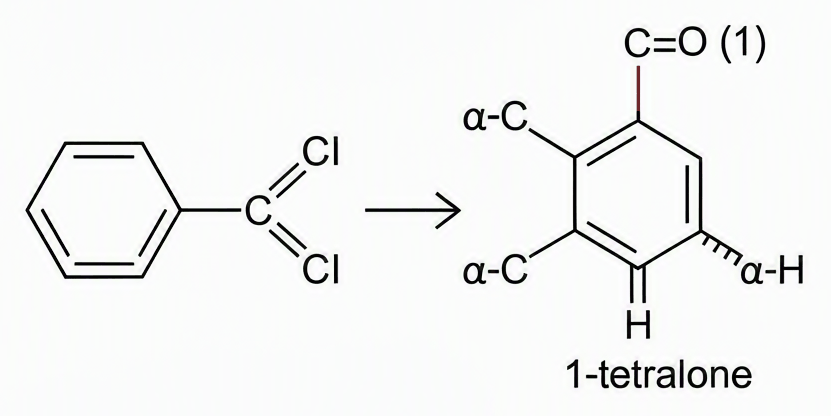
S contains a ketone with alpha hydrogens. It enolises and undergoes alpha-bromination, which decolorises bromine water. This confirms B.
Both P and S have ketone carbonyls. They react with NH2OH to form oximes.
Carboxylic acids do not. Hence C is correct.
R with dialkylcadmium gives RCOR', a ketone. Tertiary alcohols form only with excess Grignard reagent followed by hydrolysis. D is therefore incorrect. The correct options are A, B and C.
Why do students select the wrong option D in the JEE Advanced 2022 benzene succinic anhydride question?
Students select D when they treat the dialkylcadmium reaction with acid chlorides as equivalent to Grignard addition. They assume both organometallics produce alcohols.
R2Cd stops cleanly at the ketone stage. Excess RMgX proceeds to the tertiary alcohol after the ketone forms and reacts further. The official product for R plus R'2Cd is the ketone, not the 3° alcohol stated in option D.
What principles from Some Basic Principles of Organic Chemistry does the JEE Advanced 2022 benzene succinic anhydride question test?
This question combines these exact principles.
- Friedel-Crafts acylation using cyclic anhydride opening to keto-acid.
- Selective Clemmensen reduction of ketone in presence of carboxylic acid.
- Intramolecular Friedel-Crafts with acid chloride forming six-membered fused ring (1-tetralone).
- Enolisation and alpha-bromination explaining Br2 decolorisation by S.
- Oxime formation specific to carbonyls in P and S.
What are similar practice questions on named reductions, intramolecular acylation and carbonyl tests?
Question 1: 3-Benzoylpropanoic acid undergoes Clemmensen reduction followed by SOCl2 and then AlCl3. What is the ring size of the cyclic ketone formed?
Question 2: Which compounds among a keto-acid like P, an acid chloride like R and a tetralone derivative like S will react with NH2OH? Which will decolorise bromine water?
Question 3: What is the outcome when an acid chloride is treated with Me2Cd versus excess MeMgBr followed by hydrolysis?
You can search every JEE Advanced paper from 2007 by chapter inside the past-paper archive to find more sequences of this type, each with a worked solution.
How can you use this 2022 benzene succinic anhydride solution for JEE Advanced 2025-26?
You can expect to map every intermediate correctly if you always draw chain lengths to check if intramolecular acylation can form 5- or 6-membered ring, since four carbons between the ring and acid chloride carbon produce the 1-tetralone fusion.
You will avoid errors on P and Q by tracking each functional group separately through Clemmensen, which reduces only the ketone to CH2 and leaves COOH untouched.
You can judge statements on carbonyl reactivity once you recall the exact order: acid chloride plus R2Cd gives ketone while excess Grignard gives 3° alcohol. Carbonyl tests such as oxime formation and alpha-H for Br2 apply only to ketone or aldehyde, not carboxylic acid.
What is the quick recap checklist for solving problems like the 2022 benzene-succinic anhydride sequence?
- Succinic anhydride plus benzene/AlCl3 gives γ-keto acid (P).
- Clemmensen on P gives 4-phenylbutanoic acid (Q).
- Q to acid chloride R to 1-tetralone (S) by intramolecular FC.
- S decolorises Br2 (enolisable α-H) and forms oxime.
- R plus R2Cd gives ketone, never 3° alcohol.
Apply the checklist the moment you see a succinic anhydride opening. Spot functional group survival and precise reagent outcome first.
Next step: photograph a doubt on JEEnius and photograph any question you are stuck on and get a step-by-step solution, with a free-body diagram when the question needs one (20 free).
If that step was the hard part, work through Electrostatics JEE 2022: Charged Disk with Constant Force.
Frequently asked questions
Why is option D incorrect in the JEE Advanced 2022 benzene succinic anhydride question?
Option D states that acid chloride R reacts with dialkylcadmium to give a tertiary alcohol. Acid chlorides react with R2Cd to stop cleanly at the ketone. Tertiary alcohols require excess Grignard reagent followed by hydrolysis. This distinction makes D wrong while A, B and C are correct.
What is the product of Clemmensen reduction on the keto-acid P in JEE 2022?
Clemmensen reduction converts the ketone in P (4-oxo-4-phenylbutanoic acid) to a CH2 group while leaving the carboxylic acid intact. This yields Q as 4-phenylbutanoic acid. Both P and Q are carboxylic acids, confirming statement A.
Why does S decolorise bromine water in the tetralone question?
S is 1-tetralone, a cyclic ketone with enolisable alpha hydrogens. It undergoes alpha-bromination that decolorises bromine water. P and S both form oximes with NH2OH because they contain ketone carbonyls while carboxylic acids do not.
What does acid chloride give with dialkylcadmium versus Grignard reagent?
Acid chloride R with R'2Cd produces a ketone. Excess Grignard reagent continues past the ketone to yield a tertiary alcohol after hydrolysis. Students confuse the two reagents, leading to the wrong choice of option D in the 2022 paper.
What principles from Some Basic Principles JEE 2022 are tested in this question?
The question tests Friedel-Crafts acylation with succinic anhydride, selective Clemmensen reduction leaving COOH untouched, intramolecular acylation forming 1-tetralone, alpha-hydrogen reactivity for Br2 decolorisation, and specific oxime formation with ketones.