

What was the thermodynamics jee 2020 movable diathermic partition question?
The JEE Advanced 2020 question placed a frictionless diathermic partition of mass 8.3 kg inside a thermally isolated vertical cylinder of height 8 m. The partition started at 4 m from the top, with each compartment containing 0.1 mol of ideal gas at 300 K. The partition was released and moved without leakage until new equilibrium. The task was to find its final distance from the top.
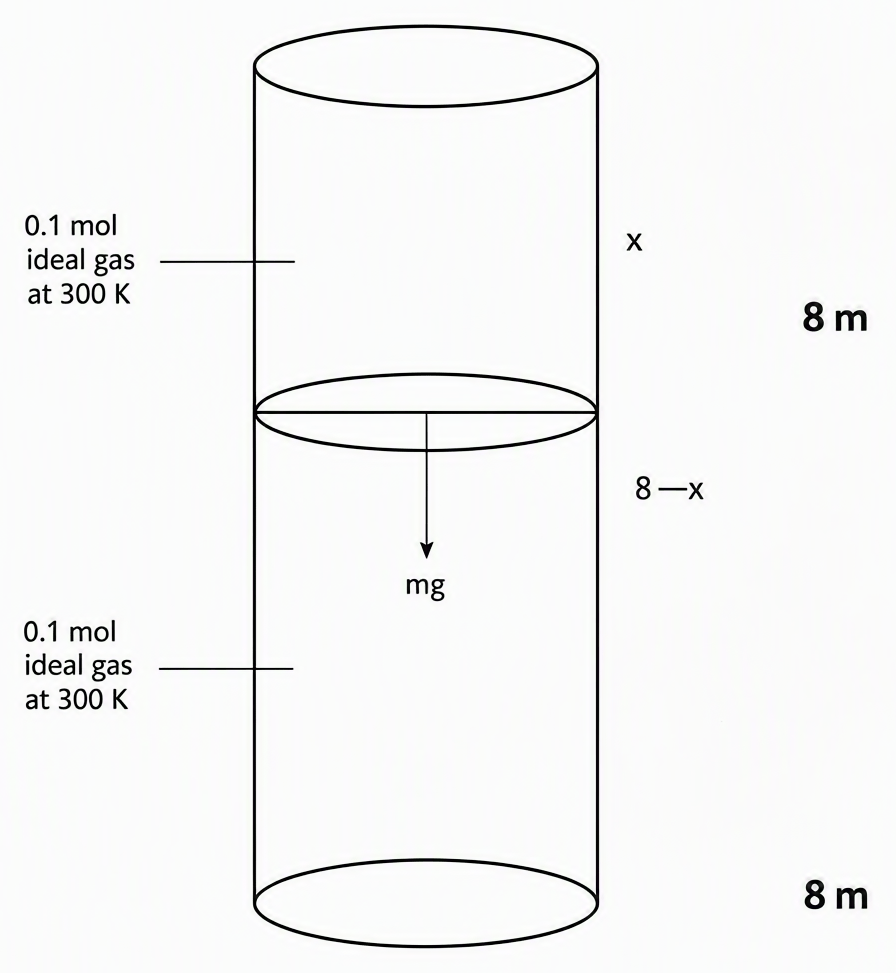
The vessel has no heat exchange with surroundings. The diathermic partition equalises temperatures on both sides at final T. Force balance on the partition and energy conservation for the isolated system are both required. Mechanical equilibrium alone cannot fix a unique numerical value for final x.
What does the official solution show step by step for the thermodynamics jee 2020 question?
Let final distance from the top be m with cross-sectional area . The diathermic partition gives the same final temperature on both sides.
Mechanical equilibrium requires:
Substitution yields:
Energy conservation for the isolated vessel is:
This gives:
Final depends on unknown . No unique numerical answer satisfies both equations. The official note declared the question ambiguous and awarded bonus marks to all.
How does assuming constant temperature produce x = 6 in the thermodynamics jee 2020 question?
Many students assume final T remains 300 K because the partition is diathermic. This ignores that the vessel is thermally isolated, so gravitational PE change must alter total internal energy of both gases.
They calculate and obtain:
Algebra gives:
Positive root is . This satisfies force balance only under the isothermal assumption. The error treats the diathermic partition as a guarantee of constant temperature instead of equal final temperatures. Gravitational PE term converts to internal energy and requires the term the question omits.
Why did the thermodynamics jee 2020 question receive bonus marks?
Final T is not necessarily 300 K because the whole vessel is thermally isolated. The gravitational PE term must be balanced by change in internal energy of both gases. That energy equation explicitly needs molar heat capacity , which the question never supplied.
Mechanical equilibrium alone relates and . Energy conservation supplies a second relation still containing . Substituting leaves dependent on an unknown constant, so no unique numerical answer exists. The official note stated this ambiguity and awarded bonus to all candidates. JEE Advanced sometimes contains such flaws.
Which related thermodynamics questions test partitions and energy conservation?
Question 1: Two ideal gases are separated by a fixed diathermic wall inside an insulated container. If one side is supplied heat slowly, what happens to the final pressures and temperatures on both sides? Compare with a conducting wall scenario. (See the similar ideas in the Thermodynamics JEE 2022 soap bubble multi-correct question.)
Question 2: A movable adiabatic piston of mass separates two compartments of ideal gas in a vertical insulated cylinder. Compare the final temperatures and equilibrium heights with the diathermic case studied in the thermodynamics jee 2020 question. Explain why temperatures now differ.
Question 3: A conducting piston of mass 5 kg falls under gravity in a closed insulated vessel containing 0.2 mol of monatomic ideal gas with . Initial height is 2 m and temperature 300 K. Calculate the final temperature after equilibrium, including the gravitational potential energy term.
The past-paper archive lets you search every JEE Main paper from 2002 and every Advanced paper from 2007, by year, subject or chapter, each with a worked solution (free).
What should you remember for similar JEE Advanced thermodynamics problems?
Diathermic partitions enforce equal final temperatures but do not keep equal to initial 300 K. For any thermally isolated vessel, total energy balance must include of every massive moving part. Always check whether or is supplied before assuming a numerical answer for final or .
The numbers and were chosen so the isothermal path yields the clean root . Compare with the adiabatic partition case where temperatures differ and no heat transfer occurs. In every isolated piston problem write the energy equation first, before substituting numbers. This habit prevents the isothermal assumption in future papers. When you meet a similar doubt, photograph the question to receive a step-by-step solution with the required free-body diagram.
Next step: photograph a doubt on JEEnius and photograph any question you are stuck on and get a step-by-step solution, with a free-body diagram when the question needs one (20 free).
Frequently asked questions
Why was the thermodynamics JEE 2020 partition question ambiguous?
The final position x could not be found uniquely because the energy conservation equation contains CV, which was not given. Mechanical equilibrium relates x and T while energy balance introduces CV, leaving no single numerical solution.
What is the value of x in thermodynamics jee 2020 question?
There is no unique numerical value. Assuming constant temperature of 300 K yields x=6 m from the force balance, but this ignores the thermally isolated system where gravitational PE change alters internal energy and thus temperature.
Does diathermic partition mean temperature remains 300 K?
No. The diathermic partition only ensures both gases reach the same final temperature T. Since the vessel is thermally isolated, the drop or rise in gravitational PE of the partition changes the total internal energy, so T differs from the initial 300 K.
Why were bonus marks given in thermodynamics jee 2020?
Officials declared the question ambiguous because the two equations involve an unknown CV, preventing a unique numerical answer for final x. Energy conservation requires the CV term to balance the gravitational PE change of the 8.3 kg partition.