What was the hard soap bubble thermodynamics multi-correct question in JEE Advanced 2022 Paper 2?
The JEE Advanced 2022 Paper 2 hard multi-correct question involves a soap bubble with surface tension S containing ideal gas of γ = 3/2 that remains spherical. It gives two states (Pa1, r1, T1) and (Pa2, r2, T2). Students must identify which statements are correct for an insulating surface versus a conducting surface.
How do you correctly visualise the soap bubble and the excess pressure due to surface tension?
A soap bubble has two liquid-air surfaces, so excess pressure inside equals 4S/r rather than 2S/r. The bubble retains its spherical shape in both states, first at radius r1 and temperature T1 under Pa1, then at r2 and T2 under Pa2.
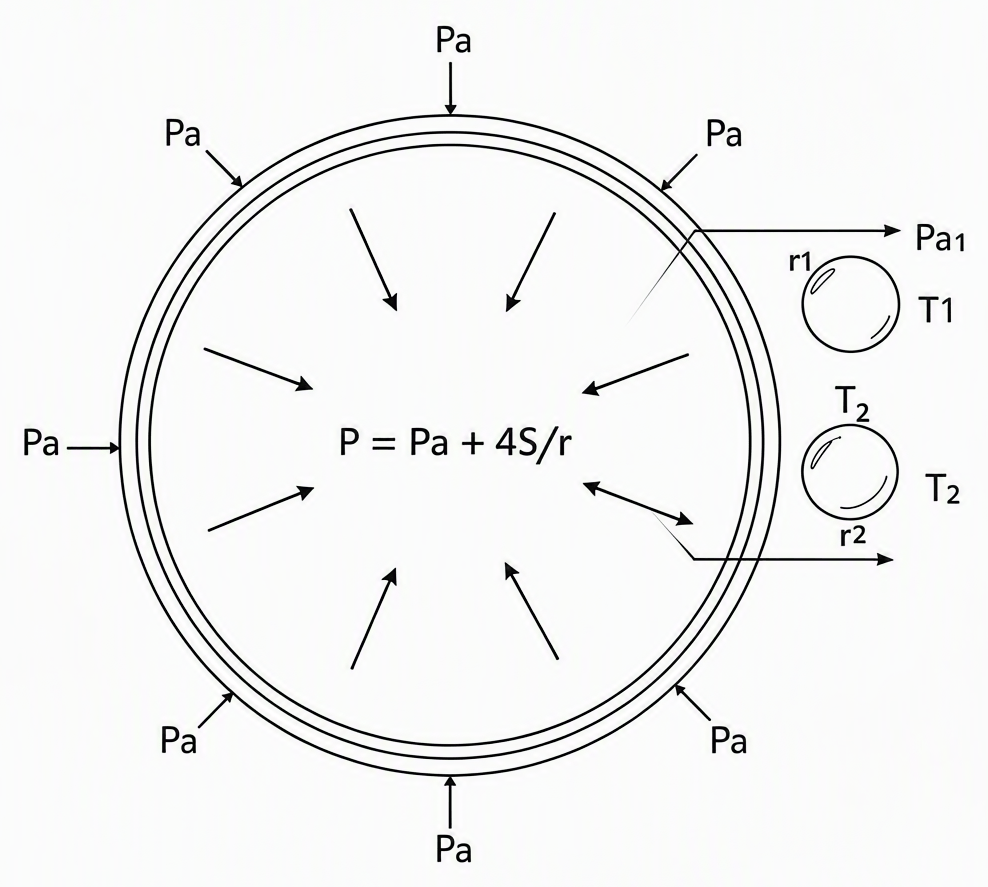
Surface tension pulls along both the inner and outer surfaces of the thin film. This doubles the usual excess pressure term seen in single-surface air bubbles inside liquids.
What is the official step-by-step solution for the JEE Advanced 2022 soap bubble thermodynamics question?
Internal pressure equals Pa + 4S/r at every stage. Excess pressure inside the soap bubble ΔP = 4S/r, therefore P = Pa + 4S/r.
For the perfect heat insulator the process is adiabatic. The gas satisfies PV^γ = constant. Volume V ∝ r^3, so P r^{3γ} = constant. With γ = 3/2 this exponent becomes 9/2.
Thus
and
Temperature follows from the adiabatic link P ∝ T^{γ/(γ-1)}. For γ = 3/2 the exponent equals 3, so
and
This matches option D.
For a perfect heat conductor with negligible atmospheric temperature change the gas stays isothermal. Then PV = constant. With V ∝ r^3 this simplifies to P r^3 = constant.
This matches option C. Option B is incorrect because work can be done by the atmosphere even if no heat exchange occurs, so total energy of the gas plus surface is not constant. The correct options are therefore C and D.
What method mistake produces the wrong relation in option A?
Option A reaches an incorrect equation by using single-surface excess pressure 2S/r instead of 4S/r for the soap bubble and deriving the wrong exponent 5 instead of 9/2. This stems from treating the bubble as an air bubble with one surface and misremembering the volume scaling in PV^γ = constant as r^5 rather than r^{9/2}.
The resulting wrong adiabatic relation reads
This mismatches the correct adiabatic soap-bubble path.
Which two related questions on bubble thermodynamics test the same concepts?
Related question 1: An air bubble (single surface) of radius r in a liquid with surface tension S and surrounding pressure P0 undergoes adiabatic compression with γ = 5/3. Derive the new radius if pressure becomes 8P0.
Internal pressure starts at P1 = P0 + 2S/r. Final internal pressure P2 = 8P0 + 2S/r_f. For adiabatic change use 2S/r and γ = 5/3. Volume scaling gives exponent 3γ = 5, so
Therefore
Related question 2: A soap bubble with conducting surface expands isothermally from r to 2r when external pressure is halved. Find the required change in surface tension if temperature is constant.
Internal pressure starts at P1 = Pa + 4S/r. For isothermal conducting case PV = constant and V2 = 8V1, so P2 = P1/8. Final external pressure equals Pa/2, final radius 2r, therefore
The factor changes from 4S/r for soap bubbles to 2S/r for air bubbles and the polytropic exponents shift with γ and process type.
What are the key repeatable rules from this JEE Advanced thermodynamics question?
Always use 4S/r for soap bubbles, 2S/r for air bubbles inside liquid. For adiabatic with γ = 3/2 the radius exponent is 9/2 and temperature exponent is 3. Distinguish insulator (adiabatic, use T or PV^γ) from conductor with constant T_atm (isothermal, use PV).
Total energy of the bubble is not conserved in the adiabatic case because PdV work occurs with the atmosphere. You can expect to solve any similar JEE Advanced bubble or balloon thermodynamics question without algebraic mistakes after applying these distinctions the moment you read insulator or conductor. Search the past-paper archive for every JEE Advanced paper from 2007 by chapter to drill identical patterns. If a variant still blocks you, photograph a doubt for a step-by-step solution with the required diagram.
Next step: photograph a doubt on JEEnius and photograph any question you are stuck on and get a step-by-step solution, with a free-body diagram when the question needs one (20 free).
For a worked example of the same idea, see Some Basic Principles JEE 2022: Benzene Succinic Anhydride Sequence.
Frequently asked questions
What is the excess pressure inside a soap bubble in JEE Advanced questions?
A soap bubble has two surfaces, so excess pressure is 4S/r. Internal pressure is therefore Pa + 4S/r. This must be used in both adiabatic and isothermal calculations rather than the 2S/r value for single-surface bubbles.
What are the correct options for the JEE Advanced 2022 soap bubble question?
Options C and D are correct. C applies to the perfect heat conductor case which is isothermal leading to P r^3 = constant. D applies to the perfect heat insulator case which follows the adiabatic relation P r^{9/2} = constant for γ = 3/2.
How do you solve the soap bubble thermodynamics question for insulating surface?
For an insulating surface the process is adiabatic. Use internal pressure P = Pa + 4S/r in the relation P r^{9/2} = constant because V ∝ r^3 and γ = 3/2 gives the exponent 9/2. This also leads to (T2/T1)^3 = P2/P1.
Why is option A wrong in the JEE Advanced 2022 thermodynamics question?
Option A incorrectly uses excess pressure 2S/r instead of 4S/r for a soap bubble. It also applies the wrong exponent 5 instead of 9/2 in the adiabatic relation. These mistakes come from confusing soap bubbles with single-surface air bubbles.
Is the process isothermal or adiabatic for a conducting soap bubble in JEE questions?
For a conducting soap bubble with negligible atmospheric temperature change the gas temperature remains constant, making the process isothermal. Use PV = constant which simplifies to P r^3 = constant since volume is proportional to r^3.