
What was the 2021 JEE Main vector algebra question on forces P+Q and P-Q?
Both statements are false. Deriving the cosine of each angle from the given resultant magnitudes produces expressions that require Q = 0 to hold, which is physically impossible for nonzero forces. This matches option (3).
The question gave two forces expressed as P+Q and P-Q with P perpendicular to Q. Their resultant magnitude is √(3P² + Q²) when the angle between them is θ₁ and √(2P² + Q²) when the angle is θ₂. Statement I claims these magnitudes are possible only if θ₁ < θ₂. Statement II asserts that θ₁ = 60° and θ₂ = 90°. The four options evaluate the truth values of the two statements.
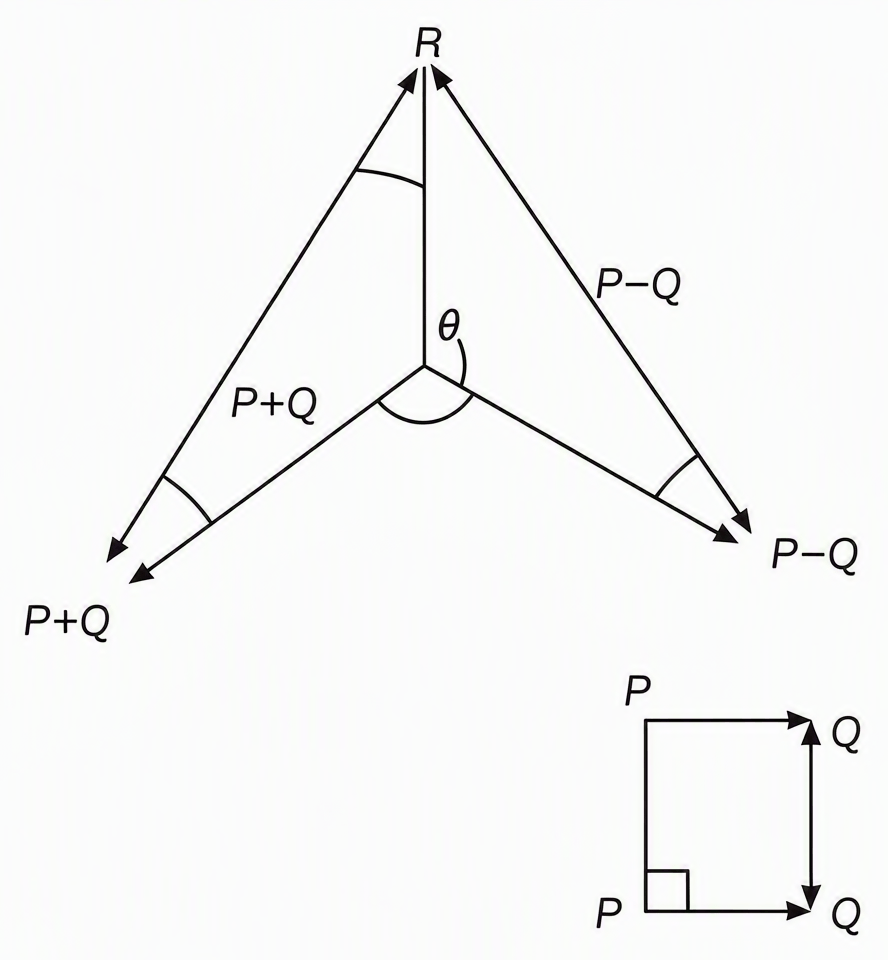
How does the official solution prove both statements false?
The official solution begins with the resultant formula after applying P perpendicular to Q. This gives |P+Q| = |P-Q| = √(P² + Q²) and simplifies the dot product.
After substitution it reduces to
For the first resultant √(3P² + Q²) at θ₁, equate and solve for the cosine:
For θ₁ = 60° the cosine term after expansion yields (P² – Q²)/[2(P² + Q²)] which forces Q = 0 to match the given magnitude, a contradiction.
For θ₂ = 90° the expression simplifies to 2(P² + Q²) which cannot equal 2P² + Q² unless Q = 0 again. The resolved component relationships lead to inconsistent logic for the inequality θ₁ < θ₂ under the supplied resultant values. Both statements lack validity, corresponding to option (3).
What method mistake produces a wrong option in this vector algebra JEE 2021 question?
Treating the angle inequality as automatically true from the monotonicity of cosine without expanding and equating the full R² expressions after applying perpendicularity leads to a wrong option. Directly substituting θ = 60° or 90° into the resultant formula without first isolating cosθ and checking consistency against P and Q magnitudes produces the same error.
Either mistake yields the contradictory conclusion that Statement II holds or that both statements can be simultaneously true. Derive the exact cosine first, then test the claimed angles.
What vector algebra concepts does this JEE 2021 PYQ reinforce?
This PYQ reinforces perpendicular vectors, resultant simplification, and consistency checks on derived angles.
- |P+Q|² = |P-Q|² = P² + Q² when P · Q = 0.
- R² = 2(P² + Q²)(1 + cosθ) after simplification.
- Derived cosθ₁ = (P² – Q²)/[2(P² + Q²)] and cosθ₂ = –Q²/[2(P² + Q²)].
- Both cosines lead to Q = 0 for the specific angles quoted in Statement II.
- Comparison showing cosθ₁ is always greater than cosθ₂ yet the given magnitudes still generate internal contradiction with non-zero Q.
Apply these results and contradictions appear in under a minute.
Which other JEE questions test similar vector algebra skills?
One JEE Main question asks for the angle between vectors A = 2i + j and B = i + 2j given their magnitudes. Their dot product is 4 and each magnitude is √5, so cos φ = 4/5 and φ = cos⁻¹(4/5).
A second problem requires the magnitude of resultant of two vectors of magnitudes 3P and 4P at 90° and comparison with P+Q type expressions. The algebra repeats the same simplification steps.
The hard projectile momentum vector question from JEE 2022 uses identical dot-product consistency checks. Work it next at the hard projectile momentum vector question from JEE 2022.
How do you handle assertion-reason questions on vector algebra under exam pressure?
Always reduce to an expression for cosθ before inserting any numerical angle; 60° or 90° must satisfy the derived equation exactly. Check boundary conditions: any solution forcing Q = 0 or |cosθ| > 1 immediately falsifies the statement.
If the algebra does not close in the first 90 seconds, treat the 240-second expected time as a signal to move on. Mark the question for later.
Search every JEE Main paper from 2002 in the past-paper archive on this platform for timed practice. When a similar doubt appears, photograph the question for a step-by-step solution with the required free-body diagram.
Next step: the past-paper archive on JEEnius and search every JEE Main paper from 2002 and every Advanced paper from 2007, by year, subject or chapter, each with a worked solution (free).
Frequently asked questions
Why are both statements false in the vector algebra JEE 2021 question?
Both statements are false because deriving cosθ₁ and cosθ₂ from the given resultant magnitudes √(3P² + Q²) and √(2P² + Q²) only holds true if Q = 0. This is physically impossible for nonzero forces P and Q that are perpendicular.
What is the official solution for the JEE 2021 vector algebra PYQ?
The official solution uses perpendicularity of P and Q to simplify |P+Q| = |P-Q| = √(P² + Q²) and reduces R² to 2(P² + Q²)(1 + cosθ). Equating to given magnitudes gives cosθ₁ = (P² – Q²)/[2(P² + Q²)] and cosθ₂ = –Q²/[2(P² + Q²)]. These contradict the claimed θ₁ = 60° and θ₂ = 90° unless Q = 0.
What mistake do students make in the vector algebra JEE 2021 question?
Students treat the angle inequality as true from cosine monotonicity or directly substitute θ = 60° and 90° into the resultant formula without first isolating cosθ from the full R² expression after applying perpendicularity. This produces the wrong option by ignoring the inconsistency with nonzero Q.
How to solve assertion reason questions in vector algebra for JEE?
Reduce the problem to an exact expression for cosθ before inserting any claimed angle. Check boundary conditions immediately: any solution forcing Q = 0 or |cosθ| > 1 falsifies the statement. If algebra does not close quickly, flag the question and move on.