What is the answer to the silver–thiosulphate question in JEE Advanced 2016?
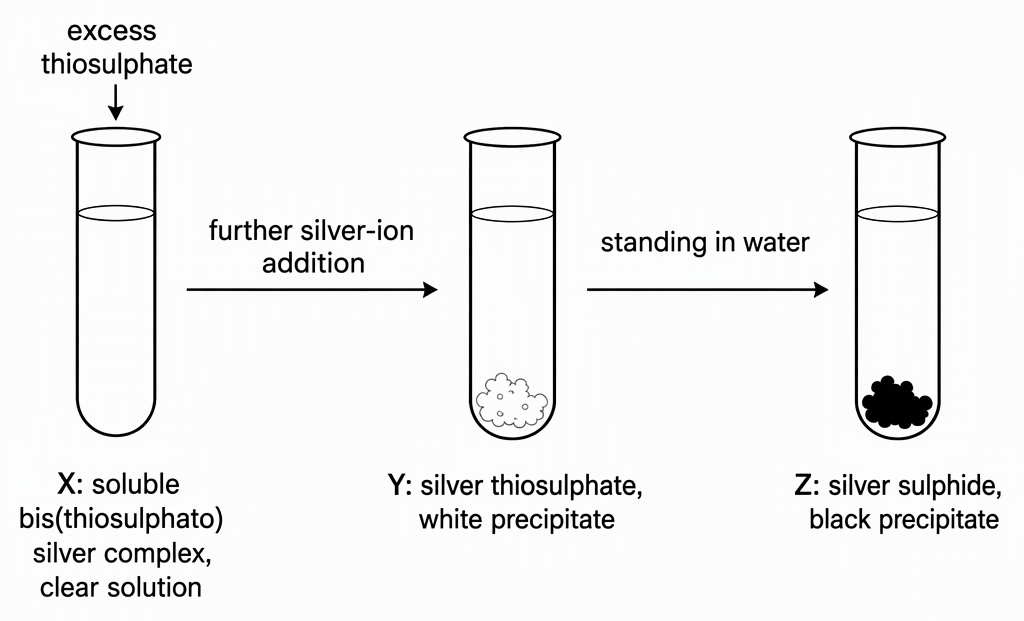
Option A is correct in the JEE Advanced 2016 silver–thiosulphate question: the clear solution contains a soluble silver complex, the white solid is silver thiosulphate, and the black solid is silver sulphide. All three identities must match, not just the final precipitate.
The source is JEE Advanced 2016, Paper 2, Chemistry, under d- and f-Block Elements. It is a single-correct MCQ, rated medium on the question bank’s scale; the bank’s expected solve time is 60 seconds, not a measured student average.
Silver ions are added to aqueous thiosulphate, initially giving a clear solution containing X. Further silver-ion addition forms white precipitate Y, which becomes black precipitate Z on standing. Identify X, Y and Z, respectively:
- A:
- B:
- C:
- D:
Why does excess thiosulphate keep silver in a clear solution?
Initially, thiosulphate is in excess relative to the silver ions added. Following the official solution, silver forms a water-soluble bis(thiosulphato) complex, so this first addition leaves a clear solution rather than a persistent precipitate.
The complex-formation equation is:
One silver ion contributes one positive charge. Each of the two thiosulphate ligands contributes two negative charges:
The dissolved species is:
Keep the ligand identities separate:
- Thiosulphate:
- Sulphite:
These are different ligands, not alternative spellings. Substituting sulphite changes the chemistry.
The bis(thiosulphato) complex is the chemical fact used here. Charge arithmetic checks its formula; it does not independently establish that silver binds two ligands rather than three. This distinction matters when rejecting option B.
Why does adding more silver ion produce a white precipitate?
Further silver-ion addition produces sparingly soluble silver thiosulphate, the white precipitate. The reagent proportions have changed: the initial excess-thiosulphate condition must not be assumed to persist unchanged as more silver ions enter the solution.
The official net precipitation equation is:
Two singly charged silver ions balance one doubly charged thiosulphate ion. The resulting solid is electrically neutral:
The white precipitate is therefore:
This is the net precipitation equation, not a claim that the earlier soluble complex never formed. The same added silver ion gives different observed results because the reagent proportions change, not because thiosulphate has become sulphite.
Why does the white solid turn black on standing?
Silver thiosulphate is unstable on standing in aqueous medium and decomposes to black silver sulphide, not silver metal. This completes the sequence: excess thiosulphate keeps silver dissolved, further silver-ion addition gives the white solid, and time in water produces the black solid.
The official aqueous decomposition equation is:
Check the total atoms on each side, including the sulphur in sulphuric acid:
The equation is balanced as written. Water supplies the additional oxygen and both hydrogen atoms.
Silver remains in oxidation state positive one in silver sulphide. Taking sulphide as negative two gives:
The conditions and observations are:
- Excess thiosulphate: soluble complex, clear solution.
- More silver ions: silver thiosulphate, white precipitate.
- Time in water: silver sulphide, black precipitate.
The complete sequence gives correct option A:
Why is option B wrong if it also ends in silver sulphide?
A solver who identifies the black solid as silver sulphide and stops checking can accept B incorrectly. A and B both end in silver sulphide, so the final colour cannot distinguish them; the question requires all three identities.
B gives a tris-thiosulphate complex instead of the required bis-thiosulphate complex. Its complex charge is nevertheless arithmetically consistent:
Charge checking alone therefore cannot eliminate B. A consistent charge does not prove that this reaction forms that species.
B also gives silver sulphite as the white solid, rather than silver thiosulphate:
Verify ligand identity, species formula and observation at every arrow. Choose the whole sequence only after all three checks agree.
What three practice questions check the same chemistry?
These original related practice questions are not additional verified JEE PYQs. They test the ligand ratio, aqueous decomposition and silver oxidation state, with a worked answer directly beneath each question.
1. If 1 mmol of silver ions forms only the bis(thiosulphato) complex, how much thiosulphate is incorporated?
The 1 mmol quantity is a defined practice input, not an exam statistic. The equation’s 1:2 ratio requires two moles of thiosulphate per mole of silver ions:
This is the ligand incorporated into the complex. It excludes any extra free thiosulphate needed to maintain excess in solution.
2. A white silver thiosulphate precipitate turns black in water. Complete and balance the reaction below.
The products are silver sulphide and sulphuric acid:
All coefficients are one. Each side contains two silver, two sulphur, four oxygen and two hydrogen atoms.
3. Does this conversion mean silver ions have been reduced to silver metal?
No. Using the thiosulphate ion’s charge for the white solid:
Using the sulphide ion’s charge for the black solid:
Elemental silver would have oxidation state zero. Cover the answers and reproduce all three equations, then check charges and atom totals before looking back.
Next step: the past-paper archive on JEEnius and search every JEE Main paper from 2002 and every Advanced paper from 2007, by year, subject or chapter, each with a worked solution (free).
If that step was the hard part, work through Doppler Effect in Sound JEE 2017: Two Shifts, 6 Hz Beats.
Frequently asked questions
What is the answer to the JEE Advanced 2016 silver–thiosulphate question?
Option A is correct: X is [Ag(S2O3)2]^3−, Y is Ag2S2O3 and Z is Ag2S. These are the soluble bis(thiosulphato) silver complex, white silver thiosulphate and black silver sulphide, respectively.
Why does silver form a clear solution in excess thiosulphate?
In excess thiosulphate, silver ions form the water-soluble complex [Ag(S2O3)2]^3− rather than leaving a persistent precipitate. Its charge is +1 + 2(−2) = −3, but charge arithmetic alone does not establish the number of ligands.
Why does silver thiosulphate turn black on standing?
White silver thiosulphate is unstable in aqueous medium and decomposes to black silver sulphide: Ag2S2O3 + H2O → Ag2S + H2SO4. Silver remains in oxidation state +1; the black solid is not silver metal.
Why is option B wrong in the silver–thiosulphate question?
Option B gives a tris-thiosulphate complex instead of the required bis-thiosulphate complex, and silver sulphite instead of silver thiosulphate as the white solid. Its complex charge is consistent, and its final product is silver sulphide, but neither check validates the whole sequence.