
What is the Doppler effect in sound JEE 2017 question?
The Doppler effect in sound JEE 2017 question gives a beat frequency of 6 Hz, but requires two Doppler shifts, not one. It is from JEE Advanced 2017, Paper 1, Physics, Oscillations and Waves, and is a single-digit integer-answer question, not an MCQ.
A stationary source emits sound at 492 Hz. A large car approaches it at 2 m/s, reflecting sound back to the source, where it overlaps the original signal. Sound travels through air at 330 m/s. Find the beat frequency, taking the reflected frequency to equal the received frequency in the car’s frame.
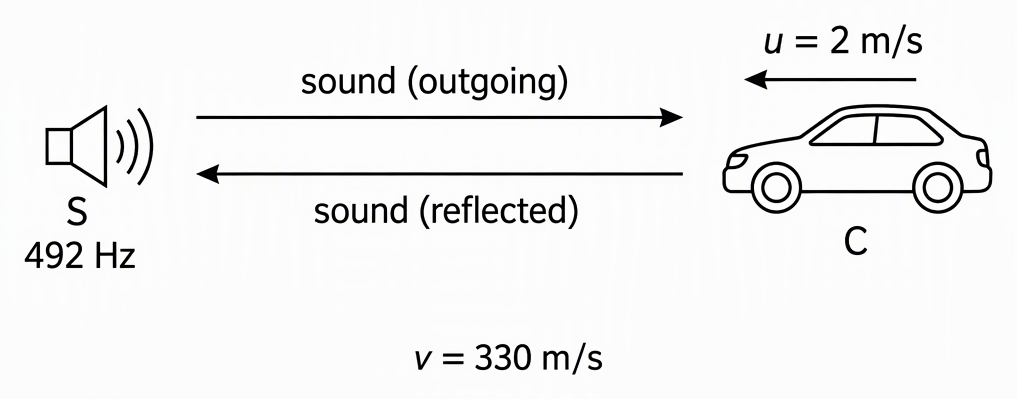
The question bank tags this as medium, with a 90-second expected solving time. These are bank metadata, not official exam classifications or a guaranteed student time.
How does the approaching car receive the sound?
The car first acts as a moving observer approaching a stationary emitter. It meets incoming wavefronts faster than a stationary observer would, so its received frequency increases. The source itself has not moved, so this step uses the moving-observer formula.
Define the quantities:
The plus sign belongs in the numerator because the car meets wavefronts faster:
Substitute without rounding:
Keep this fraction exact. It is the frequency measured by the moving car, not the reflected frequency heard back at the source.
Why does the reflecting car become a moving source?
On the return journey, the car acts as an effective moving emitter approaching the stationary receiver at the original source. Reflection preserves the frequency received in the car’s frame. It does not make the stationary receiver hear 492 Hz: the return journey requires another Doppler transformation.
Define the returned frequency at the original source:
Use the moving-source formula:
The minus sign in the denominator accounts for compressed reflected-wavefront spacing ahead of the approaching car. The stationary receiver meets these more closely spaced wavefronts, so it detects another increase in frequency.
Substituting the first-stage result gives:
Cancel the sound-speed factors:
Now insert the numerical values:
Both stages increase frequency. Use this ordering to check the signs:
How does the beat frequency become exactly 6 Hz?
The beats come from the original and returned signals at the stationary source. Both frequencies must be measured at that same receiving location. Subtract the original frequency from the returned frequency, not from the frequency received by the car.
The beat relation is:
Since the returned frequency is higher:
Complete the arithmetic without approximation:
The integer to enter is 6. The returned frequency is 498 Hz; the requested beat frequency is 6 Hz.
After completing the two-stage calculation, extract this exact check:
It correctly becomes zero when the car’s speed becomes zero:
Why is stopping after the first Doppler shift wrong?
Subtracting the source frequency from the car’s received frequency gives about 2.98 Hz, not the beat frequency at the source. This integer-answer PYQ has no supplied wrong options; the error can be examined directly through the incomplete calculation:
Rounding this to 3 does not repair the reasoning. The calculation has stopped at the car and omitted the return journey.
There is also a frame mismatch. The first received frequency belongs to the moving car, whereas the actual beats involve the original and returned frequencies at the stationary source.
Label the emitter and receiver separately for each journey before choosing a formula. Outward, the car receives from the stationary source; returning, the car emits effectively towards the stationary receiver.
How do stationary and receding cars change the answer?
A stationary reflector gives no beats here, while a receding reflector gives a lower returned frequency and approximately 5.93 Hz beats. Both questions below are author-created practice extensions of this setup, not additional verified PYQs.
For another worked question from the same chapter, see Oscillations and Waves JEE 2017: Laplace’s Correction. It is not another Doppler problem.
What is the beat frequency if the car is stationary?
Question 1: Keep the source at 492 Hz and sound speed at 330 m/s, but make the reflecting car stationary. The beat frequency is zero because neither reception nor reflection introduces a Doppler shift:
Reflection alone does not create a frequency difference. The returned sound overlaps the original without producing beats.
What if the car moves away at 2 m/s?
Question 2: Keep all original numerical values, but let the car recede at 2 m/s. The returned frequency falls below 492 Hz, giving approximately 5.93 Hz beats.
The car meets fewer outgoing wavefronts per second:
The receding effective emitter then stretches the returning wavefront spacing:
The returned frequency is lower, so subtract it from the original:
The denominator contains a sum rather than a difference because the effective source recedes. Label both journeys before checking these signs.
Next step: photograph a doubt on JEEnius and photograph any question you are stuck on and get a step-by-step solution, with a free-body diagram when the question needs one (20 free).
Frequently asked questions
What is the answer to the Doppler effect in sound JEE 2017 question?
The beat frequency is 6 Hz, so the integer to enter is 6. For the 492 Hz source, car approaching at 2 m/s and sound speed of 330 m/s, the returned frequency is 492 × 332/328 = 498 Hz. The beats at the stationary source have frequency 498 − 492 = 6 Hz.
Why are two Doppler shifts needed for sound reflected by a moving car?
On the outward journey, the approaching car acts as a moving observer and receives a higher frequency. On the return journey, it acts as an effective moving source approaching the stationary receiver, causing another increase. Reflection preserves frequency in the car's frame, not in the stationary receiver's frame.
Why is 3 Hz the wrong answer to the JEE 2017 Doppler problem?
The value near 3 Hz comes from subtracting 492 Hz from the frequency received by the moving car. That calculation omits the return Doppler shift and compares frequencies measured in different frames. The actual beats involve the original and returned signals at the stationary source, giving 6 Hz.
What happens if the reflecting car moves away at 2 m/s?
With the source still at 492 Hz and sound speed at 330 m/s, both Doppler shifts reduce the returned frequency. The beat frequency is 492 × (1 − 328/332) = 492/83 Hz, approximately 5.93 Hz. This is a practice extension of the setup, not an additional verified JEE question.