
What does the Oscillations and Waves JEE 2017 question ask?
Laplace’s correction uses an adiabatic process, and the verified answer is option D. This Oscillations and Waves JEE 2017 question comes from JEE Advanced 2017, Paper 1, Physics, not JEE Main. The task is to identify the thermodynamic process behind Laplace’s correction to the speed of sound in an ideal gas.
The supplied option codes are:
The referenced matching table is unavailable, so its individual labels cannot be independently decoded. We can derive the physics, but must use the supplied verified key for the option mapping.
This question is medium on the question bank’s scale. Its 60-second target is a practice benchmark, not an official exam time allowance.
How does Newton’s isothermal assumption give the sound speed?
Newton assumed that the gas stays at constant temperature during sound propagation, making its bulk modulus equal to its pressure. This gives a sound-speed prediction below the observed speed in air.
Sound travels through successive compressions and rarefactions, changing local pressure and density. The general speed relation is:
The symbols denote sound speed, the relevant bulk modulus and equilibrium gas density, respectively. The bulk modulus is defined by:
Here, the capital letters inside the derivative represent pressure and volume, respectively. The derivative must follow the assumed thermodynamic process. Compression decreases volume while increasing pressure, so the derivative is negative; the minus sign makes the modulus positive.
For a fixed amount of ideal gas at constant temperature:
Differentiating gives:
Substitute into the bulk-modulus definition to obtain the isothermal modulus and Newton’s expression:
Why does Laplace use an adiabatic process instead?
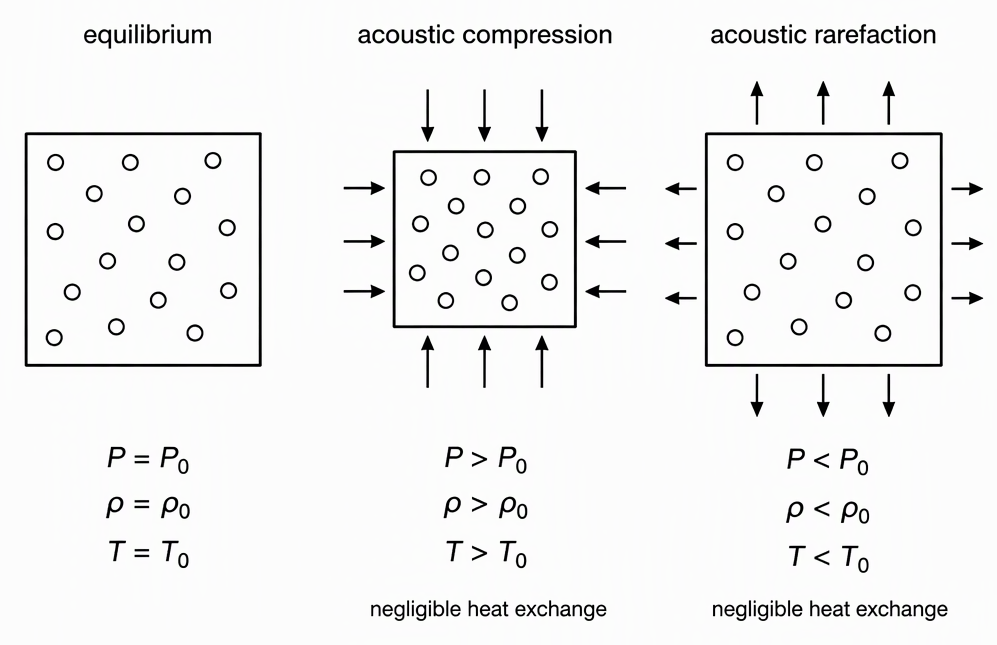
Acoustic compressions and rarefactions are rapid compared with the time needed for heat exchange. Each change therefore occurs with approximately negligible heat transfer, rather than at constant temperature. Laplace uses the adiabatic modulus instead of Newton’s isothermal modulus.
Adiabatic does not mean constant temperature. Compression can raise the gas temperature, and rarefaction can lower it, even when essentially no heat crosses a small gas element’s boundary.
For these approximately adiabatic changes in an ideal gas:
The heat-capacity ratio is:
The numerator is the heat capacity at constant pressure; the denominator is the heat capacity at constant volume. Treating their ratio as constant, differentiate:
Divide throughout by:
Then:
The adiabatic bulk modulus is therefore:
Substitute into the sound-speed relation:
The physical sequence is rapid compression and rarefaction, negligible heat exchange, adiabatic modulus, corrected speed. The correction changes the gas’s pressure response, not the general wave-speed formula.
Why is option D correct if the matching table is missing?
The required process is adiabatic, and the supplied verified answer key and worked solution identify D: (I) (iv) (Q). The derivation establishes the process, but not the separate meanings of those labels. Without the table, we cannot independently eliminate the other codes.
Check the correction at the same pressure and density:
The corrected prediction is larger, consistent with correcting Newton’s underestimate. This checks the physics, not the missing label definitions.
Answer: adiabatic process; option D: (I) (iv) (Q).
Why is a room’s steady temperature not enough to justify an isothermal process?
A steady room temperature does not mean that each acoustic compression happens at constant temperature. The room’s temperature describes the long-term surroundings; the sound wave involves much faster local changes. What matters is heat exchange during each compression and rarefaction.
Assuming constant temperature gives this wrong-answer route:
The algebra is valid for an isothermal process, but that process choice is wrong for Laplace’s correction. It retains Newton’s result instead of correcting it.
The missing matching table prevents us from identifying which of A, B or C encodes this error. We can reject the reasoning without inventing a meaning for any code.
Choose the thermodynamic process before differentiating pressure with respect to volume. Correct calculus cannot repair a wrong physical assumption.
How do you solve related sound-speed questions?
Use the adiabatic speed formula with the ideal-gas equation to track changes in pressure, density and temperature. The following are original related practice questions, not additional verified JEE PYQs.
What is the ratio of Laplace’s speed to Newton’s speed at the same pressure and density?
The ratio is the square root of the heat-capacity ratio. Pressure and density cancel because both expressions refer to the same gas state:
What happens when the same ideal gas’s absolute temperature becomes four times its initial value?
The speed doubles, treating the heat-capacity ratio as constant. The ideal-gas equation introduces these quantities:
Substituting gives:
For the specified temperature change:
Does doubling pressure at fixed temperature change the sound speed in the same ideal gas?
No. Density also doubles, leaving the pressure-to-density ratio and sound speed unchanged:
Therefore:
Before substituting a changed pressure, use the ideal-gas equation to check whether density changes with it.
Next step: the past-paper archive on JEEnius and search every JEE Main paper from 2002 and every Advanced paper from 2007, by year, subject or chapter, each with a worked solution (free).
Read next: How to Study Parabola JEE: Geometry, Tangents and Normals.
Frequently asked questions
What is the answer to the Oscillations and Waves JEE 2017 question?
The required process is adiabatic, and the supplied verified key identifies option D: (I) (iv) (Q). This question is from JEE Advanced 2017, Paper 1, Physics. The matching table is unavailable, so the physics can be derived but the individual option labels cannot be independently decoded.
Why does Laplace's correction use an adiabatic process?
Acoustic compressions and rarefactions occur rapidly compared with the time needed for heat exchange, so heat transfer is approximately negligible. The adiabatic bulk modulus is therefore B = γP, giving sound speed v = √(γP/ρ). Adiabatic does not mean constant temperature.
What is the ratio of Laplace's sound speed to Newton's sound speed?
At the same pressure and density, the ratio is √γ, where γ = C_P/C_V. Newton's expression is √(P/ρ), while Laplace's expression is √(γP/ρ). Since γ > 1, Laplace's correction increases the predicted speed.
Does doubling pressure at constant temperature change the speed of sound?
For the same ideal gas at fixed temperature, doubling pressure does not change the sound speed. Density also doubles, so P/ρ remains unchanged in v = √(γP/ρ), treating γ as constant.