
How should I study Nuclei for JEE in five steps?
To study Nuclei for JEE, classify each question before choosing a formula. Separate size, binding energy, reaction energy and decay questions, then calculate and check. Use these five steps to decide which relation applies.
- Set the syllabus boundary.
Consult the official syllabus for your exam and attempt year. For Main, use jeemain.nta.nic.in; for Advanced, consult its current official syllabus separately. An older book containing radioactivity does not prove that every decay topic is required for current Main.
- Read nuclear notation fluently.
For an isotope, the lower index counts protons, the upper index counts nucleons, and their difference counts neutrons:
Mass number is an integer count, not a mass measured in atomic mass units. Do not substitute one for the other in a mass-defect calculation.
- Build a question-family map.
Classify from what the question asks, not from whichever formula you remember first. Match the task to its governing relation:
- Nuclear size: use the radius relation.
- Mass defect: find the missing mass, then convert it to binding energy.
- Reaction: balance nucleon number and charge, then calculate the Q-value.
- Decay, where prescribed: connect a remaining fraction to exponential change.
- Write the governing relation before inserting numbers.
For nuclear masses, use free proton and neutron masses:
For neutral atomic masses, use hydrogen-atom mass:
The second form balances electron masses. It neglects electronic binding-energy corrections at usual textbook precision.
Total binding energy belongs to the whole nucleus; binding energy per nucleon is an average. They are not interchangeable.
This is a physical conversion constant, not an exam statistic. For a reaction, balance nucleon number and charge first:
Using nuclear binding energies consistently gives:
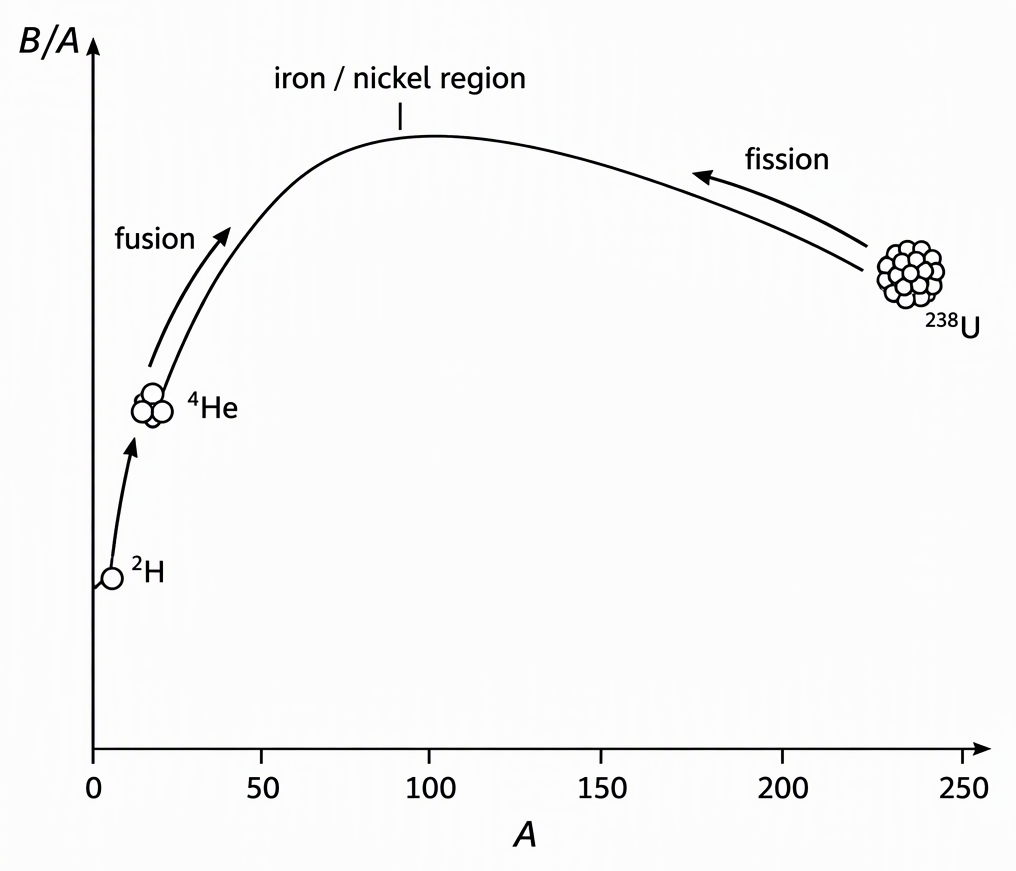
The binding-energy-per-nucleon curve has a broad maximum near iron and nickel. It explains why suitable light-nucleus fusion and heavy-nucleus fission can release energy, but the actual reaction still needs a Q-value calculation.
- Audit the answer.
Check units, the Q-value sign, and total versus per-nucleon quantities. Before doing lengthy arithmetic, check whether a ratio would cancel the constants.
How do I compare nuclear radii without calculating either radius?
Use the mass-number ratio and take its cube root. You do not need the radius constant when it is common to both nuclei. Approximate nuclear densities are equal because both nuclear mass and nuclear volume scale with mass number.
Illustrative teaching problem, not an attributed PYQ: Two nuclei have mass numbers 27 and 216. Find the ratio of the second nucleus’s radius to the first, and their approximate density ratio.
Classify: This is a nuclear-size question. Assume a common radius constant, spherical nuclei and nuclear mass approximately proportional to mass number.
Calculate: Write the ratio before substituting:
Volume scales as the cube of radius:
Therefore:
Check: The larger nucleus has eight times the mass spread through eight times the volume, so the density stays approximately unchanged. A radius ratio of eight diagnoses a specific error: using direct proportionality to mass number instead of its cube root.
How do I calculate fusion energy without confusing total and per-nucleon binding energy?
Use total binding energies for reaction energy. Binding energy per nucleon helps compare how tightly nuclei are bound, but it does not represent the energy of an entire nucleus.
Illustrative teaching problem, not an attributed PYQ: Deuterium and tritium fuse. Calculate the energy released per reaction:
Use these rounded total binding energies as problem inputs:
- Deuterium: 2.2 MeV.
- Tritium: 8.5 MeV.
- Helium-4: 28.3 MeV.
- Free neutron: zero nuclear binding energy.
Classify: This is a reaction-energy question, not a request for average binding energy. First check nucleon number and charge:
Calculate: Subtract the initial total binding energy from the final total binding energy:
The release is 17.6 MeV per reaction. A positive Q-value means the final system has lower rest energy, leaving energy available for motion or radiation. Greater binding lowers a system’s rest energy relative to its separated nucleons.
Now calculate helium-4’s binding energy per nucleon:
That value must not replace 28.3 MeV in the reaction calculation. Doing so counts an average for one nucleon where the energy of the whole helium nucleus is needed.
Mass-data variant: If masses are supplied, subtract final masses from initial masses and convert atomic mass units to MeV using the conversion constant above. Never mix atomic and nuclear mass conventions.
Check: The Q-value is the total energy released, not automatically the kinetic energy of one chosen product. Energy sharing also depends on momentum conservation.
For another total-versus-average question, JEEnius practice mode offers topic sets that skip questions already seen, with free sets included.
How do I turn a remaining activity fraction into elapsed half-lives?
Match the remaining fraction to a power of one-half before using logarithms. This method applies where radioactive decay is prescribed, including Advanced preparation subject to its current official syllabus. Do not assume it belongs to current Main.
Illustrative teaching problem, not an attributed PYQ: A single radioactive isotope has a half-life of six hours. When does its activity fall to one-eighth of its initial value?
Classify: This is a decay-fraction question. Assume a fixed sample containing one relevant radioactive isotope, with no replenishment or parent feeding. Activity is proportional to the number of undecayed nuclei because the decay constant stays fixed:
Calculate: One-eighth remaining means three half-lives:
Check: One-eighth remaining is not one-eighth decayed. After three half-lives, seven-eighths of the original radioactive nuclei have decayed:
For a fraction that is not a convenient power of one-half, use:
Choose powers first and logarithms when necessary. Do not compare activities of different isotopes from atom counts alone: their decay constants may differ, so equal atom counts need not mean equal activities.
What should I practise next if I keep choosing the wrong formula?
Choose the next set from your error log, not from the hardest question available. Repair the failed decision before mixing question families. Practise in this order, keeping every set within your applicable syllabus:
- Notation and radius ratios.
- Mass-defect calculations with clearly labelled atomic or nuclear masses.
- Total versus per-nucleon binding energy.
- Reaction balancing and Q-values.
- Decay fractions and logarithms, where prescribed.
Before mixed practice, explain four choices aloud without notes:
- Why does a radius ratio use a cube root?
- When should hydrogen-atom mass replace proton mass?
- Why does the Q-value calculation use total binding energy?
- Under what assumptions do activity ratios equal atom-count ratios?
If converting sample mass into nuclei causes trouble, practise this relation:
Mole Concept: Conversions to Reactions explains the mass-to-moles-to-particles conversion. Keep sample mass and molar mass in compatible units.
Label each error classification, mass convention, per-nucleon confusion, sign, units or algebra. Re-solve the failed question without viewing its solution before attempting a fresh variant.
Then attempt syllabus-filtered JEE Main PYQs and JEE Advanced PYQs separately. Advanced has variable question types and marking schemes; do not assume Main’s format applies.
For continued topic practice, JEEnius daily practice problems provide a fresh ten-question set on a topic every day, with free sets daily. Choose the topic matching your latest error.
Readiness test: Solve one unseen, applicable problem. Name its family before calculating, then explain the final unit and sign without consulting notes.
Next step: practice mode on JEEnius and practise a topic in sets that skip questions you have already seen (free sets included).
Frequently asked questions
How should I study Nuclei for JEE?
Check your exam-year syllabus, learn nuclear notation and classify questions into size, mass defect, reaction energy and decay where prescribed. Write the governing relation before substituting numbers, then check units, signs and total versus per-nucleon quantities. Use your error log to choose targeted practice before attempting mixed PYQs.
Is radioactivity included in the JEE Main Nuclei syllabus?
Check the official JEE Main syllabus for your attempt year at jeemain.nta.nic.in rather than assuming radioactivity is included. An older textbook containing decay topics does not establish their inclusion in current Main. Check the current JEE Advanced syllabus separately.
When should I use hydrogen mass instead of proton mass in mass defect?
Use hydrogen-atom mass when the supplied nucleus mass is given as a neutral atomic mass, so electron masses balance. If a nuclear mass is supplied, use free proton and neutron masses instead. Do not mix atomic and nuclear mass conventions.
Can I use binding energy per nucleon to calculate Q-value?
Use total binding energies: Q equals the sum of final binding energies minus the sum of initial binding energies. If binding energy per nucleon is supplied, multiply it by the relevant mass number to obtain each nucleus's total binding energy. A positive Q-value indicates energy release.
How do I compare the radii of two nuclei?
For a common radius constant, use R2/R1 = (A2/A1)^(1/3), where A is the mass number. Nuclei with mass numbers 216 and 27 therefore have a radius ratio of 2, not 8. Their approximate densities are equal because both nuclear mass and volume scale with mass number.