
What is the hydrogen-electrode question from JEE Advanced 2016 Paper 2?
Option D is correct: the required exponent is two. The JEE Advanced 2016 electrochemistry solution starts with the balanced cell reaction, which fixes the concentration-ratio direction. This is a Chemistry single-correct question from JEE Advanced 2016, Paper 2, tagged medium by the question bank, not by the exam authority.
The cell operates at 298 K. On the left, a platinum hydrogen electrode has hydrogen gas at 1 bar and hydrogen-ion concentration at 1 M. On the right, a platinum electrode contacts the oxidised and reduced metal ions. The measured cell potential is 0.092 V.
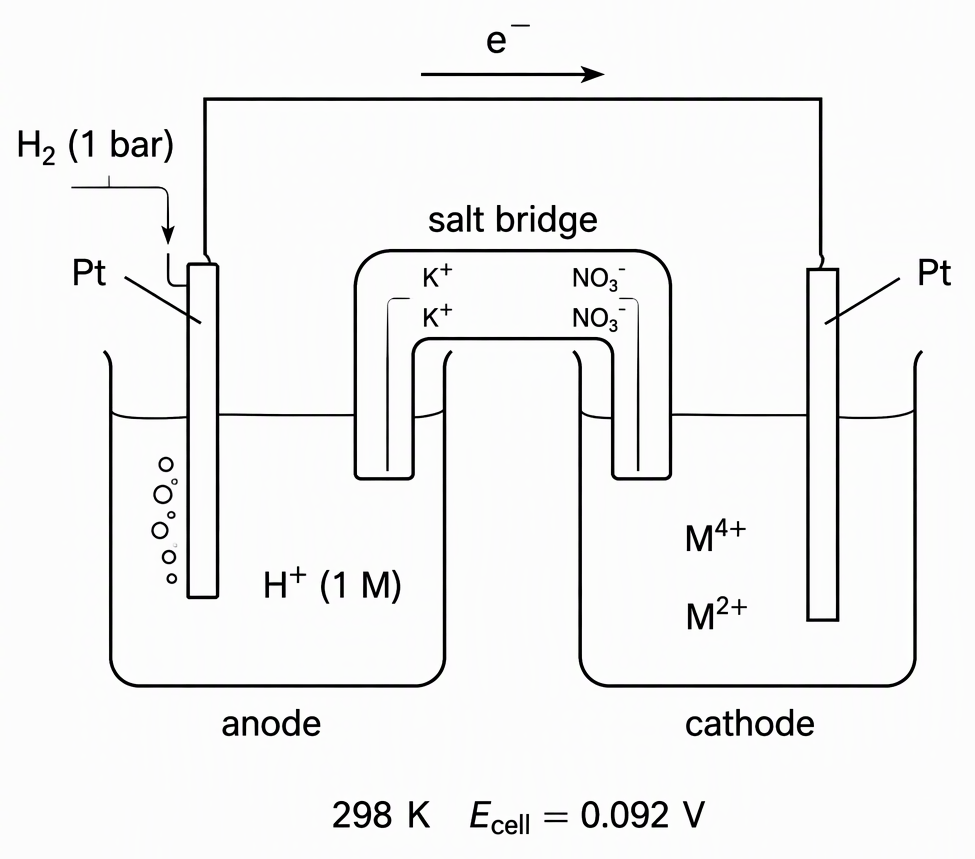
Determine the exponent in the given concentration ratio, using the supplied values:
The four choices are:
How do you balance the reactions and choose the electron count?
Two electrons are transferred per balanced cell reaction. Following the official solution, start with oxidation at the left-hand anode and reduction at the right-hand cathode. Choose the electron count from these reactions, not from the number of electrodes or the charge on the higher metal ion alone.
At the anode, hydrogen loses electrons:
At the cathode, the metal ion gains those electrons:
Add the half-reactions and cancel the electrons:
The electron count for this balanced reaction is:
Platinum provides an inert conducting surface for electron transfer. It is not consumed, so it does not appear in the net reaction. Every factor in the reaction quotient must come from this balanced equation.
How do you find the standard cell potential and reaction quotient?
The standard cell potential is 0.151 V. The quotient reduces to the lower-charge metal-ion concentration divided by the higher-charge ion concentration because of the specified hydrogen conditions. First calculate the standard cell potential using both electrode potentials as reduction potentials.
For the standard hydrogen electrode:
Hence:
From the balanced reaction, products go above reactants:
The coefficient two on hydrogen ions becomes its exponent in the quotient. Electrons cancel from the reaction, and inert platinum is absent, so neither appears.
The quotient is dimensionless. This concentration-and-pressure shorthand uses concentrations and gas pressure relative to their standard-state values, with the question’s concentration approximation for ion activities.
Substitute the given hydrogen conditions:
The hydrogen half-cell is standard, but the complete cell need not be standard. Its metal-ion concentration ratio remains in the quotient and need not equal one.
How does the Nernst equation give option D?
The voltage decrease gives a positive exponent of two. The measured potential is below the standard potential, so the Nernst correction must subtract a positive amount. This gives an independent sign check on the concentration ratio.
At 298 K:
Substitute the known values:
Use the logarithm identity:
Rearrange without changing the ratio:
The answer is option D, with the concentration ratio:
The sign check agrees. A potential below the standard value requires a positive logarithm, so the quotient must exceed one:
Back-substitute the quotient of 100 to check the measured voltage:
How does reversing the quotient produce option A?
Option A comes from using the reverse reaction’s quotient with the forward reaction’s potential. Invert the metal-ion ratio but retain the original positive standard cell potential, and the calculation gives the wrong sign:
The resulting incorrect equation is:
That gives option A, but contradicts the earlier sign check for the forward reaction. A negative exponent would make the actual forward quotient less than one:
The measured potential is lower, not higher. Write products over reactants from the balanced net reaction. If you reverse that reaction, both its standard potential and its actual cell potential must change sign too.
How do you solve variations involving concentration and hydrogen ions?
Keep the full quotient until every condition has been substituted. These are original practice variations on the same chapter, not additional verified JEE PYQs. All three retain the following temperature, standard cell potential, electron count and Nernst constant:
- With the original hydrogen conditions and a cell potential of 0.1215 V, find the exponent. Hydrogen remains at 1 bar and hydrogen-ion concentration at 1 M. The quotient therefore remains the stated metal-ion ratio:
- With the original hydrogen conditions and a metal-ion ratio of 1000, find the cell potential. The quotient is 1000, so its base-ten logarithm is three:
- With hydrogen-ion concentration 0.10 M, hydrogen at 1 bar and a metal-ion ratio of 100, find the cell potential. Under the same concentration approximation, the hydrogen-ion factor changes the answer:
The hydrogen half-cell is no longer standard, yet the complete reaction quotient equals one. Cancel hydrogen terms numerically only when their given values justify it. Write the full quotient before inserting a single number.
Next step: photograph a doubt on JEEnius and photograph any question you are stuck on and get a step-by-step solution, with a free-body diagram when the question needs one (20 free).
If that step was the hard part, work through Atoms and Nuclei JEE 2017: Iodine-131 Blood Volume.
Frequently asked questions
What is the answer to the JEE Advanced 2016 hydrogen-electrode question?
Option D is correct: x = 2, so [M²⁺]/[M⁴⁺] = 100. Substituting the given values into the Nernst equation gives 0.092 = 0.151 − (0.059/2)x, which yields x = 2.
Why is n equal to 2 in this electrochemistry question?
The reduction half-reaction is M⁴⁺ + 2e⁻ → M²⁺, so two electrons are transferred. Hydrogen oxidation supplies those same two electrons, giving n = 2 for the balanced cell reaction.
How do you write the reaction quotient for the hydrogen-electrode cell?
The balanced reaction is H₂ + M⁴⁺ → 2H⁺ + M²⁺, so Q = [H⁺]²[M²⁺]/([M⁴⁺]P_H₂), with concentrations and pressure expressed relative to their standard-state values. At [H⁺] = 1 M and hydrogen pressure = 1 bar, this reduces to Q = [M²⁺]/[M⁴⁺]. Platinum is inert and does not appear in the quotient.
Why is x = −2 wrong in the JEE 2016 Nernst equation question?
The value x = −2 comes from inverting the concentration ratio while retaining the forward reaction's cell potentials. For the forward reaction, the measured potential is below the standard potential, so the Nernst equation requires Q > 1 and a positive exponent. Reversing the reaction requires changing the signs of both the standard and actual cell potentials.