
What five steps should I use to study and solve Oscillations?
- Check prerequisites through tasks, not chapter names. To study Oscillations for JEE, start by drawing a free-body diagram, applying conservation of mechanical energy and differentiating a sine or cosine. Revise only the prerequisite that blocks a task. This method covers the core SHM problem families, not every possible oscillatory system.
- Choose the coordinate and find equilibrium first. State the positive direction, balance the forces, then measure displacement from equilibrium. Spring extension is measured from natural length; SHM displacement is measured from equilibrium. Those zeros coincide for an unloaded horizontal spring, but not for a hanging mass.
- Write the restoring equation before choosing a formula. For a linear spring, displacement from equilibrium gives:
The general test for SHM is:
Acceleration must be proportional to displacement and opposite in direction, with a constant positive coefficient. A force merely pointing towards equilibrium is not enough. If the proportionality holds throughout the motion, the SHM is exact.
Potential-energy curvature gives another route for a particle with kinetic energy:
Near a stable equilibrium:
This is a local, small-oscillation approximation. It retains the quadratic change in potential near the minimum; it does not assume the full potential is quadratic.
For a simple pendulum, the exact restoring equation is:
Only when the angular displacement is small, measured in radians, can we use:
- Use both initial conditions to fix amplitude and phase. Below, the initial-position symbol means displacement from equilibrium at release, not the equilibrium coordinate used in the potential test above. Amplitude follows from position and velocity together:
For the cosine convention:
Displacement fixes the cosine but cannot select the phase quadrant. Velocity supplies the missing direction. Keep one convention throughout the solution rather than switching between sine and cosine.
- Choose the shortest finishing route and check it. Use energy for speed versus position, phase for event times, and the restoring equation for period. Check units, acceleration direction and limiting cases. For fixed mass, the period formula predicts a shorter period for a stiffer spring; zero amplitude means no motion.
Make these steps your study order. At the top of each solution, use this five-line sheet:
- Coordinate and equilibrium: origin, positive direction and balance condition.
- Restoring equation: net force or local potential expansion.
- Frequency and period: derived from that equation.
- Initial conditions: displacement and velocity, then amplitude and phase.
- Requested quantity and check: the shortest route plus one physical verification.
How do I use velocity to choose the correct SHM phase?
Use the initial velocity to choose between angles having the same cosine. Original illustrative problem, not a previous-year JEE question: a mass on a frictionless horizontal spring has the following data. Find its motion and the first time it reaches its positive extreme.
Take rightward displacement as positive, with zero at equilibrium. The restoring equation fixes the frequency before the initial conditions enter:
The initial displacement is not the amplitude because the mass is already moving:
Positive initial velocity requires negative sine. Choose the negative branch:
The phase starts below zero and increases. Its first arrival at zero gives the positive extreme:
Differentiate to verify the positive initial velocity:
An inverse cosine gives a candidate angle, not the complete phase decision.
Why does a vertical spring have two different zeros?
Natural length is the zero of spring extension; equilibrium is the zero of SHM displacement. Original illustrative problem, not a previous-year JEE question: an ideal vertical spring can extend and compress. Release its mass from rest at natural length, using:
Define downward extension from natural length as the coordinate. Gravity acts downward and spring force upward when extended.
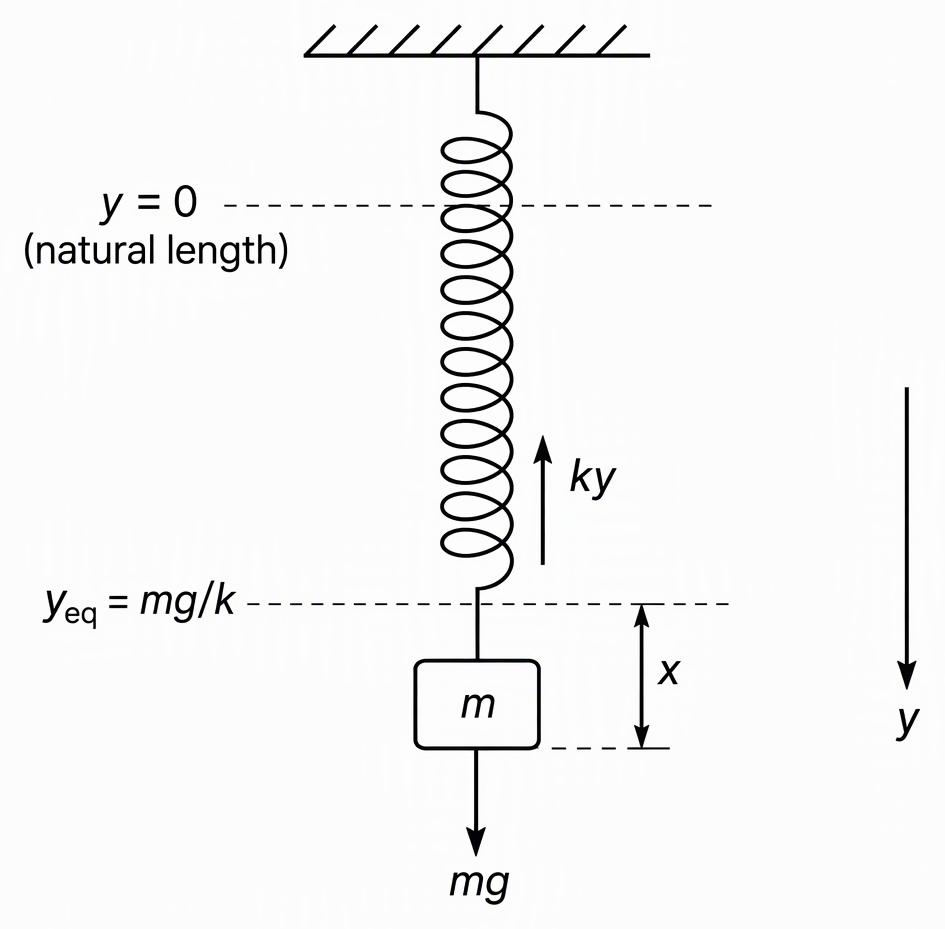
Shift the coordinate before finding amplitude:
Release from rest occurs at an extreme relative to equilibrium. Hence:
The motion in the original coordinate is:
Amplitude is 0.10 metres, while maximum spring extension is 0.20 metres. Gravity shifts equilibrium but does not change this ideal linear system’s frequency.
For energy, include both spring and gravitational potential:
Thus, energy measured above its minimum is:
Spring potential alone is not the full potential in the original coordinate. Shift to equilibrium before using this energy shortcut.
For spring practice, JEEnius daily practice problems provide a fresh ten-question set on a topic every day, with free sets daily.
How do I find SHM hidden near a potential minimum?
Find equilibrium from the first derivative and stability from the second derivative. Then expand about a stable point using a fresh displacement. Original illustrative problem, not a previous-year JEE question: find the equilibria and small-oscillation period for a particle with the following mass and potential:
The equilibrium condition gives three positions:
Classify them through curvature:
The origin is unstable. At either nonzero equilibrium:
Both are stable, so either can support sufficiently small oscillations.
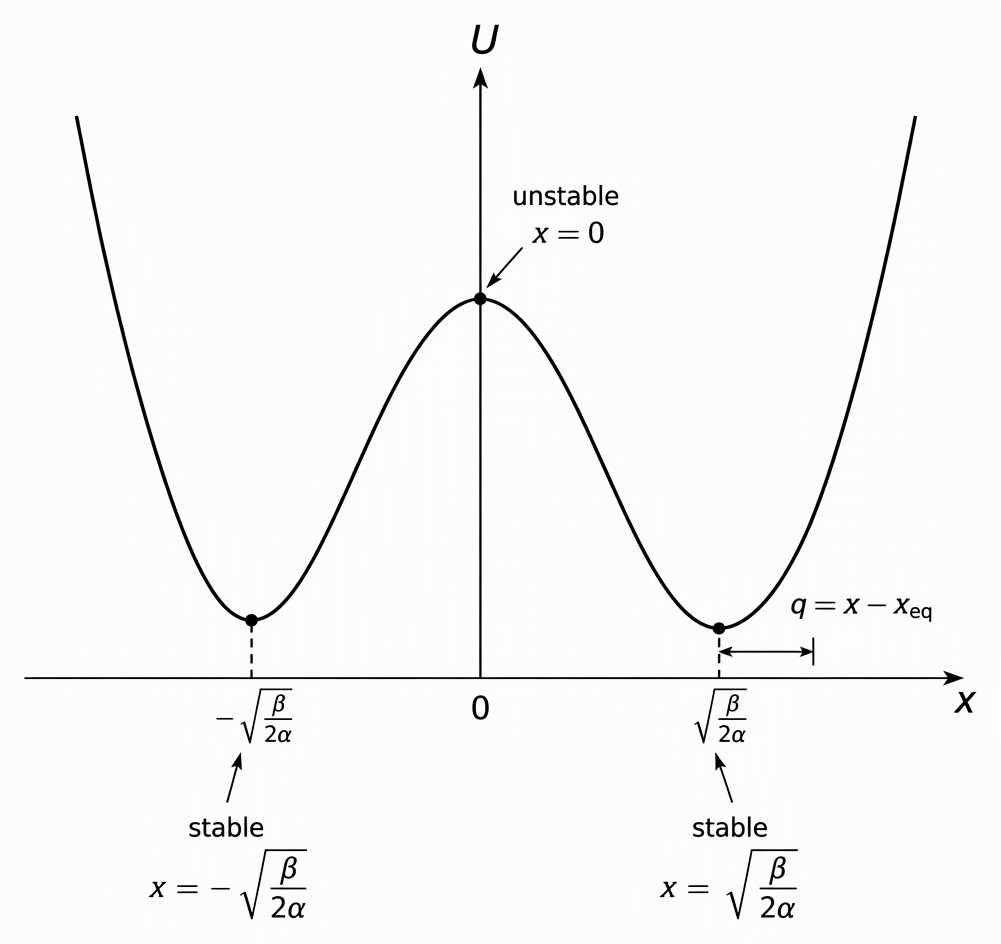
Introduce displacement from the selected minimum, not from the original origin. To first order in that displacement:
The quadratic coefficient has the units of a spring constant:
This period is the small-amplitude limit, not an amplitude-independent result for every trajectory in the full nonlinear potential. The quartic coefficient sets the equilibrium positions but cancels from the curvature there. Do not reject a result merely because one supplied parameter disappears.
What should I practise next if I keep making SHM mistakes?
Choose the next set by the failed step, not by how familiar the question looks. Study the problem families in this order, then return to the stage where your solution first breaks:
- Displacement, velocity and acceleration relations and graphs.
- Initial conditions and phase.
- Spring equilibrium and energy.
- Simple pendulums and effective gravity.
- Mixed constraints and small oscillations from potential energy.
For pendulums, derive the small-angle restoring equation before using the period formula. Attempt an elevator case only after you can explain how the accelerating frame changes effective gravity through the pseudo force.
Use this recommended ten-question diagnostic, not exam weightage:
- Three kinematics or phase questions.
- Three spring or equilibrium questions.
- Two energy questions.
- Two pendulum questions.
Mark the first incorrect line in each missed solution. Match it to a specific repair:
- Wrong coordinate or equilibrium: redraw the system and write the force balance.
- Wrong frequency: rederive the restoring equation.
- Wrong time: track phase and velocity direction.
- Wrong approximation: state the small-displacement assumption before calculating.
Reattempt every missed problem closed-book, then solve an unseen problem of the same type. Recognising a remembered solution is not evidence that you can reproduce the method.
Once the basic sheet is reliable, attempt chapter-wise JEE Main previous-year questions. Then use JEE Advanced previous-year questions involving unfamiliar constraints or local stability.
Select the diagnostic distribution and record repairs yourself. For the unseen follow-up, JEEnius practice mode offers topic sets that skip questions already seen, with free sets included: choose the topic matching your first incorrect line.
Next step: daily practice problems on JEEnius and get a fresh ten-question set on a topic every day (free sets daily).
Related on JEEnius: Metallurgy Practice Questions JEE: PYQs and Worked Drills.
Frequently asked questions
What prerequisites do I need before studying Oscillations for JEE?
Check whether you can draw a free-body diagram, apply conservation of mechanical energy and differentiate a sine or cosine. Revise only the prerequisite that blocks one of these tasks, rather than restarting entire chapters.
How do I find the correct phase in SHM?
For x = A cos(ωt + φ), use the initial displacement to find cos φ = x₀/A. Then use v₀ = −Aω sin φ to select the correct phase quadrant. Initial displacement alone cannot distinguish between angles with the same cosine.
Is amplitude the same as maximum extension in a vertical spring?
No: amplitude is measured from equilibrium, while spring extension is measured from natural length. For an ideal vertical spring released from rest at natural length, the amplitude is mg/k and the maximum extension is 2mg/k. Gravity shifts equilibrium but does not change this ideal linear system’s frequency.
How do I find the time period of small oscillations from potential energy?
For a particle with kinetic energy K = mv²/2, find an equilibrium x_eq using U′(x_eq) = 0 and check that U″(x_eq) > 0. The small-oscillation angular frequency satisfies ω² = U″(x_eq)/m, giving T = 2π/ω. This is a local small-amplitude approximation, not a period formula for every trajectory in a nonlinear potential.